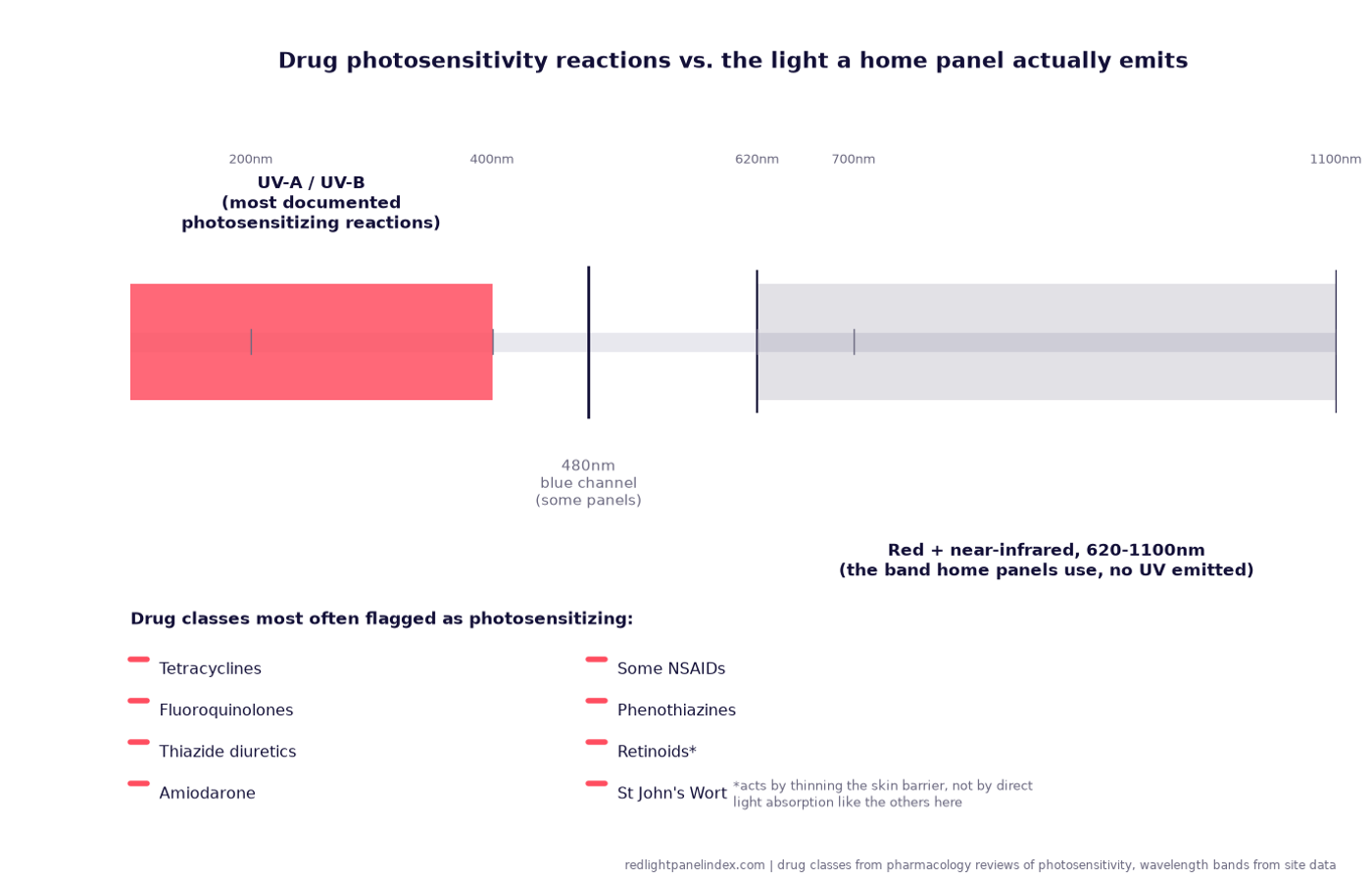
A short, well-documented list of drug classes, tetracycline and fluoroquinolone antibiotics, thiazide diuretics, amiodarone, some NSAIDs, phenothiazines, retinoids and St John's Wort, are flagged in the pharmacology literature as photosensitizing, meaning they can make skin react more strongly to light than it otherwise would. If you take one of these, the reasonable move is to ask the prescriber before starting regular red or near-infrared panel sessions, not because a trial has shown a panel-specific problem, but because none has looked.
Choosing a panel? Our ranking of the best red light therapy panels is computed from published, method-labeled specs across 188 devices. For a photosensitizing medication caution, the spec that matters is the panel's spectral output, since the documented reactions below cluster almost entirely in the ultraviolet band that a red-and-near-infrared panel does not emit.
What "photosensitizing" means
A drug is called photosensitizing when it changes how skin responds to light exposure, through one of two mechanisms. A phototoxic reaction happens when the drug or a metabolite absorbs light energy directly and that absorbed energy damages skin cells, producing something that looks like an exaggerated sunburn, sometimes with blistering, on exposed skin. A photoallergic reaction is slower and immune-mediated: light exposure changes the drug's structure enough that the immune system treats it as foreign, producing an itchy, eczema-like rash that can spread beyond the exposed area. Both patterns are documented mainly for ultraviolet light, because that is the band with enough photon energy to trigger the chemistry in most of the implicated drugs, and because sun exposure, not a light therapy panel, is the exposure route nearly every case report and clinical review was written to describe.
The drug classes most often named
- Tetracycline antibiotics (doxycycline, tetracycline, minocycline). Skin discoloration and sun sensitivity are among the most characteristic side effects of this class, and photo-onycholysis, a lifting of the nail from its bed after light exposure, has been reported with it.
- Fluoroquinolone antibiotics (ciprofloxacin, levofloxacin, and especially the more heavily halogenated older agents). Phototoxic potential varies by molecule; compounds with a halogen at a specific ring position are consistently the most reactive, while moxifloxacin is considered the least.
- Thiazide diuretics (hydrochlorothiazide and related blood-pressure medications). Regularly named among cardiovascular drugs with a photosensitizing profile.
- Amiodarone, an antiarrhythmic, is one of the most consistently implicated drugs in photosensitivity reviews, alongside other agents such as chlorpromazine and voriconazole.
- Some NSAIDs, naproxen and piroxicam in particular, appear repeatedly on photosensitizing-drug lists compiled from adverse event reporting.
- Phenothiazines, an older class of antipsychotic and antiemetic drugs (chlorpromazine is the most cited example).
- Retinoids (isotretinoin, tretinoin, and other vitamin A derivatives) are associated with increased light sensitivity, though the mechanism is different from the other classes here: a retinoid thins and speeds the turnover of the outer skin layer rather than being directly activated by light itself, so the sensitivity comes from having less of a barrier, not from the drug reacting to photons.
- St John's Wort, an herbal supplement, is one of the few non-prescription substances that shows up consistently on photosensitizing lists; hypericin, one of its active compounds, is itself light-reactive.
This is not an exhaustive list. Several hundred drugs across antimicrobial, cardiovascular, psychiatric and antihyperlipidemic categories have been linked to photosensitivity reactions somewhere in the literature; the classes above are the ones that recur most often across pharmacology reviews as the most consistently implicated.
Why nearly all of this evidence is about UV light, not red or near-infrared
Phototoxic and photoallergic reactions require the drug or its metabolite to absorb the wavelength of light it is exposed to, and the molecules implicated above are documented reactors mainly to ultraviolet-A, roughly 320 to 400 nanometers, with some overlap into visible blue light. A home red light therapy panel does not work that way. This site's wavelength guide covers the bands panels actually use: red light in the 620 to 700 nanometer range and near-infrared from about 700 to 1,100 nanometers, chosen because those bands penetrate tissue and are absorbed by mitochondrial chromophores, the mechanism behind photobiomodulation. Panels sold for home use are built around that red-and-near-infrared design and do not emit ultraviolet light. A visible blue channel around 480 nanometers is included on some devices marketed for skin and blemish work, closer to the edge of the range where a handful of the reactions above have been reported, but it is still well short of the ultraviolet band that accounts for nearly all the documented cases.
That gap between the well-documented risk (UV exposure while on one of these drugs) and the exposure a red or near-infrared panel actually delivers is the reason this caution is framed as a reasonable precaution rather than a demonstrated hazard. It is reasoning from photochemistry, not from a trial that tested the interaction and found nothing, because that trial does not exist. This site's safety and side effects page grades the overall evidence for panel safety as Limited for exactly this reason: most of what is known comes from trials designed to test whether the light works, not trials designed to test specific caution groups like this one.
What to actually do about it
If you take a photosensitizing medication and want to start red light therapy sessions, a few practical steps carry over from general phototherapy caution even without panel-specific data:
- Ask the prescriber first, especially for a new prescription or a recent dose change. They know the specific drug's documented photosensitivity profile and any interaction with your other medications, which this guide cannot.
- Start conservative rather than matching a published protocol immediately. This site's guide to session dosing walks through picking a starting dose from the lower end of a trial's tested range; that same conservative-start logic applies here even though no trial measured this specific combination.
- Check the treated skin after the first few sessions for redness that goes beyond the panel's usual mild warmth, or any reaction that looks more like a sunburn than a normal response. Stop and consult the prescriber if you see it.
- Remember that a retinoid changes your skin barrier, not just your light sensitivity. If you use a retinoid on the same skin you plan to treat, the ordering and spacing of the two matters for irritation reasons independent of the photosensitivity question above.
- Wear the goggles that come with most panels if you are also being conservative about facial treatment; this site's eye protection guide covers when that matters most, which is largely the same population, close-range facial use, that this caution applies to.
What this guide cannot tell you
No trial in this site's evidence register has tested a red or near-infrared panel against a list of photosensitizing medications, in either direction. That means there is no dose threshold, no distance, and no session count below which the interaction has been shown to be safe, and no case series showing it causes a problem either. The guidance above is a reasonable precaution built from general drug pharmacology and basic photochemistry, not a documented panel-specific risk, and it should be treated that way: worth a conversation with whoever prescribed the medication, not a reason to avoid light therapy on its own.