Dose in red light therapy is irradiance multiplied by time: how strong the light is at your skin, times how long you sit in it. The unit trials report it in is joules per square centimeter (J/cm2), and this site's dose calculator turns an irradiance figure and a session length into that number directly.
Choosing a panel? Our ranking of the best red light therapy panels is computed from published, method-labeled specs across 188 devices. For dosing, the spec that matters is a method-labeled irradiance figure at your working distance, not the wavelength count on the box.
The formula, in plain terms
The calculator's formula is dose (J/cm2) equals irradiance (mW/cm2) times seconds, divided by 1000. Irradiance is how much light lands on each square centimeter of skin at a given distance, measured in milliwatts. Multiply that by how many seconds you sit in front of the panel and you get millijoules per square centimeter; divide by 1000 to convert to joules. Every term in that formula depends on getting the input right, which is where dosing usually goes wrong before the arithmetic ever does. This site's J/cm2 explainer covers the same formula in more depth, including why the target dose itself shifts by tissue type rather than staying fixed across every goal.
Irradiance is not one fixed number for a panel; it changes with distance, and this site's irradiance page tracks it almost entirely at 6 inches, because that is the distance most brands choose to publish. It also depends on which instrument measured it: a solar power meter reads roughly twice as high as a laboratory spectrometer on the same panel, a median 2.18 times across a 44-panel dataset this site has checked, so a brand-published figure with no stated instrument should be treated with real skepticism before it goes into the calculator. If a panel offers a pulsed mode, use that mode's average irradiance, not its peak; this site's pulsed versus continuous page explains why a low duty cycle can drop the average well below the peak figure printed on the spec sheet.
Time is the session length in seconds, which the calculator converts from minutes for you. It is the one input entirely under your control, and it is also the variable that has to change if your irradiance figure changes, whether because you moved farther from the panel or switched devices.
Distance does not appear in the formula directly, but it decides which irradiance figure is valid to use. This site's guide to distance covers how fast irradiance falls off between 6 and 24 inches, and why plugging a 6-inch figure into the calculator while sitting 18 inches away will overstate your real dose.
Per-area dose, the J/cm2 output, is what lets you compare a laser trial's dose to a panel's dose only when both are expressed in the same unit. A trial dose reported instead as joules delivered to a single point, common in laser studies, cannot be converted into J/cm2 without knowing the spot size the laser covered, a detail abstracts frequently omit.
What irradiance figure to use, and one variable trials rarely name
Total optical power in milliwatts, the whole-device output, is a different number from irradiance density in mW/cm2, and the two are easy to confuse when a trial reports one and a panel's spec sheet reports the other. This site's irradiance versus total power page covers the distinction and why a trial's total-power figure for a small laser spot cannot be dropped into the calculator as though it were an irradiance density for a broad panel.
A 2018 review of photobiomodulation parameters looked across the range of doses used in published studies and found a pattern tied to tissue type: tissues and cells with higher numbers of mitochondria, including muscle, brain, heart and nerve, tended to respond to lower light doses than tissues with fewer mitochondria, including skin, tendon and cartilage, and ineffective results in the high-mitochondria tissues were more often explained by over-dosing than under-dosing (PMID 30550048). That is a reason to treat "more dose" as not automatically better once you have a working figure, particularly for a deeper, higher-mitochondria target like muscle; this site's explainer on the biphasic dose response covers the cell-level mechanism behind that caution in more depth, and a study review of the two papers it draws on covers what those reviews did and did not measure.
The dose ranges trials actually used
The trials this site tracks cluster into rough ranges by what they were treating, though the units are not always directly comparable to each other:
- Skin, red or red-plus-near-infrared: around 9 J/cm2 per session in the largest skin trial in the register, a 2025 head-to-head trial confirmed no advantage for a higher session frequency at 8.05 J/cm2, twice versus three times a week.
- Hair, red LED helmet: a stated 67 J/cm2 per session, every other day for 16 weeks.
- Whole-body pain, LED bed: 25.2 J/cm2 per session, 28 mW/cm2 irradiance, 20 minutes, 3 sessions a week for 4 weeks (PMID 36369323).
- Joint pain, laser therapy: reported as energy per treatment point rather than J/cm2. A 2019 meta-analysis pooling 22 knee osteoarthritis trials and 1,063 participants found pain reductions were larger in trials that used 4 to 8 joules per point at 785 to 860nm, or 1 to 3 joules per point at 904nm, the ranges the World Association for Laser Therapy recommends (PMID 31662383); a 2025 trial using 790nm at 4 joules per point across nine knee sites, roughly 36 joules delivered per session, reported significant pain reduction against both sham and no-intervention control (PMID 40545487). Neither figure converts to a panel's J/cm2 without a stated spot size, which is why this site's review of the Stausholm meta-analysis treats the wavelength band as the transferable finding and the exact joule figure as not.
- Chronic low back pain, laser therapy: a 2016 meta-analysis of 15 sham-controlled trials found short-term pain relief only in the subgroup using at least 3 joules per point, but the abstract does not report a wavelength, session count, or total course length, so no dose target beyond that per-point threshold can be stated with confidence (PMID 27207675); this site's evidence page on back pain and its full study review cover what that review did and did not establish.
The general range the dose calculator displays as commonly studied, roughly 10 to 60 J/cm2, spans most of what is above once the per-point laser figures are set aside.
Three worked examples
Each example below starts from a real, independently measured panel irradiance figure in this site's database and a real trial dose target, and works out the session length the formula gives.
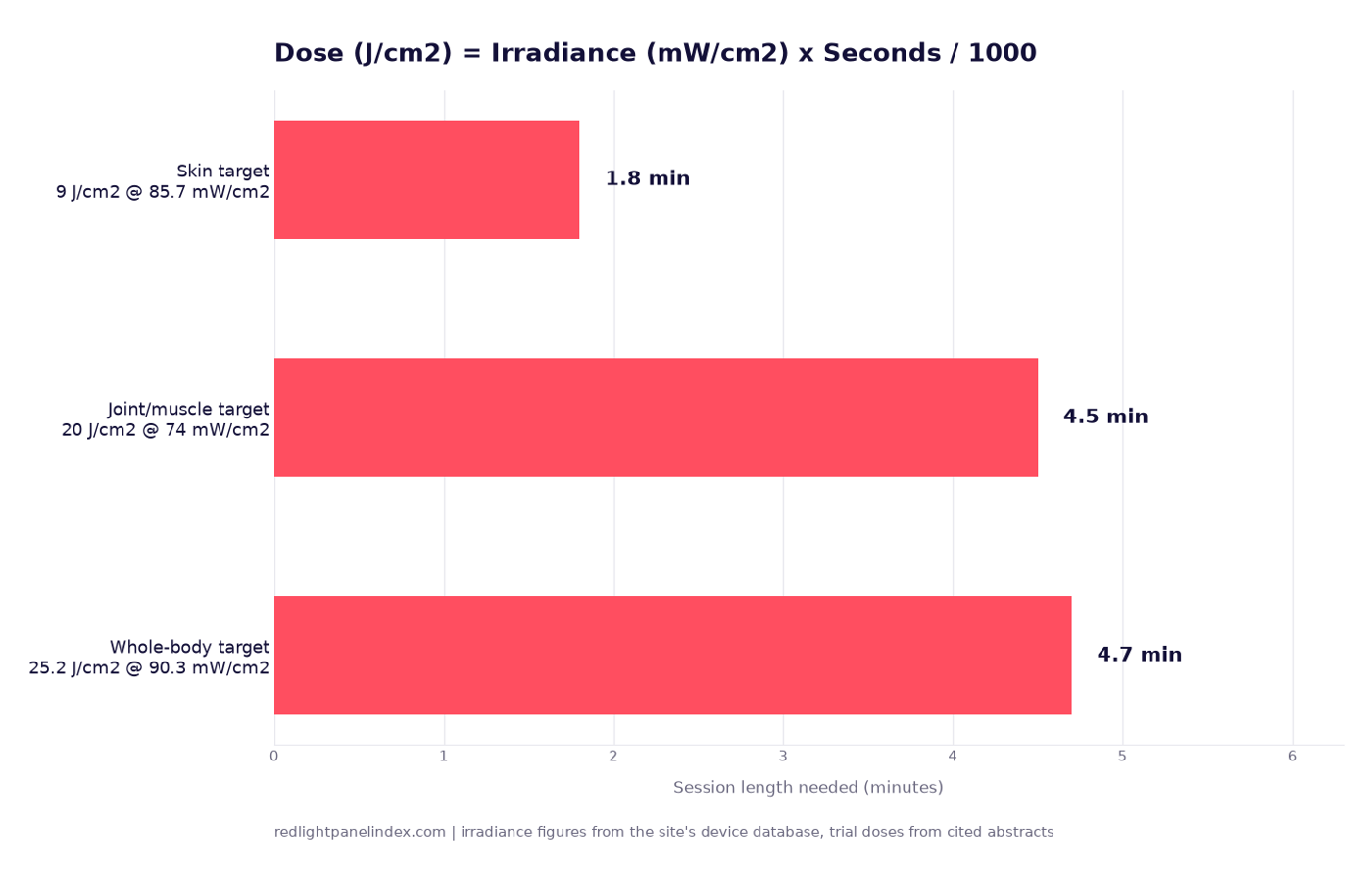
Skin target. The RLT Home Total Spectrum ULTRA posts an average measured irradiance of 85.7 mW/cm2 at 6 inches (Electropossible Ltd spectrometer). Targeting the 9 J/cm2 dose used in the largest skin trial: 9,000 divided by 85.7 is about 105 seconds, roughly 1 minute 45 seconds, at that distance.
Joint or muscle target. The Hooga ULTRA360 posts a measured irradiance of 74 mW/cm2 at 6 inches (LTI spectrometer testing). Targeting a mid-range 20 J/cm2, inside the calculator's commonly studied range: 20,000 divided by 74 is about 270 seconds, 4.5 minutes.
Whole-body target. The PlatinumLED BioMax 900 posts an average measured irradiance of 90.3 mW/cm2 at 6 inches (LTI spectrometer testing). Approximating the 25.2 J/cm2 delivered per session in the whole-body fibromyalgia trial above: 25,200 divided by 90.3 is about 279 seconds, roughly 4 minutes 39 seconds, though that trial's bed illuminated the body from multiple angles at once, so a panel session covering one side of the body is not the same exposure geometry even at a matching J/cm2 figure.
None of these three examples reproduces a trial exactly; they show how the same formula, applied to a real measured irradiance figure, turns a trial's reported dose into a session length you can actually use. Swap in your own panel's irradiance figure at your working distance and the same arithmetic applies.
Putting it together
Start from a method-labeled irradiance figure at the distance you actually plan to sit, not a brand's headline number at an unstated distance or instrument. Pick a target dose from the range that matches your goal, skin toward the lower end of the general range, joints and muscle in the middle, and use the dose calculator to convert that into minutes; how long should a session be walks through that same conversion with two more worked examples. Hold the session length steady across a course of weeks rather than changing it session to session, since how often trials actually dosed matters as much as how much any single session delivers, and revisit the calculation any time your distance, panel, or working assumption about the irradiance figure's measurement method changes. If you are also starting a new prescription, check whether it falls on the list of photosensitizing medications before you settle on a starting dose.