Irradiance and total power answer two different questions, and a spec sheet that only gives you one is not telling you the other. Irradiance, in milliwatts per square centimeter, tells you how strong the light is at one spot in front of the panel. Total power, the sum of that output across the whole emitting surface, tells you how much of the body you can treat at once and how the panel performs at a distance. A small panel can post a higher irradiance number than a large one and still deliver far less usable light overall, because irradiance says nothing about area.
Choosing a panel? Our ranking of the best red light therapy panels is computed from published, method-labeled specs across 188 devices. When panels differ in size, the spec that matters is irradiance combined with area, not irradiance alone.
What each number actually measures
Irradiance is a point measurement. A spectrometer or sensor is placed at a fixed distance from the panel, usually 6 inches in the figures this site tracks, and it reads however many milliwatts of light are landing on each square centimeter of sensor at that exact spot, almost always the center of the panel where output is highest. Our irradiance page covers how sensitive this figure is to the instrument used: a solar meter reads roughly twice as high as a spectrometer on the same panel, averaged 2.11 times across a 44-panel dataset, so the instrument matters before the panel's size ever enters the comparison. What a solar power meter actually measures explains why that gap exists: the meter's sensor is calibrated against broad sunlight, not the narrow wavelength bands an LED panel emits. Distance matters just as much and in a less intuitive way: because a panel is a flat, extended source rather than a single point of light, its irradiance falls off with distance more gradually than the inverse square law would predict, which is one more reason a 6-inch figure cannot simply be scaled to a different distance.
Total power is a whole-panel measurement, and almost no consumer brand publishes it directly. It is what you would get by measuring irradiance at many points across the panel's face and integrating over the entire emitting area, which is the physical quantity that actually determines how many square inches of skin you can treat at a useful dose in one session. A panel with a smaller emitting area can post a higher center-point irradiance reading while still producing far less total light than a larger panel reading lower at its own center point.
Why a small panel can out-read a large one
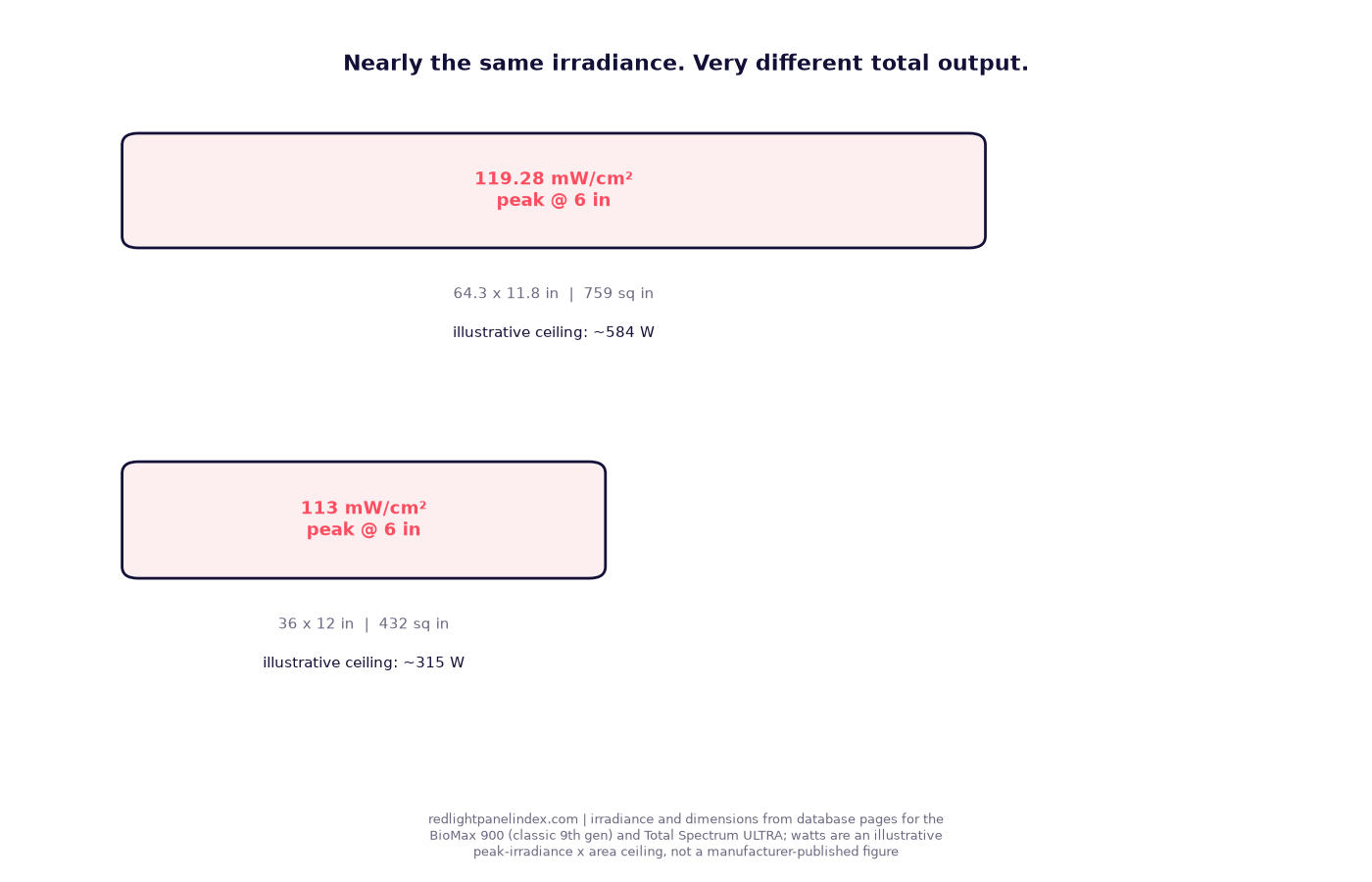
Two panels in this site's database illustrate the gap directly. The PlatinumLED BioMax 900 measures 36 by 12 inches and posts an independently measured peak irradiance of 113 mW/cm² at 6 inches (LTI spectrometer testing), with an average of 90.3 mW/cm² across the panel at that same distance. The RLT Home Total Spectrum ULTRA measures 64.3 by 11.8 inches, nearly twice the emitting area, and posts a peak irradiance of 119.28 mW/cm² at 6 inches on an independent spectrometer test (Electropossible Ltd), a second lab's reading centers at 85.7 mW/cm² with a max of 111.2 mW/cm² at the same distance.
Read as a pair, the peak numbers are close: 113 against 119.28, a difference of about 6 percent, well inside the kind of spread you would expect between two labs testing two different panels. Judged on irradiance alone, a buyer would call these two panels roughly equivalent in strength. They are not equivalent in what they can treat, because one panel is emitting that strength across roughly 432 square inches and the other across roughly 759 square inches, a ratio of nearly 1.8 to 1.
Combining irradiance with area: a rough worked comparison
There is no substitute for a manufacturer publishing total radiant power directly, and almost none do. A rough stand-in is to multiply a panel's peak irradiance by its total emitting area, converted to square centimeters, which gives an illustrative ceiling on total output rather than a true measured wattage; it overstates the real figure because peak irradiance is a single center reading, not the average across the whole surface, and every panel's output falls off toward its edges.
Even with that caveat, the arithmetic makes the point. The BioMax 900's 432 square inches converts to about 2,787 cm²; at a peak of 113 mW/cm², that is roughly 315 watts of illustrative ceiling output. The Total Spectrum ULTRA's 759 square inches converts to about 4,894 cm²; at a peak of 119.28 mW/cm², that is roughly 584 watts, despite its peak irradiance being only marginally higher than the BioMax 900's. The Hooga HG300, a compact 12.2 by 8.2 inch panel with a brand-stated 73 mW/cm² at 6 inches (method not stated), covers about 645 cm² for an illustrative ceiling near 47 watts, the smallest of the three by a wide margin. Ranked by irradiance alone, the order is ULTRA, then BioMax, then HG300. Ranked by this rough total-output figure, the order is the same here, but the gap between ULTRA and BioMax nearly doubles once area is factored in, which is the part a bare irradiance comparison hides.
When irradiance is the number that matters
For a single joint, a patch of skin, or any treatment area smaller than the panel's beam, irradiance at your working distance is the number to use, because it is what determines the dose landing on that specific spot regardless of what the rest of the panel is doing. Feed that figure into the dose calculator with your actual session length to get joules per square centimeter, the same formula this site's J/cm2 explainer walks through with real trial dose targets, and a smaller panel with a strong, method-labeled irradiance reading is a completely reasonable choice for spot treatment, often at a fraction of the price of a full-body unit. Dosing explained walks through that same formula with three worked examples using real measured irradiance figures.
When total power and coverage matter more
For anything closer to whole-body use, standing in front of a panel to treat the torso, both thighs, or the back in one session, total emitting area starts to matter as much as the reading at any single point, because a narrow panel simply cannot put useful irradiance on tissue outside its beam width, however strong that beam measures at the center. Our buying checklist treats coverage as a separate step from irradiance for exactly this reason, and the site's full-body rankings score panels partly on physical dimensions rather than irradiance alone, because a panel sized for a knee is not sized for standing full-body use no matter how it reads on a spectrometer. The same logic applies to a narrower goal: this site's athlete recovery panel picks score coverage against treating a standing quad or hamstring in one session, not a full-body area.
The same gap shows up in price comparisons
The irradiance-versus-area gap also explains why a straight price-per-watt or price-per-panel comparison across different-sized products is misleading. The Hooga HG300 lists at $199, the PlatinumLED BioMax 900 at $1,299, and the RLT Home Total Spectrum ULTRA at $2,895, verified prices as of the dates each database page shows. On price alone, the HG300 looks like the value pick by a wide margin. Divide the same rough total-output ceiling used above by price, and the picture shifts: the HG300 delivers its roughly 47 watts of illustrative ceiling output for about $4.23 per watt, the BioMax 900 delivers its roughly 315 watts for about $4.12 per watt, and the ULTRA delivers its roughly 584 watts for about $4.96 per watt. The three panels end up closer together on this measure than either the sticker price or the peak irradiance figure alone would suggest, because a bigger emitting surface costs more to build regardless of how strong any single point on it reads.
None of this means a bigger panel is automatically the better buy. A person treating a single knee has no use for 759 square inches of emitting surface, however efficiently that panel converts dollars to illustrative watts, and paying for coverage nobody uses is its own kind of waste. The point is narrower: price, irradiance, and total power move somewhat independently of each other as panel size changes, so comparing any two of the three without the third can make a panel look like an outlier when it is actually in line with panels of a similar size.
What a published total-power figure would fix
The underlying problem here is not that irradiance is a bad measurement; it is a precise one, at the one point it measures. The problem is that almost no brand in this site's database publishes total radiant power in watts, the number that would let a buyer skip the area arithmetic entirely and compare whole-panel output directly, the same way LED grow light and stage light manufacturers routinely do. Until that becomes standard on red light therapy spec sheets, area times peak irradiance, with the overstatement caveat above attached, is the closest a buyer can get without an independent lab test of their own.
A published average irradiance across the whole panel face, rather than a single center-point peak, would close most of the remaining gap on its own. The BioMax 900 already publishes both: a peak of 113 mW/cm² and an average of 90.3 mW/cm², a 20 percent difference between the two readings at the same 6 inch distance. Where a brand publishes only a peak figure, treat the true panel-wide average as meaningfully lower than the headline number, on top of whatever gap the choice of measuring instrument already introduces.
Verdict by use case
If you are treating one area at a fixed distance, session after session, compare irradiance at your working distance and stop there; total panel output is close to irrelevant to a spot you can fully cover with a smaller, cheaper panel. If you are trying to treat as much of the body as possible in one session, irradiance alone will mislead you, because two panels can post nearly identical peak readings while one delivers less than half the other's total output once area is accounted for. In that case, look at both numbers together, or failing a published total-power figure, do the same rough multiplication used above with the panel's own peak irradiance and its stated dimensions before assuming a higher irradiance number means a stronger panel overall.