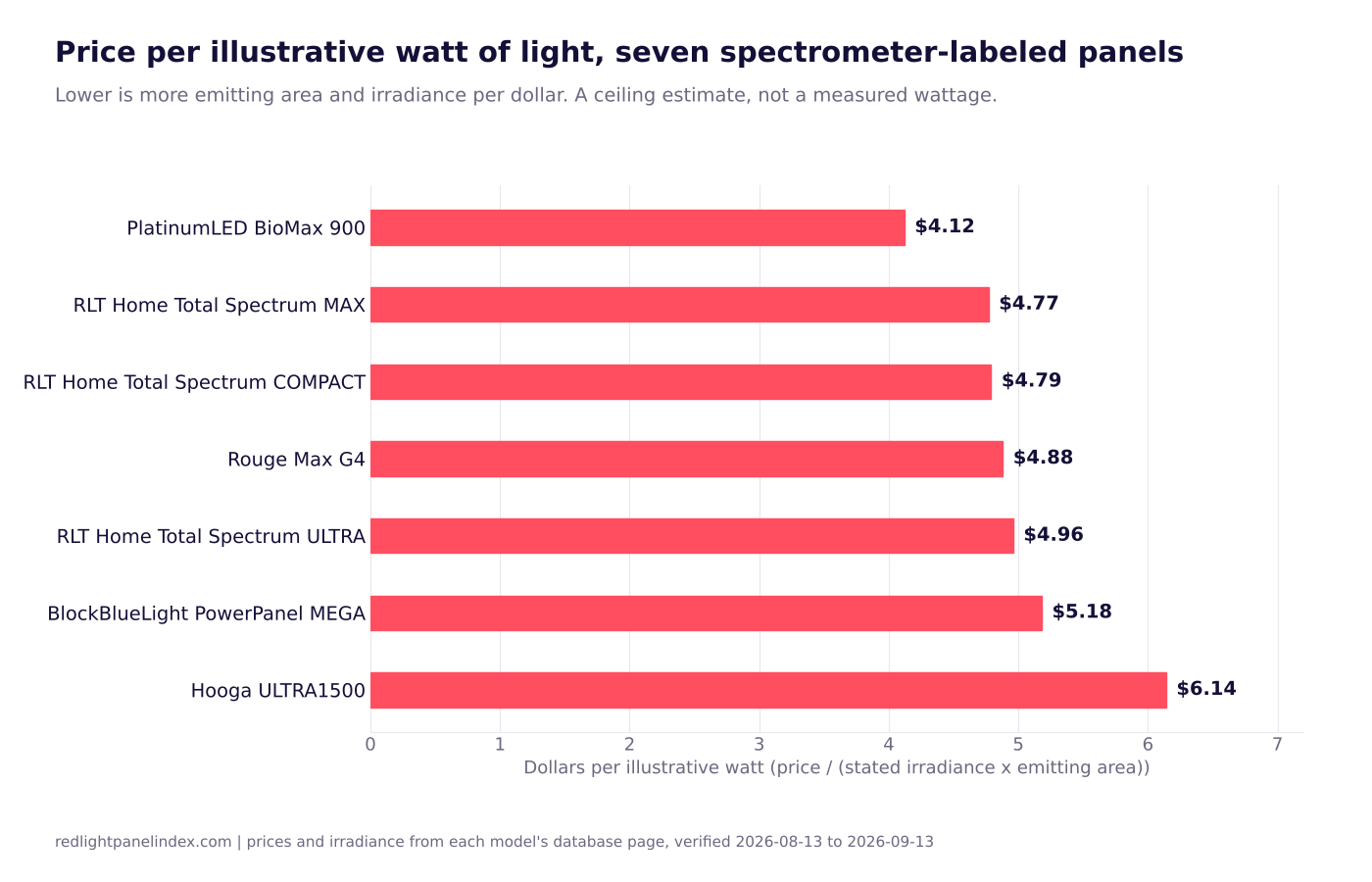
Among seven spectrometer-tested panels in the database, the price of an illustrative watt of light runs from $4.12 to $6.14, a spread of about 50 percent, even though sticker prices span $1,095 to $2,895. The cheapest watt belongs to the PlatinumLED BioMax 900 and the dearest to the Hooga ULTRA1500, and the measure only means something for panels whose irradiance was read with a spectrometer, because brand figures from other instruments are not comparable.
Choosing a panel? Our ranking of the best red light therapy panels is computed from published, method-labeled specs across 188 devices. For value, the spec that matters is irradiance multiplied by emitting area, not irradiance or price alone.
The question this index answers
A price tag compares badly across sizes. A $1,095 panel and a $2,895 panel differ by 2.6 times in price, but one is also much larger, so the useful question is how much light each dollar buys. This index answers it with one number per panel: price divided by an illustrative output, where output is the stated irradiance multiplied by the panel's area in square centimeters. The result is dollars per watt of illustrative output, which is the same idea the irradiance versus total power explainer introduced for three panels, extended here to seven.
It is a value index, not a quality index. It does not say which panel is better for any person or condition, and it makes no claim about outcomes.
Method, step by step
- Qualify the panel. Only models whose irradiance in the database is labeled as a spectrometer reading at 6 inches are included. The claimed versus measured dataset shows that brand figures taken with a solar meter or an unnamed instrument run a median 2.18 times the spectrometer figure on the 44 panels where both exist, so mixing methods would reward whoever used the more generous meter. The irradiance page explains the instrument gap.
- Take the stated irradiance. Where a lab reported one figure, we used it. Where it reported a peak and an average, the main index uses the peak, so every panel is treated the same way, and a second column shows the average-based result for the panels that have one.
- Compute area. Panel dimensions from the database page, multiplied, converted at 6.4516 square centimeters per square inch. This is panel area, not emitting area, which brands rarely publish.
- Multiply and convert. Irradiance in mW/cm2 times area in cm2 gives milliwatts; divide by 1,000 for watts.
- Divide the price by that wattage. Prices are the database prices on their stated verification dates.
The index
| Rank | Panel | Price (verified) | Area, sq in | Irradiance, mW/cm2 at 6 in | Illustrative watts | $ per watt | $ per watt on average |
|---|---|---|---|---|---|---|---|
| 1 | PlatinumLED BioMax 900 | $1,299 (2026-08-13) | 432 | 113 peak | 315 | 4.12 | 5.16 |
| 2 | RLT Home Total Spectrum MAX | $1,795 (2026-09-12) | 581 | 100.53 | 377 | 4.77 | n/a |
| 3 | RLT Home Total Spectrum COMPACT | $1,095 (2026-09-12) | 358 | 99.0 | 228 | 4.79 | n/a |
| 4 | Rouge Max G4 | $2,396 (2026-09-13) | 846 | 90 | 491 | 4.88 | n/a |
| 5 | RLT Home Total Spectrum ULTRA | $2,895 (2026-09-12) | 759 | 119.28 | 584 | 4.96 | n/a |
| 6 | BlockBlueLight PowerPanel MEGA | $1,500 (2026-09-12) | 428 | 105 peak | 290 | 5.18 | 6.71 |
| 7 | Hooga ULTRA1500 | $1,399 (2026-09-12) | 340 | 104 peak | 228 | 6.14 | 7.81 |
The BlockBlueLight PowerPanel MEGA is listed at 920 by 300 millimeters in the database; the area above converts that to inches. The "$ per watt on average" column is blank where a lab reported only one figure. Where it is filled, it is higher because an average is lower than a peak, and the order of the three panels that have it, BioMax 900 first, MEGA second, ULTRA1500 third, does not change.
What the ranking shows
Three observations hold up against the numbers.
Value does not track price. The lowest sticker price in the set, the COMPACT at $1,095, sits third of seven on value, while the most expensive, the ULTRA at $2,895, sits fifth of seven, inside the middle cluster. Four panels land between $4.77 and $4.96 per watt, a spread of under 4 percent, which is smaller than the difference between two labs measuring the same panel. Treat that cluster as a tie.
Area drives more of the result than irradiance. The Hooga ULTRA1500 posts a 104 mW/cm2 peak, in the same range as the others, but its 39.5 by 8.6 inch face is the smallest in the set, so each dollar buys less illustrative output. The BioMax 900 leads because a mid-size face and a strong reading come at a mid-size price, and its price was verified earlier than the others, on 2026-08-13. Prices move, so treat a one-rank gap as noise.
The method rewards big, strong, cheap panels, and ignores everything else. A large panel is only worth its area if you will use the area, which the treatment area and coverage explainer covers, and a single knee never needs 759 square inches.
Limits you should know before quoting the table
- Peak is not average. A peak irradiance applies to the best spot. Average readings were 77 to 80 percent of the peak for the three panels that report both, so peak-based wattage overstates real output by roughly a fifth to a quarter. That is why a second column exists.
- Panel area is not emitting area. Frames and bezels inflate area, and they differ by brand.
- Wavelength mix is outside the index. A watt of 660nm and a watt of 850nm are different products. The index says nothing about whether a panel's mix suits your goal, and nothing about dose for any condition. See the dose calculator for session time given an irradiance, and the evidence pages for what trials used.
- Distance is fixed at 6 inches. Output at other distances is not in the database, so a ranking at 6 inches may not hold at 18.
- Prices were verified on different dates, from 2026-08-13 to 2026-09-13, and promotions change them. Check the database page for current figures.
- Seven is a small set. Only panels with a spectrometer label and a published size qualify. Other panels may be better or worse value; they are excluded because their numbers are not comparable, not because they were judged poorly.
- Warranty, trial terms, flicker and build quality are not priced in. A low dollars-per-watt figure on a panel with a short warranty is not the same value as one with a long warranty.
How to use this table
Use it as one filter among several. First decide the area you need to cover; then compare panels that cover it on spectrometer-labeled irradiance; then check price per illustrative watt as a tiebreaker between panels of similar size. The how rankings work page explains how the site's own scoring combines these fields, and the full-body ranking applies size and price together. This site lists RLT Home as one brand among 41, and the same criteria and cautions apply to every model above.
No separate data file is published with this page; the table above is the full dataset. Every input is on the linked database pages, so anyone can reproduce a row with a calculator in under a minute.