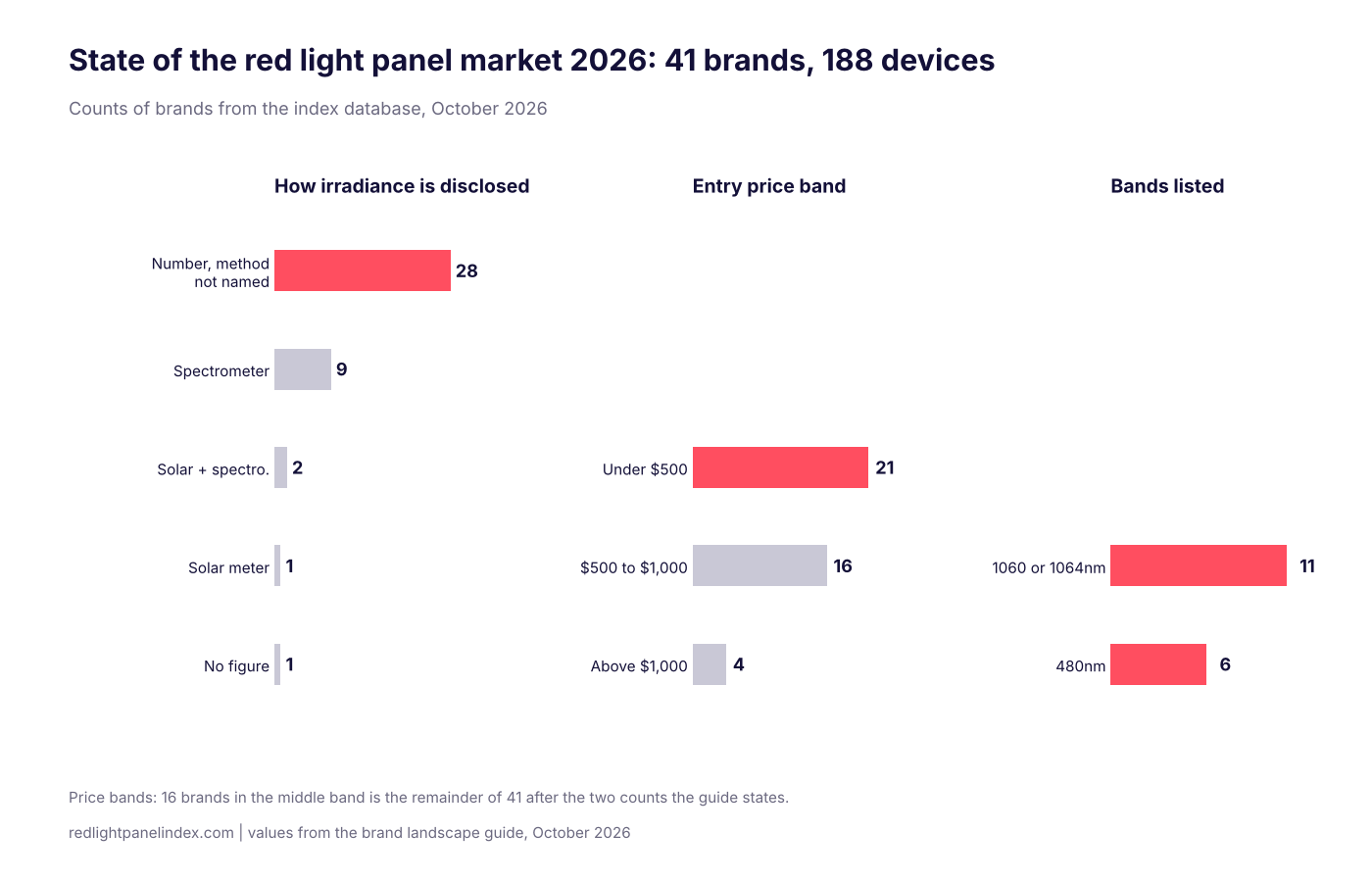
In 2026 the red light panel market is cheap to enter and hard to compare: 21 of the 41 brands in this index sell an entry model under $500, but 28 of the 41 publish an irradiance number without naming how it was measured. Most brands still cluster around 660nm and 850nm, 11 list 1060 or 1064nm, and a 3 year warranty is the most common term on a panel.
Choosing a panel? Our ranking of the best red light therapy panels is computed from published, method-labeled specs across 188 devices. For the market as a whole, the spec that matters is whether the irradiance figure names its instrument and distance, because that is what lets two panels be compared at all.
All counts below come from the index database and its published pages as of October 2026, which covers 41 brands and 188 devices. Prices carry the verification date shown on the page they come from; check the linked page before you buy, because prices move. This is a snapshot, and we plan to renew it yearly.
How brands disclose irradiance
Irradiance, measured in mW/cm2, is the headline spec of every panel, and the method behind it is the part most brands leave out. The brand landscape guide sorts all 41 brands by what they say:
| Disclosure | Brands |
|---|---|
| Publish an mW/cm2 number without naming the method | 28 |
| Label the figure as spectrometer-based | 9 |
| Disclose both a solar meter and a spectrometer reading | 2 |
| Label the figure as a solar meter reading | 1 |
| Publish no irradiance figure | 1 |
So more than two-thirds of the market asks you to take the number on trust. The gap matters because the two instruments do not agree. In our claimed vs measured comparison of 44 panels with both a brand claim and a spectrometer reading, the claim divided by the measurement had a median of 2.18 and a mean of 2.11, with a range of 1.36 to 2.60. The page notes that most of that gap is instrumentation rather than fabrication, which is exactly why the method label matters. If you want to understand the instruments, start with the irradiance explainer, the solar power meter page and the spectrometer page.
Three rows from that comparison show the pattern. The BlockBlueLight PowerPanel ELITE XL is claimed at 189 mW/cm2 by solar meter and measured at 90 by spectrometer, both at 6 inches. The Hooga ULTRA1500 is claimed at 165 and measured independently at 81.7. The RLT Home Total Spectrum MAX is claimed at 172 by solar meter at 8 inches and measured at 100.53 by spectrometer at 6 inches, so its ratio understates the pure instrument gap because the distances differ. Different brands, same lesson: the same panel can carry two very different numbers, and only the method label tells you which one you are reading.
Disclosure is not a quality ranking by itself. A brand that names a spectrometer has told you how it measured; it has not told you the panel is good. It is the minimum needed for a fair comparison, and it is a criterion in how rankings work.
Price bands
Of the 41 brands, 21 have an entry-level model under $500. Four brands start above $1,000: iRestore at $1,299, Joovv at $1,099, Leredd at $1,430 and RedLife at $1,063. The remaining 16 begin between $500 and $1,000, a count we computed as the remainder. The lowest entry price in the table is Comfytemp at $120, and the highest listed top-end price is Joovv at $11,099. Entry price is not value, though. Our price per milliwatt index looked at the seven spectrometer-tested panels and found dollars per illustrative watt running from $4.12 to $6.14, a spread of about 50 percent, while sticker prices ran from $1,095 to $2,895. The cheapest of the seven ranked third by value and the most expensive ranked fifth, so price alone did not predict value in that set. Seven panels is a small sample, and the index prices irradiance times emitting area only, not warranty, flicker or build quality.
For budget buyers, the budget panels ranking and the guide to cheap Amazon panels apply the same method-labeled criteria to the low end.
Wavelength mix
Most brands cluster around 660nm and 850nm, the pair that dominates the published research (see the wavelengths guide). Two less common additions are worth tracking:
- 1060 or 1064nm. Eleven brands list it: BlockBlueLight, Helio Cure, iRestore, Kala, LuminousRed, PlatinumLED, Rouge Care, RedLife, RLT Home and Vital Red Light, plus GembaRed on one model. Adoption is about one brand in four. If deep tissue is your goal, see the deep tissue 1064nm ranking and the 1064nm page for what the band is and is not known to do.
- 480nm. Six brands list it: Orion, PlatinumLED, RedLife, RLT Home, Vellgus and Vital Red Light. Blue light has a different safety and evidence profile from red and near-infrared, so a 480nm channel is a feature to read about, not a free bonus.
Listing a band is not the same as delivering it. Check the model page for how much of the output sits in each band, and for how the LED chips were specified; the LED chips page explains what to look for. More bands also make irradiance harder to compare, since a single number rarely says which band it describes.
Warranty and trial terms
Warranty terms on panels run from 1 year to 10 years. The longest warranty ranking found 3 years to be the most common term, with 2 years next, and five brands exceeding 3 years on a panel. The two 10 year limited warranties belong to iRestore and Recover Red, and LuminousRed lists up to 8 years depending on the product. Fine print varies as much as length: some warranties prorate by year, some require registration, some cover claim shipping only for a limited window, and some cover LED failure explicitly. A long headline term with prorated coverage is not the same as a flat one.
Return windows range widely too. Red Light Rising offers the longest trial in the table at 365 days, LuminousRed offers 100 days, and 60 days is a common term. ATaPa accepts no returns, and restocking fees run from none to 30 percent. The free trial, no restocking fee ranking lists the brands with the least friction on a return.
What the data does not show
- Brand-level counts hide model detail. A brand that lists 1064nm may do so on one model only.
- Published is not verified. Most specs are brand-published; only a minority have an independent measurement, and the pages say so.
- Snapshots go stale. Prices and warranty terms change. Use the verification date on each page.
- No clinical claims follow from any of this. The market data describes devices, not outcomes. For what the research says about conditions, use the evidence hub.
How to use this snapshot
- Start with disclosure. Prefer a panel whose irradiance figure names its instrument and distance, then use the dose calculator to turn it into a dose per session.
- Compare on emitting area as well as irradiance; the price per milliwatt index shows why.
- Treat the wavelength list as a menu, not a score. More bands does not mean better.
- Read warranty and return terms as carefully as specs, since they differ more than the hardware does.
- Browse the full database to compare any two models, and read how to read irradiance labels before trusting a number.
Our brand landscape guide lists all 41 brands side by side with the details behind every count above, and the database has the model-level pages.