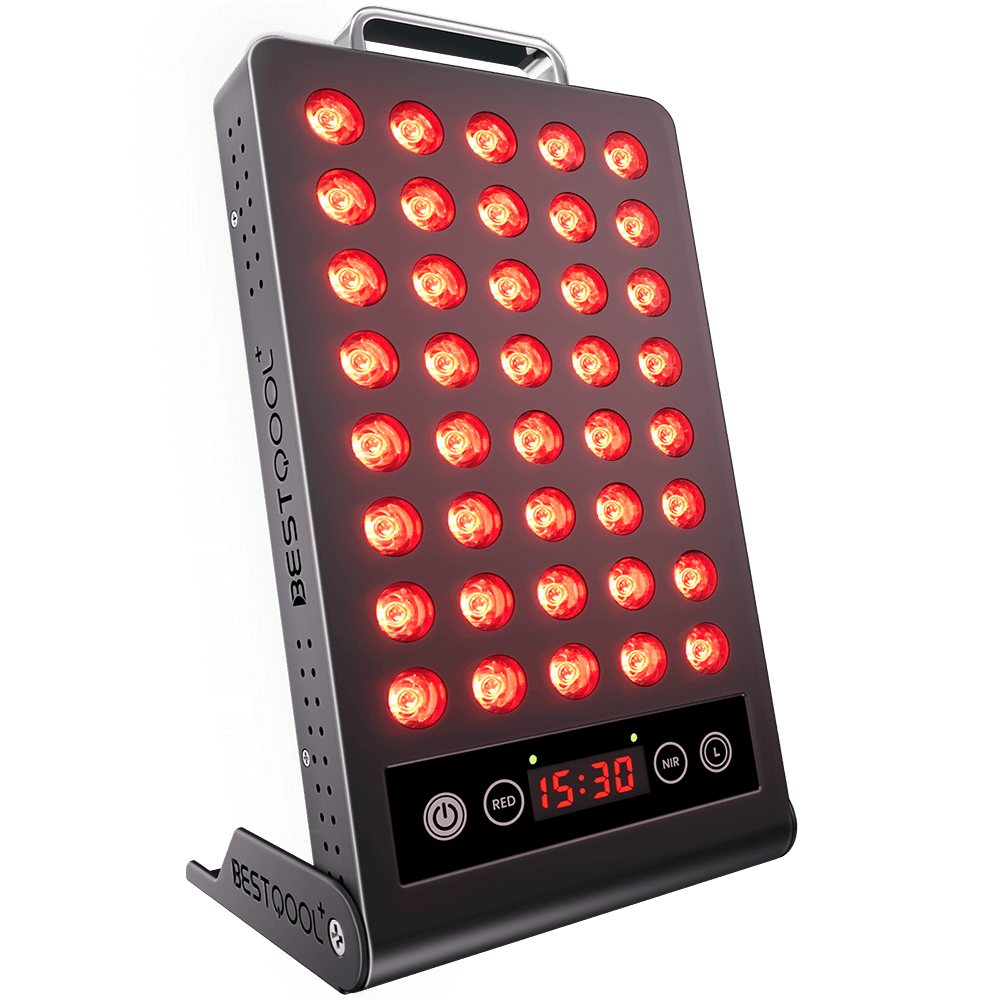
A cheap red light panel can be worth buying, but only if you can see what it actually delivers and you can send it back. In the database, the budget panels that hold up best are the ones that publish a wavelength list, a warranty and a return window; the ones that fall short usually leave out the instrument behind their irradiance number.
Choosing a panel? Our ranking of the best red light therapy panels is computed from published, method-labeled specs across 188 devices. For a budget panel, the spec that matters is an irradiance figure that names the instrument used to measure it.
Prices below are the ones the database shows, each with the date it was verified. They change, so check the model page before you buy. The database does not record which store a panel is sold through, so this guide sorts panels by what they publish, not by where they are listed.
What "cheap" buys you
Most panels under $200 in the database share a plain design: red at 660 nm, near-infrared at 850 nm, a fixed set of LEDs and a timer. That is not a flaw. Those two wavelengths are the ones most home panels use, and the 660 nm and 850 nm pages explain what each is for.
What a lower price usually removes is documentation and coverage:
- Fewer published specs. Some budget models do not state LED count, beam angle or a measured irradiance.
- Smaller treatment area. A compact panel covers a small patch of skin at working distance.
- No wavelength beyond red and near-infrared. Bands such as 630, 830 or 1064 nm are rare in this price range.
- Simpler support. Warranties run from 1 to 3 years, with one lifetime outlier in the database.
If you want a ranked list rather than a how-to-check guide, see best red light panels under $500 and the budget panel ranking.
What the database shows for budget panels
These are real entries, with the price and the date it was checked.
| Model | Price (verified) | Irradiance as published | Warranty | Return terms |
|---|---|---|---|---|
| Hooga HG200 | $149 (2026-09-12) | 100 mW/cm2 at 6 in, method unstated | 3 years | 60 days |
| Hooga HG300 | $199 (2026-09-12) | 73 mW/cm2 at 6 in, method unstated | 3 years | 60 days |
| Bestqool BQ40 | $149 (2026-08-12) | 70 mW/cm2 at 3 in, method unstated | 2 years | 30 days, no restocking fee, prepaid label after approval |
| Bestqool BQ60 | $189 (2026-08-12) | 95.6 mW/cm2 at 3 in, method unstated | 2 years | 30 days |
| LifePro BioHeal | $180 (2026-08-13) | 82 mW/cm2 at 6 in, method unstated | Lifetime | 30 days |
| Comfytemp K4037 55W | $120 (2026-08-13) | 143 mW/cm2 at 6 in, method unstated | 1 year | 30 days, 15% restocking fee |
Two patterns stand out. First, none of these figures names the instrument that produced it. Second, two of the Bestqool figures are taken at 3 inches, not the 6 inches most other brands use, so they cannot be set beside the others.
For two of the cheapest models side by side, the Bestqool vs Comfytemp comparison goes through the specs one by one.
The claimed-vs-measured problem
An irradiance number is only useful if you know how it was measured. Across 44 panels with a comparison available, the claimed-vs-measured analysis found headline claims averaged 2.11 times the spectrometer reading, with a median of 2.18 and a range from 1.36 to 2.60. Most of that gap comes from the instrument: a solar power meter is calibrated against sunlight, and a narrow LED peak at 660 or 850 nm does not match that calibration. The solar power meter page explains why.
That analysis draws on 38 panels where the maker published both a solar meter and a spectrometer figure, plus 6 panels measured by third parties. Budget brands in the table above published neither, which means you cannot tell where their numbers sit. The honest reading is "unknown", not "inflated" and not "accurate".
To compare any two panels, use the method-labeled figures and the guide to how to read irradiance labels. The irradiance science page shows how distance changes the number, which is why a 3-inch figure and a 6-inch figure cannot be compared directly.
Return terms matter more on a cheap panel
When you cannot verify a spec, the return window is your safety net. The terms in the database vary more than the prices do:
- 60 days: Hooga models in the table above.
- 30 days with no fee: Bestqool and LifePro.
- 30 days with a 15% fee: Comfytemp, so a change-of-mind return on a $120 panel costs you part of the price.
- Fees on other brands: the free-trial and restocking fee ranking lists PlatinumLED at 20% and Kala at $15, among others.
- No returns at all: the Recover Red MAX cannot be returned, and ATaPa lists "No returns accepted" on its policy.
Before you buy any panel, read the return page for the exact model and ask three things: how many days, who pays return shipping, and whether the fee applies to a change of mind. A short, free window is worth more than a few dollars saved at checkout. For long coverage, the longest warranty ranking shows which brands back their panels longest.
How to decide
Run through these in order. Stop at the first "no".
- Does the listing name the measuring instrument? If not, treat the irradiance as unverified.
- Is the distance stated, and is it 6 inches? If it is 3 inches, do not compare it with a 6-inch figure.
- Are wavelengths listed in nanometers? You want to see exact values, such as 660 and 850.
- Is the return window at least 30 days, with no fee for a change of mind? Fees of 15 to 20 percent remove most of the saving on a cheap panel.
- Is the warranty at least 2 years? One year is the shortest in this tier.
Then work out whether the panel can deliver the session you need. The dose calculator turns irradiance, distance and time into a dose. A weak or unknown irradiance means you may need longer sessions or a closer position; the session length guide and the distance guide cover both. If you plan to use a panel for a health goal, check the grade on the relevant evidence page first, since the evidence does not change with price.
Cautions
- A low price is not a sign of a bad panel, and a high price is not a sign of a good one. Judge by published specs and terms.
- A brand that publishes less is not the same as a brand that misstates. The gap is missing information.
- Prices and policies change. Confirm on the model page and the brand's own return page.
- Panels are not a substitute for medical care, and anyone using photosensitizing medication should read the photosensitizing medications guide first.
Verdict by use case
- Trying red light for the first time on a small area: a compact model with a 60-day return window, such as the Hooga HG200 or HG300, limits your risk.
- Lowest possible spend: the Comfytemp K4037 55W is the cheapest in this table, with the cost of a 15% restocking fee and a 1-year warranty.
- You want a long warranty on a low price: LifePro lists a lifetime warranty on the BioHeal at $180.
- You want to compare against other panels on a like-for-like basis: skip any model whose irradiance has no named method and use the methodology as your guide to how rankings work.