A used red light panel can be a reasonable buy, but assume you are buying it without a warranty: every brand in our database that states who its warranty covers says the original purchaser, so the protection stays with the first owner. The second assumption is that you will have to verify the panel yourself on arrival, because a used unit's output, flicker and evenness are not something a listing photo can show.
Choosing a panel? Our ranking of the best red light therapy panels is computed from published, method-labeled specs across 188 devices. For a used panel, the spec that matters is the instrument and distance behind its irradiance figure, because that is the number you will check it against.
The database does not record which stores or marketplaces sell used panels, so this guide does not name places to shop. It covers what the database does hold: warranty and return terms, and the LED aging figures brands publish.
What happens to the warranty
Warranties in this category are written for the buyer who bought from the brand. The longest warranty ranking lists the conditions each brand states. Among the brands that name who is covered, the answer is the same:
| Brand | Warranty on panels | Who is covered |
|---|---|---|
| Recover Red | 10 years, limited | Original purchaser |
| iRestore (Apex) | 10 years, limited, registration required | Original purchaser |
| Luminousred | 8 years, direct purchases only | Original purchaser |
| LightpathLED (Titan) | Up to 5 years, prorated | Original purchaser |
| BioLight | 3 years on panels | Original purchaser |
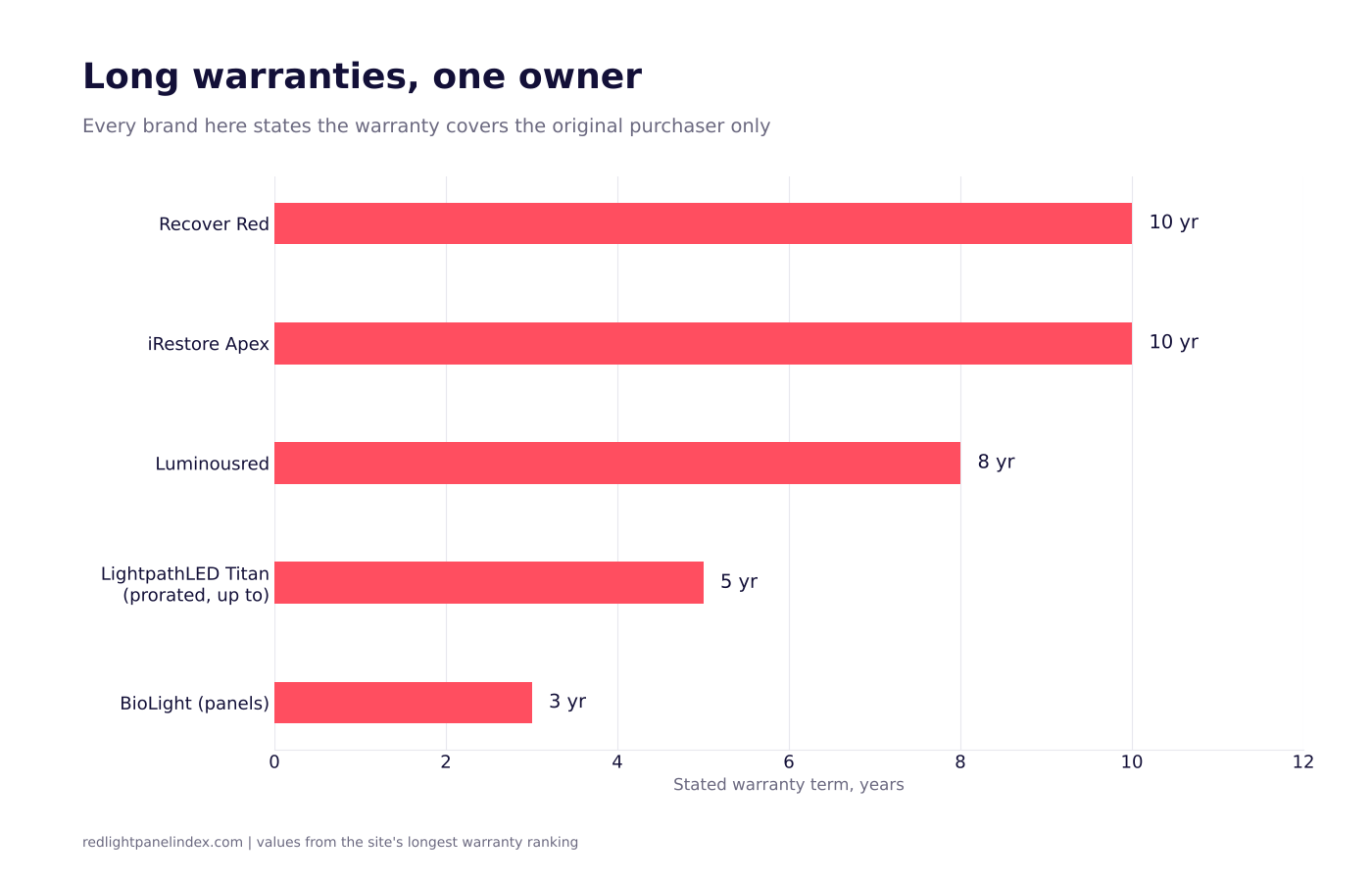
The chart at the top of this page shows the five terms. Notice what the long numbers mean for a second owner. A 10-year warranty from a brand that covers only the original purchaser is worth nothing to you, however long the term is. Luminousred goes further and limits its warranty to direct purchases, which would also rule out a unit that was bought through a reseller before it was resold to you.
Some terms also depend on a step the first owner had to take. iRestore requires registration, and BioLight says registration may be required. If the first owner never registered, there is nothing to transfer even if a brand were willing to. We did not find a published transfer procedure in the terms we hold for any brand. If a brand matters to you, ask its support in writing whether a second owner can be covered, and keep the reply.
Refurbished is not the same as used
A refurbished unit is a used one the seller or brand has inspected and repackaged. The label tells you nothing about the warranty on its own, and several return policies exclude these units:
- Bestqool offers a 30-day return, but its condition rules say open-box and refurbished units are not returnable.
- Kala lists refurbished units as final sale, along with Quad and Duo panels and stands.
Both facts come from the return terms compared in the free trial and restocking fee ranking. They apply to those brands' own policies and tell you what the brand would do if you bought a refurbished unit from it. They do not describe what a third-party seller offers. Whatever the seller says, get the return window and who pays shipping in writing before you pay.
How much life is left in the LEDs
The worry with a used panel is that the LEDs are worn out. The numbers suggest that is rarely the issue. Only 5 of the 41 brands publish an LED lifespan figure, and those figures are 50,000 hours for two brands and 100,000 hours for three, per the LED lifespan explainer. Those are brand claims, and the database does not test them.
Put them against real use. A 20-minute session every day is about 122 hours a year. A panel used that way for three years has about 365 hours on it, well under 1% of a 100,000 hour rating. A panel that fades noticeably from hours alone would be unusual.
What is more likely to differ in a used unit is everything around the chips. Per the same explainer, the parts most likely to cause trouble are the power supply or driver, wiring and connectors, fan bearings where fans exist, and the controller. Heat from poor clearance speeds LED fading, so ask the seller where and how the panel was mounted. A panel run in a closed cabinet is a worse bet than one that hung on a wall with space around it.
What to ask the seller
- Which model, exactly? Ask for the model name and the purchase date, then find it in the panel database. Many brands sell several lines with different wavelengths and LED counts, and the specs you compare against are the ones for that line.
- Was it ever repaired or opened? A swapped driver or board may change output.
- How was it used? Hours per week and whether it ran with fans clear.
- Is the original receipt available? It helps if the brand will deal with you at all.
- What is the return policy? If the answer is "as is," the check below is your only protection.
What to check when it arrives
Do these in the first days, while a return may still be possible. Measuring is the point: a used panel's condition is unknown until you read it.
- Look at every LED with the panel on. Dark patches, flickering sections or a one-sided pattern point to a failed connection. A block of dead LEDs shows up as an uneven pattern, not overall dimming.
- Check flicker. Film the panel with a phone camera in slow motion and watch for bands. The flicker explainer has the method. A failing driver is a common place for flicker to start.
- Measure the irradiance. Use the method in the guide to checking a claim yourself. Measure at the distance the brand states, and compare your solar meter reading with the brand's figure only if the brand's figure also came from a solar meter. The claimed versus measured study found brand claims average 2.11 times the spectrometer figure across 44 panels, so a reading near half the claim can be normal and does not mean the panel has faded.
- Compare across five points. Center and four corners, as in the verification guide. A big gap between center and edges is how an LED outage shows up.
- Note the fans and noise. Fans are moving parts. Grinding or rattling is a warning.
- Re-measure after a week. Same distance, same room. If the center reading drops, tell the seller right away.
If the panel reads well below the claim at the stated distance, do not just accept it. For a used unit the right question is whether it matches what the seller said it was, which you can only answer with a baseline. The best baseline is the brand's own figure, with its method and distance, from the model page.
Adjust your dose to what you measure
A used panel may not deliver the figure on the box, so base your sessions on your own reading, not the brand's claim. Dose is irradiance multiplied by time, and the dose calculator does that arithmetic. Using the database example from the verification guide, 61 mW/cm2 and a 20 minute session give 73.2 J/cm2, while a panel that now reads lower needs a longer session for the same energy. The dosing explainer covers how to choose a target, and the evidence pages show what dose ranges the studies used.
When a used panel is not worth it
- The price saving is small. Newer budget lines carry a return window. Bestqool's 30-day return and Kala's 30-day trial with a $15 restocking fee are both in the database, and the budget panel guide covers what cheap panels publish.
- The seller cannot name the model. Without it you cannot compare against a spec.
- You need the warranty. If the panel is a gift or a long-term purchase, the gift guide points to new units, where the return window is yours.
- The unit is a face mask or a hair cap. This guide covers panels; check the model's own database page for its terms.
The short version
Treat a used panel as a no-warranty purchase, price it against a new panel with a return window, and measure it the day it arrives. If it checks out, the LED hours left are rarely the problem. If it does not, you need the seller's return terms in writing before you pay.