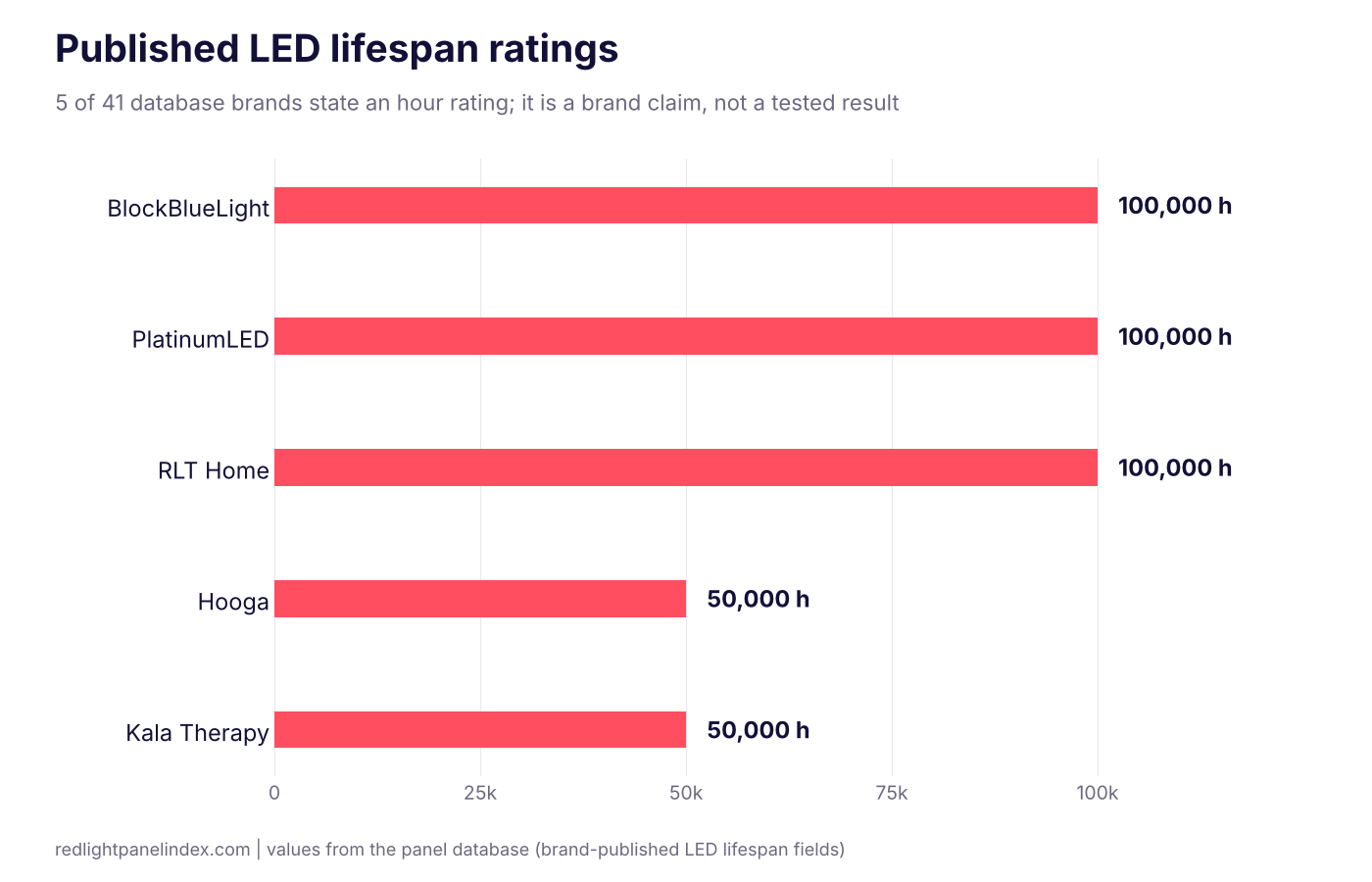
A red light panel's LEDs rarely stop working outright; they slowly get dimmer, and a lifespan rating such as 50,000 or 100,000 hours is a brand's estimate of how long that dimming takes to reach a set point, usually 70% of the original output. Only 5 of the 41 brands in our database publish an hour rating at all, so for most panels the warranty is the only written statement about durability.
Choosing a panel? Our ranking of the best red light therapy panels is computed from published, method-labeled specs across 188 devices. For longevity, the spec that matters is the warranty term and what it covers, because an hour rating is a claim and a warranty is a commitment.
What "L70" and "lumen depreciation" mean
LEDs wear out by fading. Engineers describe this as lumen depreciation: output falls gradually with operating hours instead of failing at a fixed moment. A rating written as L70 means the hours until the LED produces 70% of the output it had when new. L80 and L90 use 80% and 90% as the line. The "L" convention comes from lighting engineering, where it is applied to white lighting LEDs, and red light panel makers borrow the idea.
Three points follow from the definition:
- An hour rating is not a time to failure. An LED rated 100,000 hours to L70 is still lit at that point, just dimmer.
- Rating methods vary. A brand can quote the chip maker's figure, a figure measured at a gentle drive current, or simply a round number. The database records what each brand says, not how it was tested.
- Fading shifts the dose. Treatment dose is irradiance multiplied by time, so a panel that has faded needs longer sessions to deliver the same energy. The dose calculator shows how session time scales when irradiance drops.
What the database records
The panel database has an LED lifespan field for each brand. It is empty for most of them. These are the brand-published figures we hold:
| Brand | Published LED lifespan | Warranty on panels |
|---|---|---|
| BlockBlueLight | 100,000 hours | 5 years |
| PlatinumLED | 100,000 hours | 3 years |
| RLT Home | 100,000 hours | 3 years |
| Hooga | 50,000 hours | 3 years |
| Kala Therapy | 50,000 hours | 2 years |
| Mito Red Light | Not verified | 3 years |
Every other brand in the database lists no hour rating. That does not mean those LEDs are worse; it means the brand has not put a number in writing where we could read it. All of the figures above are brand claims, and the database does not test lifespan.
The chart at the top of this page shows the five published ratings. The gap between 50,000 and 100,000 hours looks large, but it is smaller in practice than it looks, as the next section shows.
What 100,000 hours means in daily use
Take a typical routine: a 20-minute session every day. That is about 122 hours of use per year (20 minutes x 365 days, divided by 60).
- At 100,000 hours, the rating would take roughly 820 years to reach.
- At 50,000 hours, it would take roughly 410 years.
- A 3-year warranty covers about 365 hours of that routine, which is well under 1% of a 100,000 hour rating.
So the difference between the two published ratings is academic for a home user: neither is a limit you will hit through use. The more useful reading of an hour rating is as a signal that the maker thinks about LED aging at all. What shortens a panel's life in a home is not session hours. It is heat, power supply quality, and everything around the chips. For how session length is chosen, see the dose calculator and the LED chip guide.
Heat is the main enemy
Every LED turns part of its electrical input into light and the rest into heat. That heat raises the temperature at the chip's junction, and LED makers consistently report that higher junction temperature speeds up lumen depreciation. A hot, poorly cooled chip fades sooner than the same chip run cool. This is the reason a bare hour rating says so little: the number only holds if the panel keeps the chips at the temperature the rating assumed.
Panel design decides that temperature. What differs between panels:
- Total electrical load. A panel with more diodes drawing more watts has more heat to remove. The relationship between name wattage and light output is covered in optical power vs electrical power.
- Drive current. Running each LED well below its maximum rating produces less heat per chip and slows fading. Brands rarely publish this.
- Cooling method. Panels are either passively cooled, relying on a metal back plate and fins, or actively cooled with fans. The database records fans only when a brand states them. For example, the Sun Home 360 x 5W panel lists 8 fans. Fans keep chips cooler but add moving parts that can fail, add noise, and need airflow clear of dust.
- Mounting and room. A panel hung in a warm, closed room or pressed against a wall will run hotter than the same panel with space around it.
- Single-chip and multi-chip LEDs. Packing more chips into a single LED package concentrates heat. This is one reason the chip configuration is worth reading on a spec sheet, though the database does not rank chip types by lifespan and we cannot say one lasts longer than another.
Practical habits that follow: leave clearance around the panel, keep fan vents free of dust, do not run it inside a closed cabinet, and avoid stacking panels with no air gap.
If you are weighing a secondhand unit, the used panel buyer's guide covers what to measure on arrival.
Other parts that fail before the LEDs
In a typical panel the LED chips are not the first thing to give out. The parts more likely to cause trouble, in no particular order, are the power supply or driver, the wiring and connectors, fan bearings where fans exist, and the controller or touchscreen. A panel can also lose a block of LEDs if a connection fails, which shows up as an uneven pattern rather than overall dimming. None of these show up in an LED-hour rating, but they are what a warranty is most likely to be used for.
One related quality issue is flicker. It comes from the driver, not from LED aging, but a failing or low-grade driver is often where flicker starts. The flicker explainer covers how to check for it.
How to read warranty terms as a lifespan signal
Because an hour rating is a claim, the warranty is the better signal. In the warranty comparison, 29 brands publish a warranty term. Three years is the most common (13 brands) and two years the next (7 brands). Five brands go beyond 3 years on a panel: iRestore and Recover Red at 10, Luminousred at 8, and BlockBlueLight and LightpathLED at 5.
Length is only the first thing to check. Read for:
- What is covered. Defects in materials and workmanship is standard. Output fading is rarely mentioned, so a panel that dims slowly may not qualify unless the policy names output.
- Who pays claim shipping. A full-body panel is heavy, and two-way shipping can cost more than a repair. Some brands cover claim shipping only for a short window.
- Registration or proration. Some terms need registration within a set time, and some lose coverage each year.
- Repair or replace. A policy that replaces the whole unit is simpler than one that makes you wait for parts.
- Opening the case. Some brands void coverage if the case is opened, which blocks owner repair.
The free trial and return terms matter too. A trial period is the cheapest way to find out whether a panel runs hot, loud, or unevenly before the warranty clock matters.
Used panels and aging
A used panel has unknown hours and unknown heat history, and a warranty may not transfer to a second owner. If you consider one, ask for the purchase date, whether the original warranty is transferable, and whether the seller can show a working panel with all LED blocks lit. Measuring irradiance at a fixed distance and comparing it with the brand's published figure is the closest practical check on fading; the irradiance science page explains how the published numbers were taken and why the meter type matters.
What to do with this
- Treat an hour rating as a hint about design care, not a promise.
- Weigh the warranty length and its conditions above the hour rating.
- Give the panel air and keep vents clean.
- If you notice a panel needs noticeably longer sessions to match what it used to deliver, or if one block of LEDs looks dimmer than its neighbors, that is the time to use the warranty.
- When comparing brands, use the same criteria for every one. Our methodology explains how rankings work, and lifespan is not a ranking input because most brands do not publish it.
What we cannot say
The database holds no independent test of how fast any panel's output fades, and we have not measured aging. Published hour ratings are brand statements. So we cannot say that a 100,000 hour panel will outlast a 50,000 hour one, or that one chip type outlasts another. The honest summary is narrower: heat management and warranty terms are the evidence you can check, and everything else is a claim to be read as one.