Electrical power is what a panel draws from the wall, and optical power is the light it actually emits; the second is always smaller than the first, because whatever is not emitted as light leaves as heat. A "300W" in a product name tells you, at best, something about the electrical side, so it cannot be used to compare how much light two panels deliver.
Choosing a panel? Our ranking of the best red light therapy panels is computed from published, method-labeled specs across 188 devices. For wattage claims, the spec that matters is measured irradiance at a stated distance, not the number in the model name.
Two different kinds of watts
A watt is a unit of power, a rate of energy per second. The same unit gets used for two very different things on a panel:
- Electrical power is the energy drawn from the outlet each second. It is what your electricity meter counts.
- Optical power is the light energy leaving the panel each second. It is what reaches your skin, minus anything lost to spreading and distance.
Energy is conserved, so electrical input equals optical output plus everything else, and "everything else" is overwhelmingly heat in the LEDs and in the power supply (the driver) that converts wall current to what the LEDs need. A panel that feels warm is showing you that part of the budget. The exact split depends on the LED chips, the driver and how hard the LEDs are run, and most brands do not publish it, which is why this page uses no efficiency percentage: the database does not have one to quote.
Why the name's wattage misleads
Several things get called "watts" in the red light market, and none of them is a measurement of light:
- LED rating. A spec line like "120 x 5W" means 120 diodes each rated to take 5 watts, as the site's LED chip page notes. That is what the diode is built to take, not what it emits.
- Summed nominal power. Multiplying the number of LEDs by their rated power gives a big number that looks like the panel's output but is the sum of ratings.
- Marketing round numbers. Some model names carry a wattage that the database page cannot tie to a rated draw or to anything measured.
Because the number in a name is not a standard measurement, two panels with the same wattage can emit very different amounts of light, and a lower-wattage panel can outshine a higher one. The next section shows that with real database entries.
Worked examples from the database
Three models whose names carry a wattage, with the figures their pages show. Prices were verified on the dates given and change over time; see the price per milliwatt index for how value is compared.
| Model | Wattage in name | Stated irradiance at 6 in | Method | Price (verified) |
|---|---|---|---|---|
| Fringe Red Light Therapy Panel 189W | 189W | 30 mW/cm2 | Not stated | $450 (2026-08-13) |
| Comfytemp K4037 55W Panel | 55W | 143 mW/cm2 | Not stated | $120 (2026-08-13) |
| TheThermoLab A240 1200W | 1200W | 180 mW/cm2 (brand claim) | Not stated | $855 (2026-08-13) |
Look at the first two rows. The Fringe panel has a 189W name and states 30 mW/cm2 at six inches. The Comfytemp panel has a 55W name and states 143 mW/cm2 at the same distance. On the wattage in the name, the first looks more than three times stronger. On the stated irradiance, the second is several times stronger. The Fringe database page explains the 189: it equals 63 LEDs at 3W each, a sum of nominal LED power, and the page does not say it is a measured wall draw. The Comfytemp page says the same of its 55W: it does not state whether that is rated electrical input.
Two cautions apply. The Comfytemp page lists a second brand-stated figure of 159 mW/cm2, so the entry is internally inconsistent. And none of the three irradiance figures has a stated method, so they are not directly comparable to spectrometer readings; the site's guidance is to treat about half of an unstated-method figure as the working value. The spectrometer page and the solar meter page explain why method changes the number.
An illustrative ceiling for emitted light
Optical power can be roughly bounded from published irradiance and panel size, the same approach the irradiance versus total power page uses. Multiply irradiance by the panel's face area and you get an upper bound, because irradiance is highest near the center and falls toward the edges and with distance.
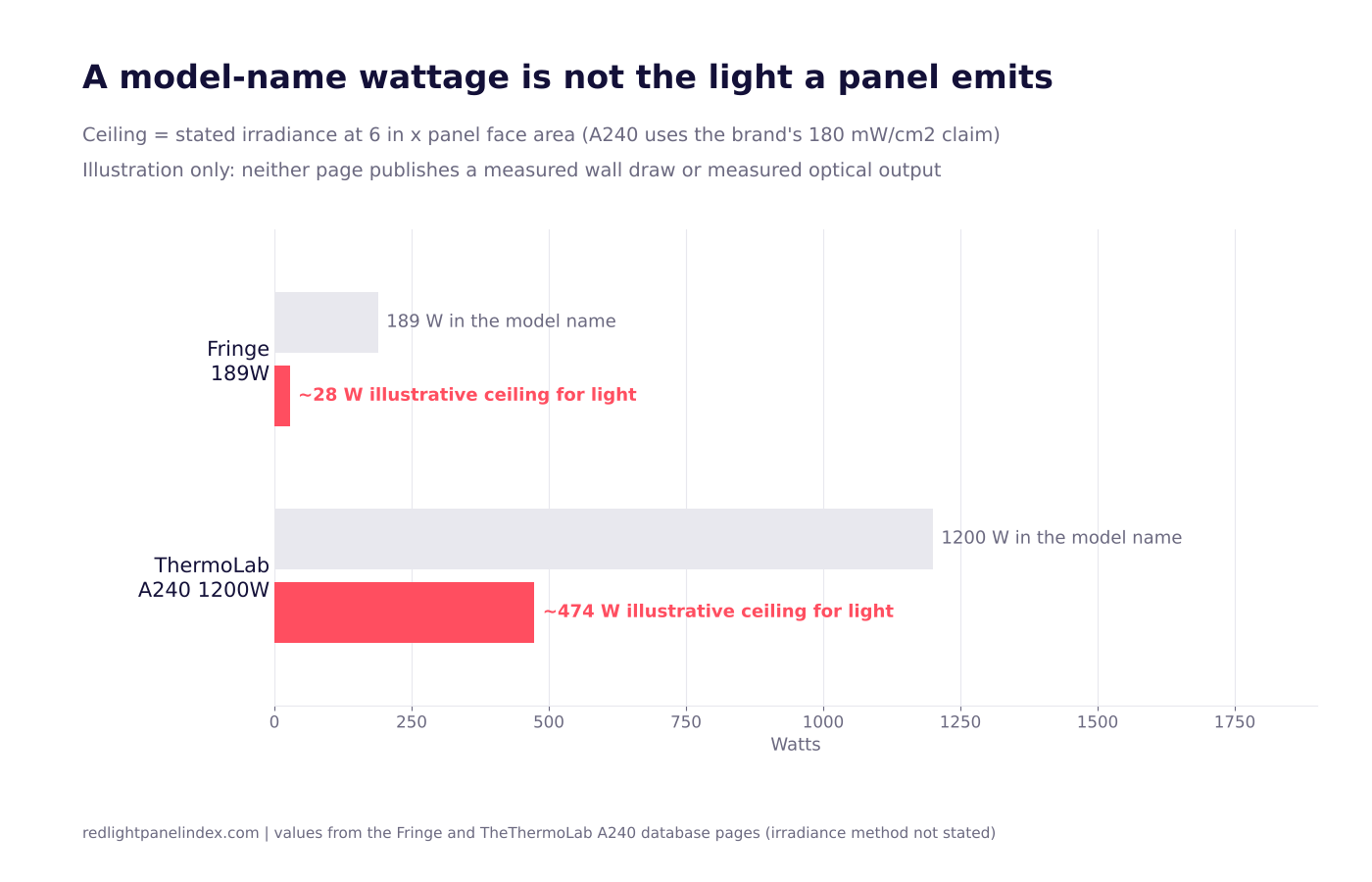
- Fringe 189W: the page gives 10.6 x 13.6 inches, about 930 cm2. At 30 mW/cm2 that is a ceiling of roughly 28 W of light, against 189W in the name.
- TheThermoLab A240 1200W: the page gives 94 x 28 cm, about 2,632 cm2. At the claimed 180 mW/cm2 the ceiling is roughly 474 W; at the halved working value of 90 mW/cm2 it is roughly 237 W. Either way, the name's 1200 is well above it.
These are illustrations, not measurements. They do not say what either panel draws from the wall, since the pages do not give that. What they do show is the order of magnitude: the light is a fraction of the number in the name, and different panels have different fractions. The irradiance explainer covers why a figure only means something with its method and distance attached.
What actually matters for your session
Your skin responds to light arriving per unit of area over time, which is dose, not to the panel's wattage. So the number to look for is irradiance at the distance you will use, with a stated method, and the number to compute is dose.
For example, the A240 page notes that at its claimed 180 mW/cm2, 10 J/cm2 takes about one minute and 60 J/cm2 about six. At the halved working figure those times roughly double. The dose calculator does this arithmetic for any irradiance, distance and time, and the joules per cm2 explainer covers what the units mean.
Coverage matters too. A larger panel emits more total light but spreads it over more area, so total optical power and irradiance answer different questions; the treatment area page shows how to match a panel to the body area you want to cover.
Where wattage does matter
Electrical power is not useless. It tells you what the panel costs to run (see how much electricity a red light panel uses for worked monthly figures), since the draw times hours of use is energy on your bill, and it affects how much heat the panel gives off and what circuit it needs. Running cost is a separate question from light output, and the wattage in a name is a rough hint at the electrical side only when the brand confirms it is a rated draw. Wattage that appears only in a model name, as on the three pages above, is a label and not a spec.
A short checklist for reading wattage claims
- Ask what the number refers to: wall draw, summed LED ratings, or just a name.
- Look for irradiance at a stated distance with a stated instrument.
- Check whether the method is a spectrometer or a solar meter; the two can differ by about a factor of two on the same panel.
- Compare panels on irradiance and dose, and treat wattage as a clue to running cost, not light output.
- If the page gives no irradiance method, assume the working value is lower than the headline. The guide to checking an irradiance claim yourself shows how to test it, and the irradiance label guide explains the labels used on this site.
The short version: wattage describes what goes in, irradiance describes what comes out, and a panel is bought for what comes out.