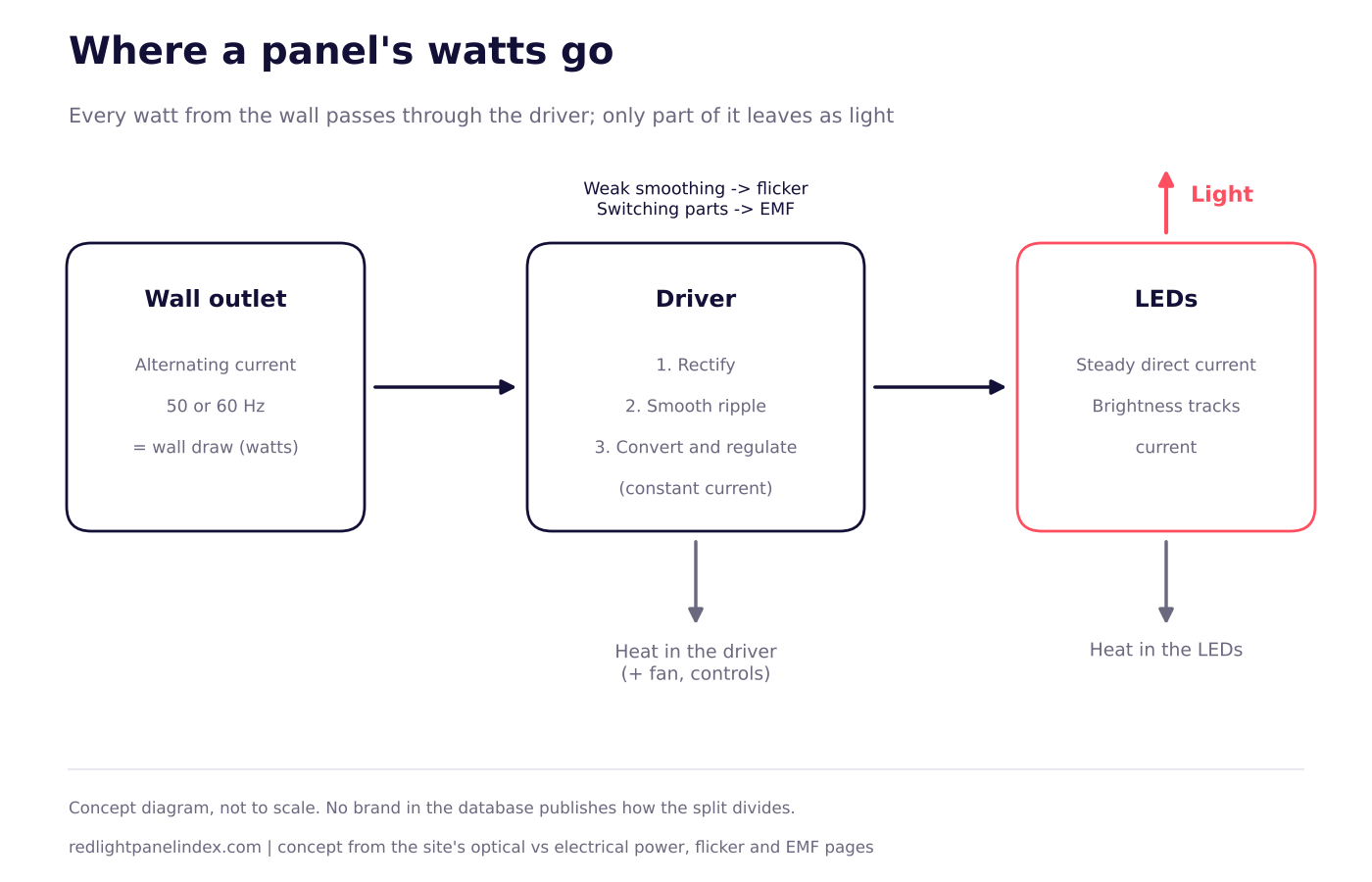
An LED driver is the power supply inside a red light panel that turns the alternating current from your wall outlet into the steady, regulated current the LEDs need. Every watt the panel draws passes through it, and the driver is one of the two places (with the LEDs themselves) where electrical power becomes heat instead of light, which is why the wall-draw figure on a spec sheet is never the panel's light output.
Choosing a panel? Our ranking of the best red light therapy panels is computed from published, method-labeled specs across 188 devices. For driver quality, the spec that matters is measured irradiance at a stated distance, because no wattage figure tells you how much of the power ends up as light.
What the driver actually does
A wall outlet supplies alternating current at a fixed voltage that reverses direction 50 or 60 times a second, depending on the country. LEDs want the opposite: a direct current that flows one way, at a low voltage, held at a steady level. The driver bridges the two in a few steps:
- Rectify. It converts the alternating current into current that flows in one direction.
- Smooth. It filters out the ripple that rectification leaves behind. How well it does this decides whether the light flickers.
- Convert and regulate. It steps the power down to what the LED strings need and holds it there as the LEDs warm up and as the wall supply wobbles.
Most panels use a switching-type driver, which does the conversion by switching current on and off very rapidly. That switching is also the source of the low-frequency magnetic field covered on the EMF page. Panels with a fan, a control board or a touchscreen feed those from the same supply, so a share of the wall draw never reaches an LED at all.
Constant current versus constant voltage
This is the one piece of driver jargon worth knowing, because it explains why LED drivers exist at all.
An LED is a current-driven device. Its brightness tracks the current flowing through it, and a small change in the voltage across it produces a large change in that current. On top of that, as an LED warms up it passes more current at the same voltage. Fed from a plain fixed-voltage supply with nothing to limit the current, a warm LED draws more current, which makes it warmer still. That is the reason LEDs are not simply wired to a battery-style supply.
There are two common answers:
- Constant-current driver. The driver measures the current through each LED string and adjusts its output voltage to hold that current fixed. Brightness stays stable as the panel heats, and the LEDs are protected from running away. This is the usual design for high-power LED arrays.
- Constant-voltage supply. The supply holds a fixed voltage, and something downstream (a resistor in each string, or a small regulator on the LED board) limits the current. It works, and it is common in LED strips, but resistors waste power as heat by design, and the current is less tightly held as temperature changes.
Neither label tells you how bright a panel is. A constant-current driver run hard and a constant-voltage design run gently can produce very different light from the same LEDs. The LED chip page notes that driver current sets a panel's total optical power; the driver type describes how steadily that current is held, not how much of it there is.
Where the watts go
Energy is conserved, so every watt drawn from the wall leaves the panel as one of three things:
- Light from the LEDs, the only part that matters for a session.
- Heat in the LEDs. No LED converts all of its input to light. The rest warms the chip and the board behind it, which is why panels have heat sinks and often fans.
- Heat in the driver and other electronics. Conversion, regulation, the fan motor and any control board each take a share.
The split depends on the specific LEDs, the driver design and how hard the LEDs are run, and no brand in this site's database publishes it. The site therefore quotes no efficiency percentage for any panel; the optical versus electrical power page makes the same point from the light side. What the database does let you do is see the size of the gap.
A worked example from the database
The Fringe Red Light Therapy Panel 189W lists 63 LEDs at 3W each, which multiplies to the 189 in its name. Its page gives no power draw, input or driver information, so the 189 is a sum of LED ratings, not a measured draw. The same page gives a brand-stated 30 mW/cm2 at 6 inches with no measurement method, a panel face of 10.6 by 13.6 inches, and a price of $450 (verified 2026-08-13).
An upper bound on the light can be worked out the way the irradiance versus total power page does it, by multiplying irradiance by face area:
- 10.6 x 13.6 inches is about 144 square inches, or about 930 cm2.
- 930 cm2 x 30 mW/cm2 is about 28,000 mW, or roughly 28 W of light, as a ceiling.
- The site treats about half of an unstated-method figure as the working value. At 15 mW/cm2 the ceiling is roughly 14 W.
So the name says 189 and the light ceiling sits somewhere between about 14 and 28 W. The rest of the gap is a mix of things the page cannot separate: LEDs run below their rating, heat in the LEDs, and losses in the driver. The arithmetic does not tell you the driver's efficiency, and it should not be read that way. It shows why a wattage figure, whether it is a name, a rating sum or even a true wall draw, cannot stand in for light output.
A second example points the same way. The TheThermoLab A240 1200W lists 240 LEDs, and 1,200 divided by 240 is 5 W per LED, which fits a sum of LED ratings; the page itself does not explain the 1200, and it lists no power draw or driver details. Its brand-stated 180 mW/cm2 at 6 inches (method not stated) over a 94 by 28 cm face, about 2,632 cm2, gives a light ceiling of roughly 474 W, or roughly 237 W at the halved working value. Price $855 (verified 2026-08-13).
The two driver effects you can notice
Most driver behavior is invisible, but two effects reach the user.
Flicker. If the smoothing step is weak, mains ripple leaks through and the light brightens and dims at twice the mains frequency, 100 or 120 times a second. It is a comfort question, not a therapeutic one; the flicker explainer covers how it is measured and the phone-camera check. No brand in the database publishes a measured flicker figure.
EMF. Current in the driver's wiring and its switching parts, plus the fan motor, produce a low-frequency magnetic field near the housing. A handful of brands publish a reading at a stated distance; the EMF page tabulates them.
There is a third, slower effect: heat, which the page on heat and thermal management in panels follows from the chip to the room. Heat in the driver and LEDs is a main reason LED output fades over time, and the driver is one of the parts more likely to fail before the LEDs do, as the LED lifespan page explains. A warm panel is showing you the share of the wall draw that did not become light, which the thermal versus photochemical page separates from the light's own effect on tissue.
Why the wall draw still matters
The wall draw is not useless. It sets running cost, which the electricity cost guide works through and which turns out to be small, and it tells you how much load a panel puts on a household circuit. A true rated input, printed on the label or in the manual, is also the only honest starting point for that arithmetic. What it cannot do is rank panels by light. For that you need irradiance at a stated distance with a stated method, explained on the irradiance page, and the session arithmetic in the dose calculator.
What to look for on a spec sheet
- What the wattage means. A rated input (wall draw), a sum of LED ratings, or just a number in the name. Only the first is what your meter counts.
- Rated input on the label. Volts, frequency range and watts or amps. It is the best running-cost figure short of a plug-in power meter.
- Driver type, if stated. "Constant-current" is a reasonable sign of a design built for LEDs, but it is a description, not a measurement.
- A flicker or EMF figure. Rare. Where one appears, check the distance and instrument.
- Measured irradiance with a method. The number that actually describes the light. If a page gives wattage but no irradiance method, the claimed versus measured page explains how far apart those can be.
- Warranty. Since the driver is one of the more likely parts to fail, the length of cover matters more than an LED-hour rating.
The short version: the driver decides how cleanly and steadily power reaches the LEDs, and how much is lost on the way. The spec sheet usually does not say how well it does that, so judge the light by measured irradiance and treat the wattage as a running-cost figure.