Red light therapy is not meant to be a heating treatment: photobiomodulation is the idea that light absorbed by specific molecules in cells changes how those cells behave, a photochemical route, while heating is a separate route that any lamp or space heater can produce. A panel still gives off some warmth, because no LED turns all of its input into light, so the useful questions are how much warmth you should expect, how it can muddy a study or a home experiment, and the few situations where heat is a real concern.
Choosing a panel? Our ranking of the best red light therapy panels is computed from published, method-labeled specs across 188 devices. For heat, the spec that matters is measured irradiance at a stated distance, because that number sets both the light dose and how warm the skin feels.
Two things light can do when tissue absorbs it
Light only does something to tissue if something absorbs it. Once a photon is absorbed, its energy goes one of two ways:
- Photochemical. The energy drives a change in the absorbing molecule. The working idea behind photobiomodulation is that cytochrome c oxidase in the mitochondria absorbs red and near-infrared light, which is then proposed to set off downstream signaling. Our pages on cytochrome c oxidase and on chromophores cover which molecules are involved.
- Thermal. The energy ends up as molecular motion, which is heat. Water and many other molecules absorb light this way, and it is the dominant route for the longer wavelengths used in heat lamps and saunas. Our guide to red light panels vs infrared heat lamps compares the two designs.
Both can happen at once. Any absorbed light that does not drive a chemical change becomes a little heat, so "non-thermal" is best read as "the effect of interest is not caused by raising tissue temperature", not as "no warmth at all". The field's standard review of mechanisms and dosimetry, "The nuts and bolts of low-level laser (light) therapy" (PMID 22045511), covers the cellular mechanisms and the light sources and dosing principles used in the field. A broader walk through the proposed chain of events is in our review of Hamblin's anti-inflammatory mechanisms paper and the explainers on mitochondria and ATP and reactive oxygen species.
Why "is it just heat?" is a fair question
Warmth feels good, increases local blood flow and loosens stiff muscles, and people have used heat for comfort for as long as there has been fire. So when someone reports that a panel session made a sore area feel better, heat is a reasonable alternative explanation. It is a fair challenge, and it is the reason serious trials use a sham control: a device that looks and feels the same, including any warmth, but does not deliver the active dose. Our page on sham-controlled trials explains why that matters. If a study compares red light only with no treatment, warmth, attention and expectation are all mixed into the result.
The two routes also use different hardware. A red light panel's LEDs sit at narrow peaks, commonly 660 nm and 850 nm, chosen to reach the target molecules. An infrared sauna heater is a broad-band emitter built to warm the skin surface. The panel vs infrared sauna guide sets the two side by side, and the page on red vs near-infrared explains why the near-infrared band behaves differently from visible red.
How much warmth does a panel produce?
The honest answer is "some, and it depends on the panel and the distance". The database does not hold skin temperature measurements, so there is no number to quote here; the figures it does hold are irradiance in mW/cm2 at a stated distance, which you can read on the irradiance page. What can be said without a figure:
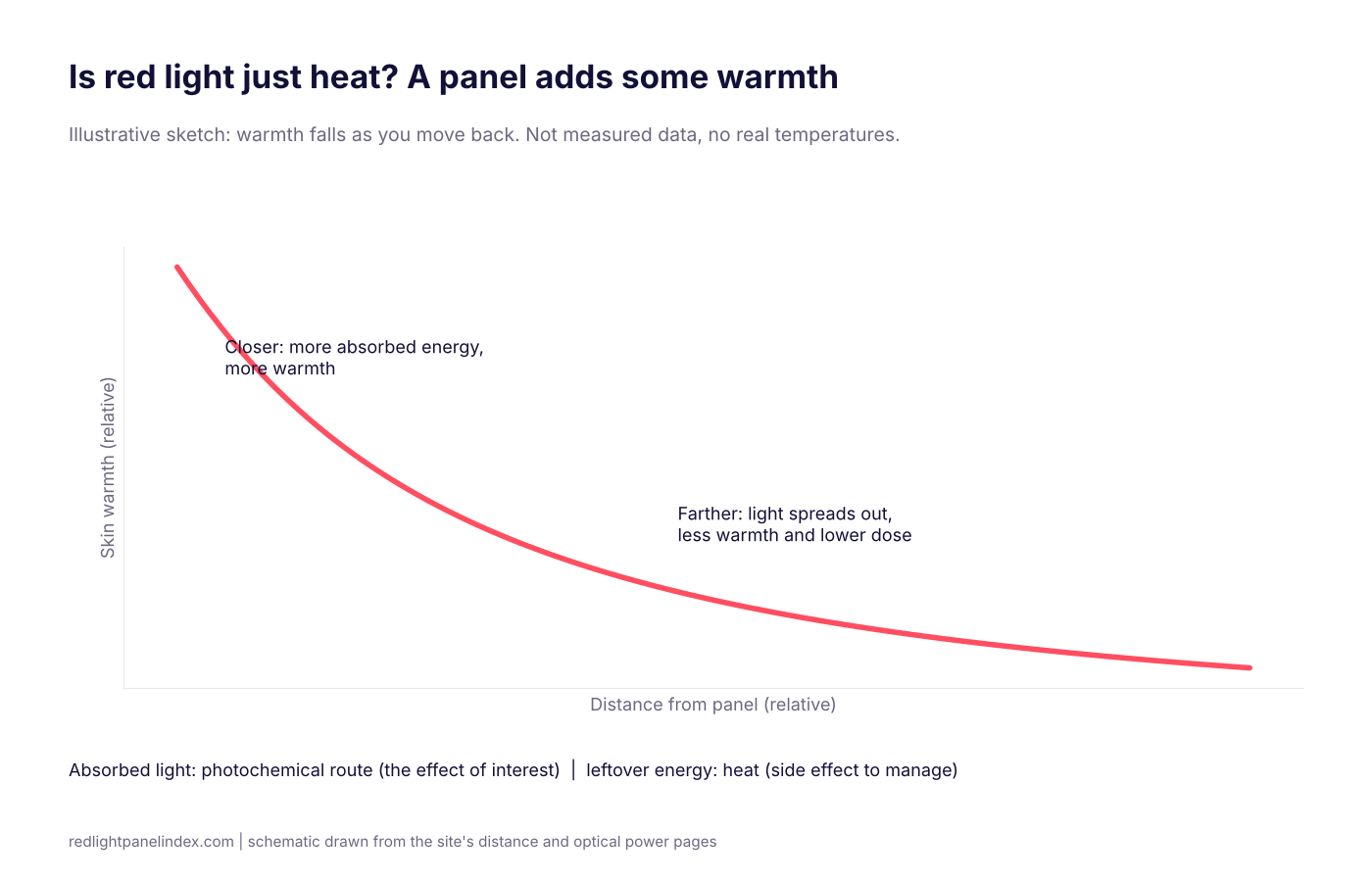
- Warmth tracks irradiance and distance. More optical power on a patch of skin means more absorbed energy and more warmth. Light spreads as you move away, so the same panel feels cooler at a longer working distance; our inverse square law explainer shows how quickly intensity falls, and the distance guide covers practical placement.
- The panel itself is a heat source. The wattage in a product name is electrical. Whatever is not emitted as light leaves as heat in the LEDs and the driver, as explained in optical vs electrical power. A panel that feels warm to the touch is showing that part of the budget, and the same heat affects how long LEDs last, as covered in LED lifespan.
- Near-infrared is easy to underestimate. You cannot see 850 nm, so a session can feel mild while delivering a full dose. Skin warmth is common with strong near-infrared. The 850 nm page suggests backing off to a longer distance if skin feels warm.
- Pulsing changes the average, not just the peak. Pulsed output has off-time between pulses. The review summarized on our pulsed vs continuous page reports pulsed light causing no measurable change in the temperature of the irradiated area at an equivalent energy density, and our duty cycle explainer covers how duty cycle and frequency appear on spec sheets.
The practical rule is simple: gentle warmth is expected, and warmth you would not accept from a heating pad is a signal to move back or shorten the session. Use the dose calculator to set session time from irradiance and distance, rather than adding time because a session feels cool.
When heat becomes a confounder
Heat gets in the way of interpretation in three common situations:
- Reading a trial. If the sham device does not match the warmth of the active one, participants may guess which arm they are in, and warmth alone can shift pain or stiffness scores. A well-built sham matches look, sound and feel.
- Running your own test. If you try a panel for a sore joint and feel better, you cannot tell whether the light, the warmth, the rest or the attention did it. A fair self-test changes one thing at a time and uses a consistent distance.
- Comparing devices. A panel that feels hotter is not necessarily delivering more useful light. It may simply be less efficient, with more of its electrical input leaving as heat. Compare measured irradiance, not how warm it feels.
When heat becomes a hazard
Heat is not a concern for most healthy adults at sensible distances, but there are cases where it is.
Reduced skin sensation. Warmth is a safety signal only if you can feel it. People with reduced sensation, for example from neuropathy, may not notice a build-up of heat. The site's neuropathy evidence page covers what is known about light for nerve problems; for heat, the practical advice is to use a longer distance and shorter sessions, check the skin afterward, and ask a clinician before starting.
Heat-sensitive tissue. The testes are the standard example. They sit outside the body because sperm production needs temperatures below core body heat, and a review of testicular heating and male infertility (PMID 7591190) summarizes how raising testicular temperature impairs spermatogenesis. A high-output panel aimed at the groin adds radiant heat to a heat-sensitive organ. Our testosterone evidence page and the study review of what exists found no controlled human trial showing a benefit, so the plausible harm is not offset by a proven gain, and aiming a panel there is a use to avoid.
Other situations. Pregnancy, photosensitizing medication and eye exposure each have their own guidance in the pregnancy guide and the eye protection guide, and the safety and side effects page pulls the main cautions together. Persistent heat, redness or pain after a session is a reason to stop and ask a clinician.
What the evidence does and does not say about heat
No trial summarized on this site isolates heat from light for a home panel, so the claim that benefits are "not just heat" is a mechanism-based position backed by sham-controlled designs, not a measured result for any specific panel. Equally, there is no basis for the claim that a panel is a replacement for a sauna or a heating pad. If heat is what you want, a heating pad is cheaper. If a specific photobiomodulation outcome is what you want, look at the trials and at the dose delivered, and treat warmth as a side effect to manage.
Bottom line
Red light therapy is defined by absorbed light changing cell behavior, not by heating tissue, but every panel makes some warmth and that warmth can mislead you in trials and at home. Choose panels by measured irradiance at a stated distance, set session length with the dose calculator, back off if skin gets uncomfortably warm, and keep panels away from heat-sensitive areas such as the groin, particularly if skin sensation is reduced.