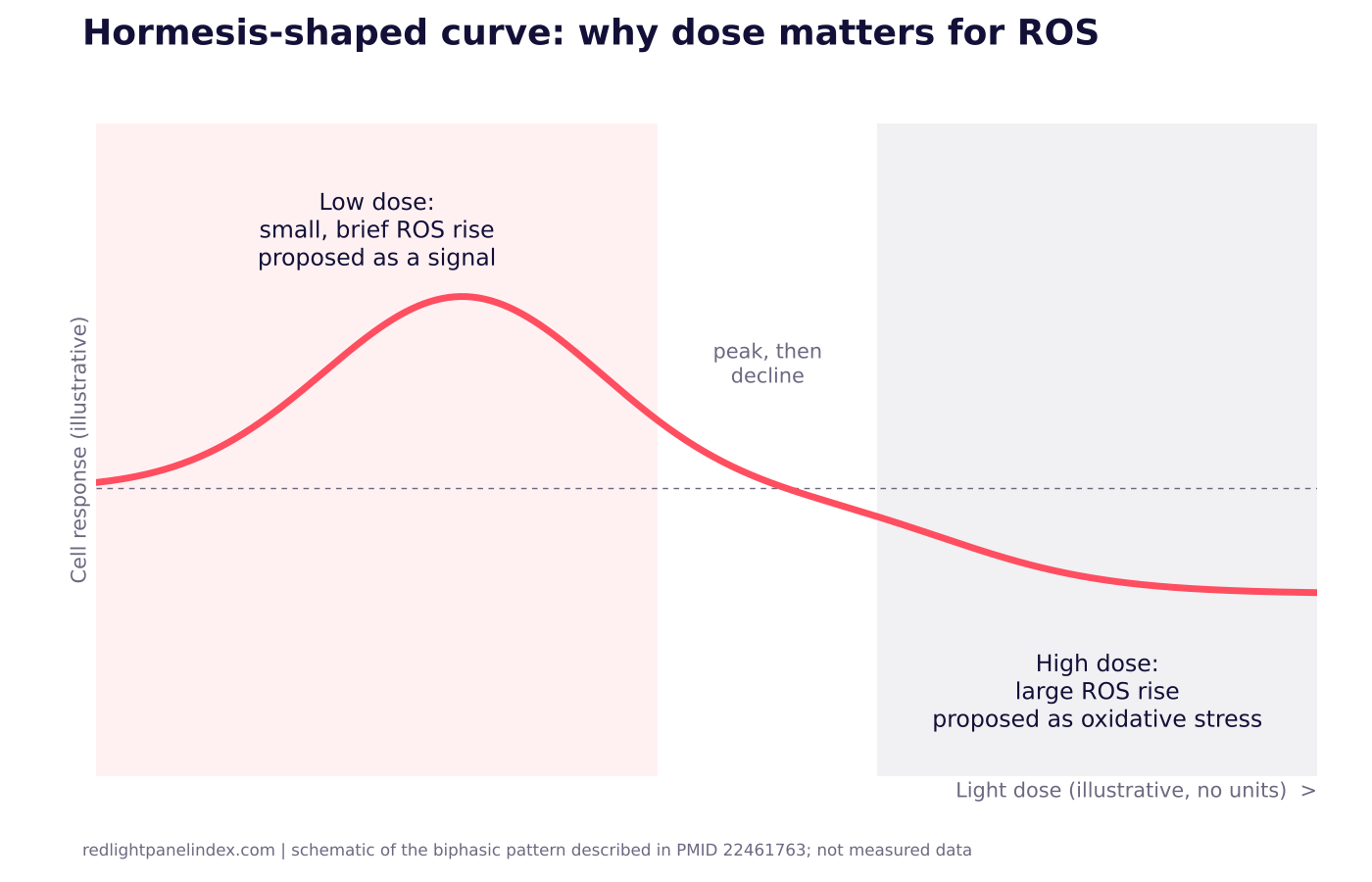
Reactive oxygen species (ROS) are small, highly reactive oxygen-containing molecules that cells make all the time. In the photobiomodulation literature, the proposal is that a brief, small rise in ROS after red or near-infrared light acts as a signal, while a large and sustained rise at high doses is damaging oxidative stress; this is a proposed mechanism seen in cell studies, not something demonstrated in people.
Choosing a panel? Our ranking of the best red light therapy panels is computed from published, method-labeled specs across 188 devices. For any dose-related mechanism, the spec that matters is method-labeled irradiance, because it is what lets you control the dose you deliver.
What ROS are, in plain terms
Cells that burn fuel with oxygen leak a little of it as ROS. The term covers molecules such as superoxide and hydrogen peroxide. Two things are true at once, and the whole topic rests on holding both:
- ROS are a normal part of how cells talk to each other. At low levels they act as short-lived messages that switch signaling pathways on.
- ROS in large amounts damage proteins, fats and DNA. That is what people usually mean by "oxidative stress."
The mitochondria, the part of the cell covered on the mitochondria and ATP page, are the main place ROS are produced. Red and near-infrared light is proposed to act on an enzyme in that chain, as described on the cytochrome c oxidase page, which is why ROS keep appearing in mechanism write-ups.
What the mechanism reviews say
The de Freitas and Hamblin review of proposed mechanisms (PMID 28070154) lays out photobiomodulation as a sequence: light is absorbed, mitochondrial activity shifts, and signaling molecules such as ATP, nitric oxide and ROS change, which in turn alter gene transcription and cell behavior. In that picture ROS are a secondary messenger, one link between the photon and the downstream cell response, not the goal in themselves. The site's nitric oxide page covers the other main signaling candidate.
The key point for readers is the label on that link: it is a proposal. Reviews of this kind assemble findings mostly from cultured cells and animal models. They do not show that the same ROS signal occurs in the tissue under a home panel.
The "Janus" idea and the triphasic ROS curve
The 2011 update on biphasic dose response (PMID 22461763) is where the two-faced nature of ROS is spelled out. Its abstract refers to "the Janus nature of reactive oxygen species," after the two-faced Roman god. The authors report that some in vitro measures, such as ATP and mitochondrial membrane potential, follow a biphasic pattern with dose. Mitochondrial ROS, in contrast, show what they call a triphasic dose-response with two distinct peaks.
In the main text the authors go a step further and hypothesize that there are two kinds of ROS. "Good ROS" are produced at fairly low fluences of light, tied to mitochondrial electron transport. "Bad ROS" appear at higher fluences. In their neuron experiments, as the fluence rose the beneficial ROS output fell, then a second, larger ROS peak appeared, and that second rise coincided with the membrane potential dropping below baseline, which they interpret as mitochondrial damage. They also cite earlier work in which relatively high light doses triggered cell death through ROS-mediated pathways, and they raise the possibility that nitric oxide at high concentrations could add to the harm.
Treat this as a hypothesis the authors offer to explain why the dose curve bends, not as a measured human threshold. The review is also candid that part of the difficulty is deciding what "dose" even means: researchers disagree on whether fluence, irradiance or illumination time is the right metric.
Where hormesis fits
Hormesis is the general principle that a small dose of something stressful can trigger a beneficial adaptive response while a large dose of the same thing does harm. Exercise is the familiar example: a moderate workout strengthens you, an excessive one injures you.
The photobiomodulation papers above do not use the word "hormesis." They describe a biphasic dose response, historically called the Arndt-Schulz pattern, which has the same shape. Reading the ROS proposal through a hormesis lens is a reasonable way to understand it, but it is an interpretation layered on those papers, not a claim they make. The site's page on the biphasic dose response goes through the curve itself and the trial evidence that surrounds it, and the Huang review study page summarizes the two source reviews.
Signaling ROS versus damaging oxidative stress
Because the same word covers both ends of the curve, it helps to compare them directly.
| Signaling-level ROS | Oxidative stress | |
|---|---|---|
| Size and timing | Small, brief rise | Large or sustained rise |
| Role in the proposal | Message that activates repair and signaling pathways | Damage to mitochondria and other cell parts |
| Where it sits on the dose curve | Low dose, rising part | High dose, falling part |
| How well it is shown | Cell and animal studies | Cell and animal studies |
Two cautions follow from the table. First, nobody has measured ROS inside human tissue during a home panel session and shown which side of the curve it lands on. Second, "antioxidant" does not mean "good" in this context: if ROS are part of the signal, the idea that more antioxidant is always better is not something this literature tests. This page makes no claim either way about supplements.
What this does and does not tell you about a home panel
The practical lesson is modest and matches the rest of the site: more light is not automatically better, and the dose should come from a published trial figure, not from a feeling that longer must be stronger.
- Aim for a stated dose. Session length is target dose divided by measured irradiance, and the dose calculator does that arithmetic. The joules per cm2 page explains the unit.
- Trust irradiance only when its method is stated. The irradiance page explains why a spectrometer reading and a solar meter reading of the same panel can differ.
- Do not read the ROS mechanism as a reason to extend sessions. If the proposal is right, overshooting is the direction that moves away from the signaling zone.
- Do not read it as proof a panel works for any condition. Health claims should rest on condition-specific trials; see the evidence hub and the safety and side effects page.
The site's guide to how often to use red light therapy applies the same idea to frequency, and the myths checked page tests common claims against the trials.
What was not shown
- No trial reviewed here measured ROS in human tissue after home-panel exposure.
- The "two kinds of ROS" idea is a hypothesis from cell work, and the authors present it as one.
- The reviews do not give a joules-per-cm2 ceiling that applies to consumer panels.
- Whether the ROS signal is necessary for any clinical benefit is not established.
Bottom line
ROS appear in the photobiomodulation literature as one proposed messenger between light and cell response, small and short-lived at low doses and damaging at high ones. That fits the biphasic curve and gives a mechanistic reason to dose to a trial figure and stop, but it remains a proposed mechanism from cells and animals. Use it to understand why dose matters, not as evidence that any particular panel or session will work.