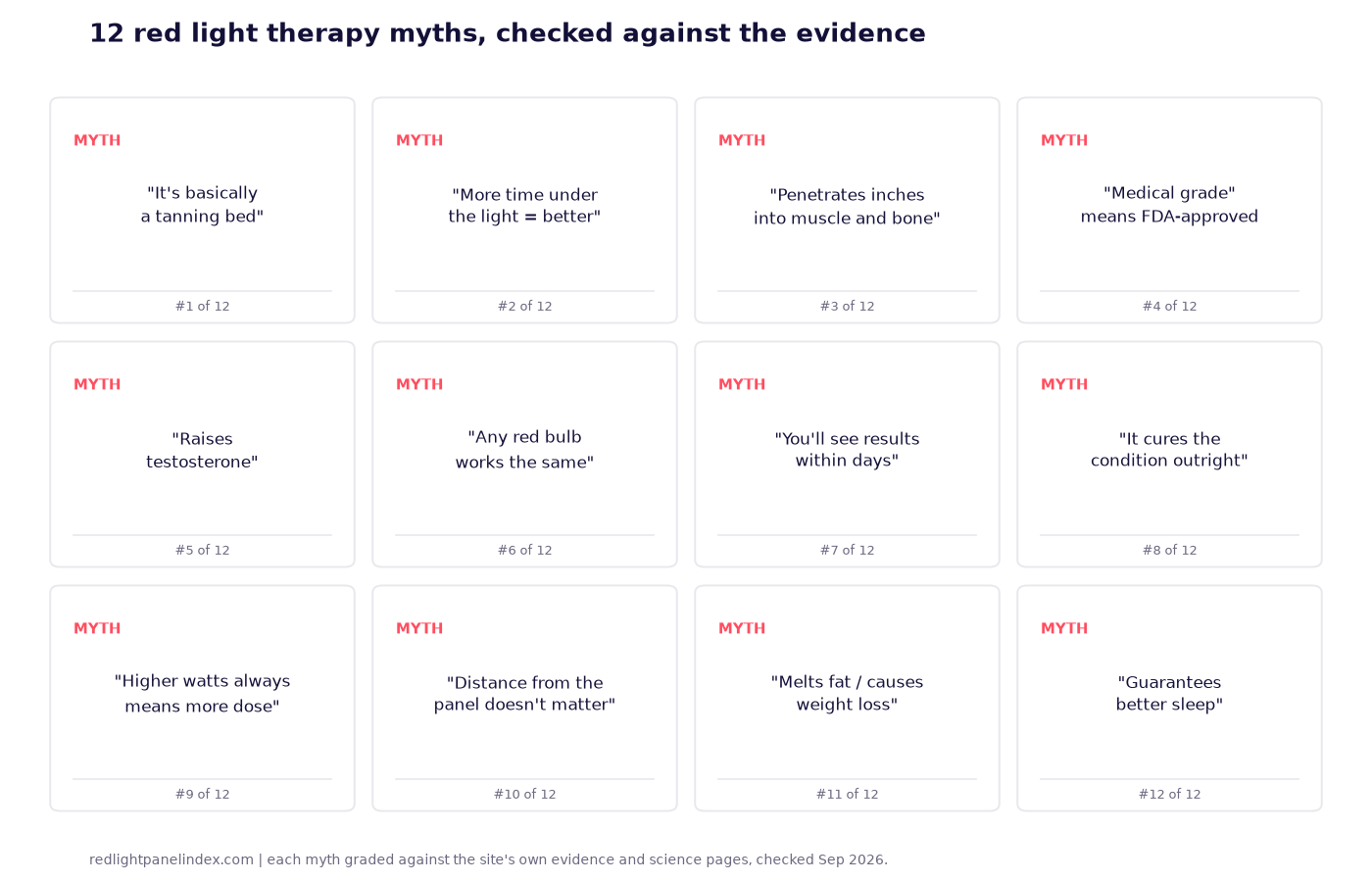
Most red light therapy myths trace back to a real finding, stretched past what it actually shows. The twelve below each get a straight verdict and a link to the page where the underlying evidence, or its absence, is covered in full.
Choosing a panel? Our ranking of the best red light therapy panels is computed from published, method-labeled specs across 188 devices. For separating a real claim from a myth, the spec that matters is whether a number on the page traces to a measured figure or just a marketing adjective.
1. "It's basically a tanning bed"
False. Tanning is a UV-driven response: UVB radiation damages keratinocyte DNA, which triggers a p53-mediated release of alpha-melanocyte-stimulating hormone that in turn drives melanocytes to produce more melanin. Red and near-infrared panels are not built to emit UV at any meaningful level; the wavelengths this site's database tracks sit at 630 to 1064 nanometers, well past the UV range that mechanism depends on. Whatever a red light panel does to skin, it is not doing it through the pathway that darkens skin in a tanning bed. This site's wavelength guide covers what each band panels actually use is chosen for instead.
2. "More time under the light always works better"
False, and this is the myth with the clearest mechanistic backing. Photobiomodulation follows a biphasic dose-response curve: a low dose stimulates and repairs cells, but past a certain point more light stops helping and can work against the same effect, a pattern two mechanistic reviews describe at the cellular level through reactive oxygen species that act as helpful signals at low concentrations and harmful agents at high ones (PMID 20011653, PMID 22461763). Neither review hands down one universal ceiling number for every wavelength and tissue, which is why this site's biphasic dose response explainer treats a trial's published dose as the target to hit, not a floor to exceed by sitting longer.
3. "It penetrates inches into muscle and bone"
False. Two inches is roughly 51 millimeters. Computational modeling of light transport through skin puts the deepest calculated reach for the longest wavelengths panels commonly use at about 5.4 millimeters, ten times short of two inches, and direct measurement of near-infrared light passing through skull and brain tissue found only single-digit percentages of surface energy remaining at 3 centimeters, and that only at power levels far above a home panel's output. This site's penetration depth page covers both studies and why marketing claims that quote a number of inches, without naming wavelength, power and the fraction of surface intensity that number describes, go well past what either study measured.
4. "'Medical grade' means it's FDA-approved"
False. "Medical grade" has no FDA definition and is not a status the agency grants; a device can carry the phrase while holding only FDA-registered status, an unverified clearance claim, or no FDA status at all. This site's audit of the phrase across 41 brands found zero panels with a public 510(k) clearance number, the only credential that would actually support a claim of FDA review.
5. "It raises testosterone"
Insufficient evidence, and what exists points the wrong direction for the marketing claim. No controlled human trial shows a red light panel raising testosterone in a healthy adult; the literature marketers lean on is a veterinary study treating rams with heat-induced testicular damage, where the lower of two tested laser doses actually reduced sperm motility and membrane integrity rather than improving function (PMID 26914685). A damaged-testis animal recovery model is not evidence for a healthy person using a consumer panel. This site's testosterone evidence page covers the full gap between the animal literature and the human claim.
6. "Any red bulb or LED strip works the same as a panel"
False. The evidence base behind red light therapy is built on specific narrow wavelength bands, not the general color red; a panel's LEDs emit a tight peak around 660 or 850 nanometers, while an incandescent bulb or a decorative red LED strip spreads its output across a much broader, dimmer spectrum with far less power concentrated at the wavelengths the trials actually used. This site's wavelength guide covers why the site's evidence pages record the specific band each cited trial used, since that is the only reliable way to match a device to a study, and a bulb with no published irradiance figure at a therapeutic wavelength cannot be compared to a panel's spec sheet at all.
7. "You'll see results within days"
False for nearly every condition this site has reviewed. Across the skin, hair, joint pain and sleep trials this site cites, the earliest reported significant result showed up at 14 to 16 weeks of consistent use in most of them, with one fibromyalgia trial that checked partway through finding no measurable difference at the halfway mark before a large effect appeared by the end of the course. This site's results timeline guide covers what each trial actually measured and when; the one exception is pre-exercise performance, where a single session before a workout shows a measurable same-day effect.
8. "It cures the condition outright"
False as a general claim, and this site avoids the word for a reason. Even where the evidence grade is Strong, as it is for joint pain, trials report reduced pain and improved function as an addition to exercise and standard care, not a cure; the same page notes plainly that photobiomodulation "does not reverse joint damage or cure the underlying disease." Look for language like "was associated with" or "reported" on any evidence page rather than "cures," "treats," or "heals," since a trial showing a statistically significant improvement in a study population is not the same claim as a cure for an individual.
9. "A higher-wattage panel always delivers more dose to your skin"
False, unless the wattage is measured, not just claimed. Total wattage is a power-draw figure for the whole fixture; what reaches skin is irradiance, power density at a stated distance, and this site's own dataset has repeatedly found gaps between a panel's claimed output and its independently measured irradiance. A panel with a bigger wattage number on the box can still deliver less measured irradiance at the same distance than a smaller, better-disclosed panel. Use a method-labeled irradiance figure, not the wattage rating, when comparing two panels' actual dose potential, and run the number through this site's dose calculator rather than assuming watts and delivered dose move together.
10. "Distance from the panel doesn't matter"
False, though the relationship is gentler than a simple point-source falloff for most sitting distances. A flat panel loses intensity far more slowly than the inverse square law predicts until a user backs away several panel-widths, after which it starts following the law closely; at typical sitting distances of 6 to 24 inches from a 1 to 4 foot panel, moving back still causes a meaningful drop in irradiance, just not the three-quarters loss the strict inverse square law would predict at the same distance change. This site's inverse square law explainer covers where that near-field behavior ends and the standard falloff takes over, and the dose calculator only gives an accurate figure at the specific distance a panel's irradiance was actually measured.
11. "It melts fat or causes weight loss"
Insufficient evidence for the consumer claim, built on a narrow finding stretched well past what it shows. Clinic laser protocols have produced a modest, temporary reduction in the circumference of a treated area, not a loss of fat mass or body weight, and that circumference change reverses within weeks of stopping treatment. Body-contouring marketing built on that finding, and consumer home panels have no demonstrated weight-loss effect of their own at all. This site's weight loss evidence page covers the gap between the clinic laser literature and a home panel's claim.
12. "A session before bed guarantees better sleep"
Limited evidence, and "guarantees" overstates even the real finding. Red light avoids the melatonin suppression that blue light causes in the evening, and early trials report improved sleep measures from whole-body red light exposure, but the trial base is small and preliminary, well short of the joint pain or skin literature this site grades Strong or Moderate. This site's results timeline guide covers one of those trials in more depth, including how short its 14-night measurement window was, a preliminary result rather than a guarantee for a diagnosed sleep disorder.
What these twelve have in common
Nearly every myth above traces to a real study or a real regulatory status, narrowed to a specific population, dose, or definition, then generalized past that boundary in marketing copy. The fix is the same each time: check what the underlying trial or status actually measured, at what dose, in what population, rather than the adjective built on top of it.