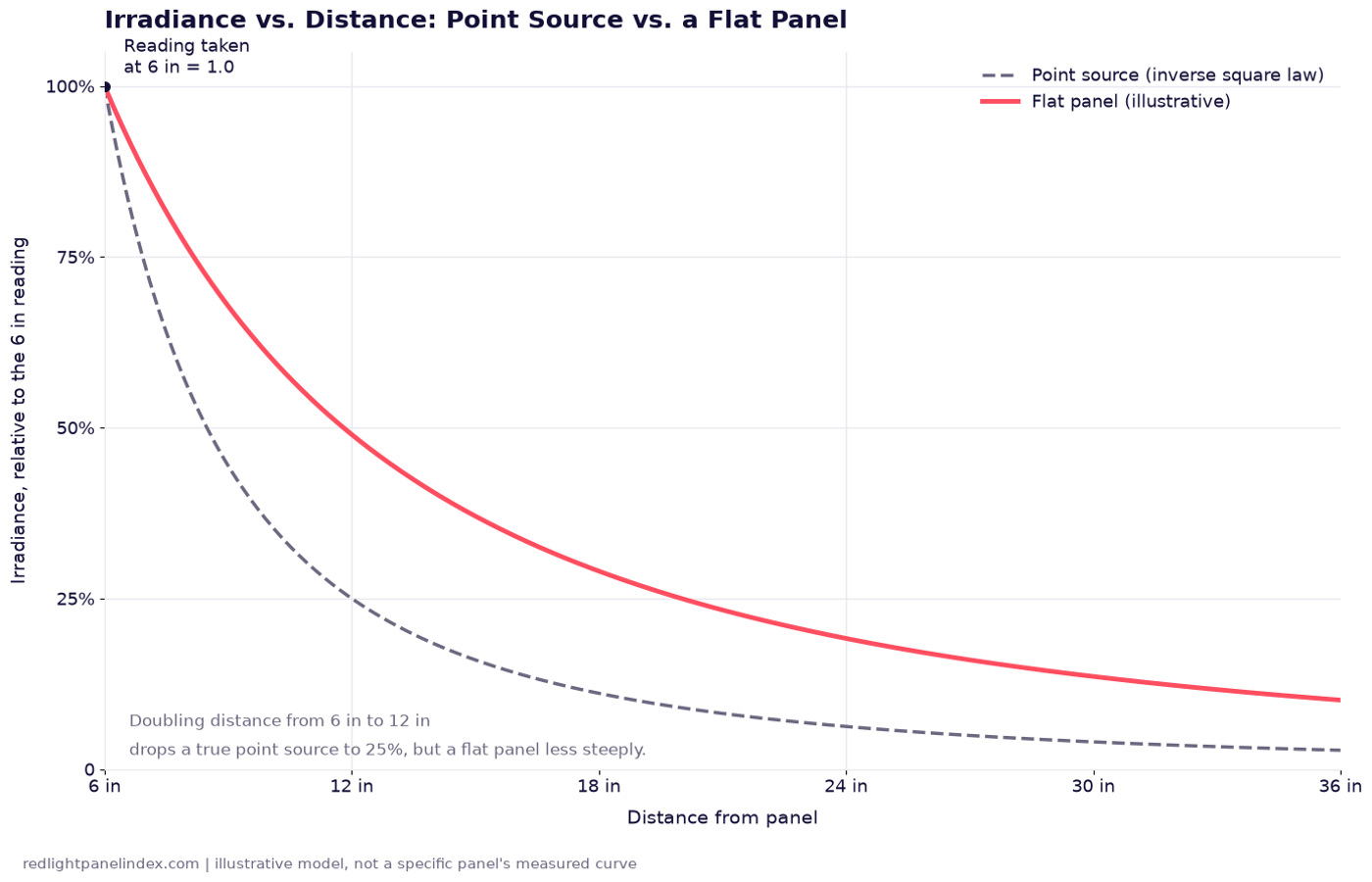
The inverse square law says that light intensity falls off with the square of distance from its source, so doubling the distance to a point of light cuts the intensity to a quarter, not a half. Red light panels are not points of light, though, and that difference matters a lot at the distances people actually sit from one: a flat panel loses intensity far more slowly than the law predicts until you back away several panel-widths, and then it starts to follow the law closely.
Choosing a panel? Our ranking of the best red light therapy panels is computed from published, method-labeled specs across 188 devices. For distance and dosing, the spec that matters is irradiance measured at the actual distance you plan to use.
What the law actually says
The inverse square law comes from basic geometry, not biology or optics specific to light therapy. A point source radiates light outward in a sphere, and the same total amount of light gets spread over a surface area that grows with the square of the radius. Move twice as far from a point source and the same light is now spread over four times the area, so each square centimeter receives one quarter as much. Move three times as far and it receives one ninth as much. The formula is simple: irradiance at a new distance equals irradiance at the old distance, multiplied by the ratio of the old distance to the new distance, squared.
This is exact for a genuine point source, a light with no meaningful physical size relative to the distance being measured, like a star or a single LED chip viewed from across a room. It is also the law behind why a flashlight beam that lights a whole room up close only lights a small patch of wall from across a football field.
Why a panel is not a point source
A red light therapy panel is a flat array, often a foot or two on a side, made up of dozens to hundreds of individual LEDs spread across its face. At the distances people actually use one, typically 6 to 24 inches, the panel is not small relative to that distance. A sensor sitting 6 inches from a 24-inch-wide panel is picking up light from LEDs spread across an area wider than the distance to the panel itself, not from a single point.
That geometry changes the falloff curve. Close to an extended source, moving back a few inches removes you from being directly in front of some of the LEDs without meaningfully changing your distance from others, so the total light reaching the sensor drops off more gently than the inverse square law predicts. Only once you are far enough back that the whole panel looks small relative to your distance, roughly three or more times the panel's longest dimension, does it start behaving like the point source the law assumes and the same doubling-distance-quarters-the-intensity relationship kicks in. Each LED's own beam angle plays into that near-field behavior too, since a narrower lens keeps an individual emitter's light concentrated into a smaller column for longer, which is part of why panels with a tighter published beam angle tend to hold a stronger reading at typical sitting distances than a similarly powered wide-angle panel does.
What this looks like in practice
<img src="/assets/img/uploads/inverse-square-law-20260917.webp" alt="Line chart comparing irradiance falloff with distance for a point source versus a flat panel">
The chart above illustrates the shape of the difference, normalized to a reading of 100 percent at 6 inches. A true point source, the dashed line, has already fallen to a quarter of its starting intensity by 12 inches and to about 4 percent by 24 inches. An extended source like a flat panel, the solid line, falls more gradually near the panel and only approaches the same steep curve much further out. This is an illustrative model of the general relationship, not a measured curve for any specific panel in this site's database, because almost no brand publishes irradiance at more than one distance; see what distance to actually sit from a panel for how to work with that limitation.
A worked example, and where it breaks down
Say a panel's independently measured irradiance is 90 mW/cm² at 6 inches, the kind of figure this site's irradiance page tracks from spectrometer testing rather than the higher number a solar power meter would print on the same panel. Applying the inverse square law literally, doubling the distance to 12 inches would predict 90 divided by 4, or about 22.5 mW/cm². That prediction only holds if the panel behaves like a point source at that range, and a foot or two away from a panel that is itself a foot or two wide, it mostly does not yet. The real drop is smaller than that, though this site cannot publish a real measured figure at 12 inches for that panel because the brands in the database do not test or publish one.
The law becomes more accurate the farther back you move. By the time you are standing several feet from the same panel, well past three times its longest dimension, the inverse square relationship is a reasonable approximation again, because from that far away the whole panel does look like a single small source of light.
The practical rule for doubling distance
Treat "doubling distance quarters the intensity" as a worst-case estimate, not a reliable prediction, at the short distances most people actually use a panel from. Close to the panel, expect a real drop that is smaller than a factor of four when you double your distance; the drop gets closer to that factor of four the farther you already are from the panel when you make the move. This is also why a panel's published irradiance figure is only useful at the exact distance it was measured, which is one reason this site does not extrapolate a single 6-inch figure into a distance table: doing so with the full inverse square law would understate the light you are actually getting up close, and any other model would be a guess dressed up as a number.
A quick way to tell where you are on the curve
You do not need the exact math to use this rule day to day. If your sitting distance is smaller than the panel's own longest side, you are in the gentle, near-field part of the curve, where the inverse square law overstates how much you lose by moving a few inches. If your sitting distance is larger than roughly three times the panel's longest side, you are in the steep, far-field part, where the law is a reasonable approximation. Most home use, sitting a foot or two from a two-to-four-foot panel, falls in the gentle zone, which is one more reason a single 6-inch figure cannot simply be divided by four to estimate a 12-inch reading.
What this means for dosing
The practical upshot is not that distance stops mattering, only that it matters less sharply at typical treatment ranges than the raw formula suggests. If you move from 6 inches to 12 inches, expect a meaningful drop in irradiance, and therefore a meaningful drop in dose for the same session length, but do not assume you have lost three quarters of the light. The only way to know your actual irradiance at your actual distance is a figure measured at that distance, and where that is not published, the dose calculator still gets you a usable number if you enter the irradiance figure for the closest distance a brand does report and treat anything calculated for a longer distance as an upper-bound estimate rather than a precise figure. For the specific question of which distance to pick for your goal, the distance guide walks through that decision using the irradiance figures brands actually publish, and irradiance versus total power covers the related question of how panel size, not just distance, changes what a single-point reading tells you.