"Medical grade" is not an FDA classification, a clearance level, or anything else with a legal definition; it is a marketing phrase a brand can print on a product page whether or not the FDA has reviewed the device at all. The only regulatory categories that actually exist for a home red light panel are FDA-registered, a listing of the manufacturer and device with no review of safety or effectiveness, and FDA-cleared, a specific 510(k) review with a public K-number, and no rectangular red light panel in this site's 41-brand database holds the second one.
Choosing a panel? Our ranking of the best red light therapy panels is computed from published, method-labeled specs across 188 devices. For a regulatory claim like "medical grade," the spec that matters is whether the brand's own page names an actual FDA status or just the phrase.
What the FDA categories actually mean
This site's own FDA-cleared versus registered explainer lays out three tiers. FDA-registered means "the manufacturer told the FDA the device exists and paid an establishment fee," with "no review of whether the device works or is safe." FDA-cleared, through the 510(k) pathway, means "the FDA reviewed the device and agreed it is substantially equivalent to a legally marketed predicate," and comes with "a public K-number you can look up." FDA-approved is a "still-higher bar reserved for high-risk devices" that does not apply to consumer red light products at all. None of the three is the same thing as "medical grade," because "medical grade" does not appear in any FDA regulation governing these devices; it is not a status the agency grants, and a device can carry the phrase while holding no FDA status whatsoever.
The same explainer page notes that where 510(k) clearance does exist in this category, it belongs to a different form factor entirely: face masks, hair-growth caps and drape devices cleared for a specific indication such as wrinkles, acne or alopecia, not the full-size or tabletop rectangular panels most of this site's database tracks.
What 41 brands' own pages actually say
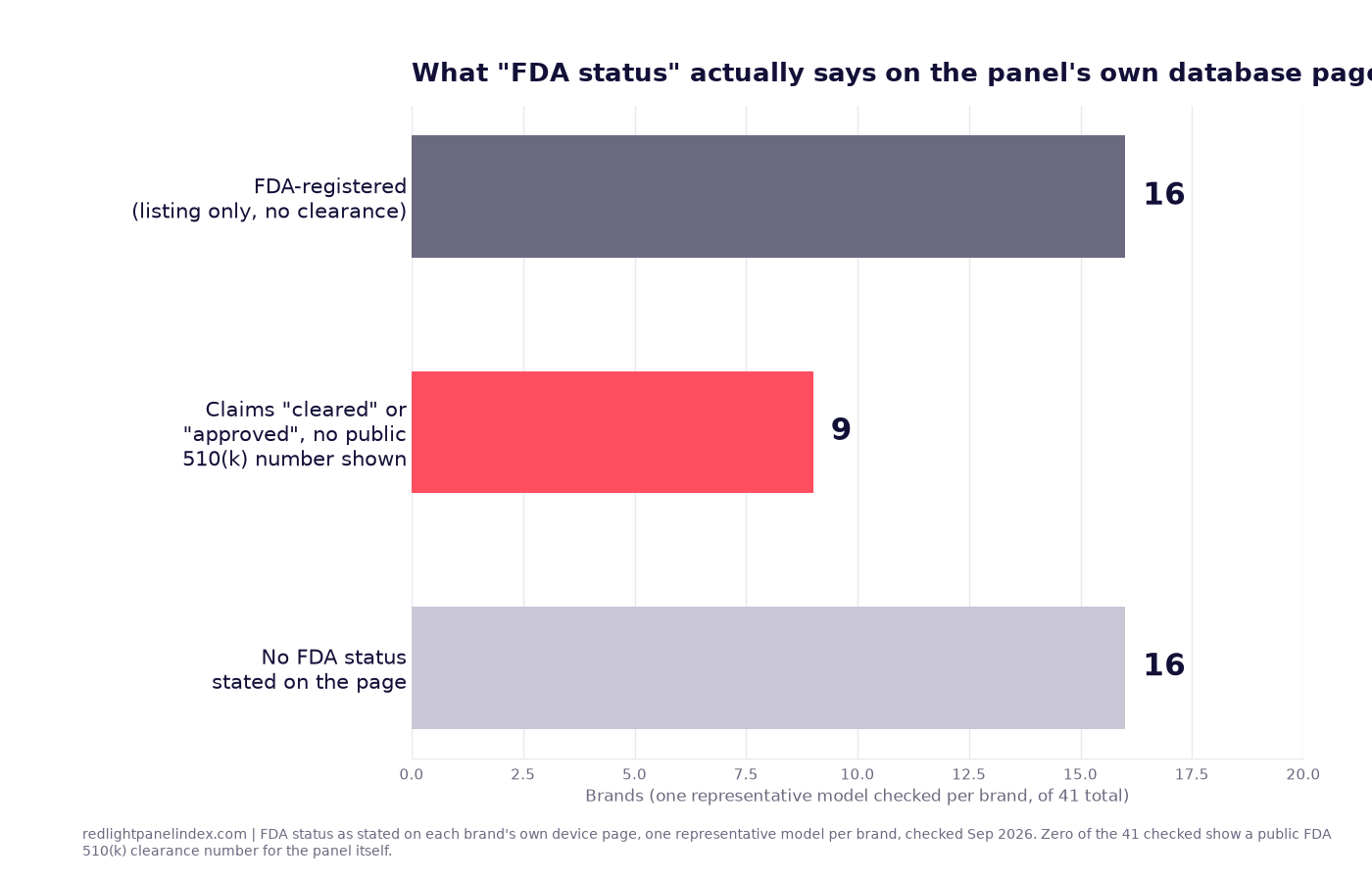
Checking one representative model's database page per brand across all 41 brands this site tracks turns up three groups, not two:
- 16 brands state FDA-registered status on the model page and nothing stronger, several explicitly noting in their own words that registration is a listing, not a clearance.
- 9 brands state a "cleared" or "approved" FDA status on the model page without a 510(k) K-number appearing anywhere on that page for the panel itself. In a few of these cases the page's own FDA-cleared claim traces to a different product the brand also sells, such as a hair-growth laser or a separate face mask, rather than the rectangular panel under discussion.
- 16 brands state no FDA status at all on the checked model page, several describing the device instead as a general-wellness product not intended to diagnose, treat, cure or prevent disease.
Zero of the 41 checked pages show a public 510(k) clearance number attached to the panel itself, consistent with what the FDA-cleared versus registered page already concludes for this device category as a whole.
The phrase "medical grade" or "medical-grade" itself, checked on the same 41 pages, appears on five: as a description of the device's construction or components on some pages, as part of a product's own printed name on another, and once inside this site's own honesty-check language quoting and then correcting a brand's marketing claim. On all five, the phrase sits next to, rather than in place of, the same FDA-registered or unverified-cleared status described above; none of the five pages that use "medical grade" pairs it with a 510(k) K-number that is not there.
Why the phrase persists despite meaning nothing regulatory
"Medical grade" borrows credibility from a category, medical devices cleared or approved for a specific use, without making the specific, checkable claim that category requires. A brand can write "FDA-registered" and be stating a true, if modest, fact, since registration is real and verifiable through the FDA's own establishment registration database. "Medical grade" makes no equivalent claim to check: there is no registry, no number, no agency definition to hold it against. That asymmetry, a checkable weak claim sitting next to an uncheckable strong-sounding phrase, is what makes the phrase useful to a marketing page and useless to a buyer trying to compare devices on regulatory standing.
Why "general wellness" is a status too, not an evasion
Several of the 16 brands with no stated FDA status describe their panels instead as general wellness products not intended to diagnose, treat, cure or prevent disease. That wording traces to a specific 2016 FDA guidance, "General Wellness: Policy for Low Risk Devices," which says the agency does not intend to review products that meet two conditions: they are intended only for general wellness use, and they present a very low risk to users. A product under that policy can claim to support a healthy lifestyle or help manage a chronic condition's general risk factors, but it cannot claim to treat or diagnose a specific disease. That is a real, checkable regulatory position, distinct from both "registered" and "cleared," and a brand stating it plainly is not hiding a weaker claim behind vague language; it is naming the actual category its marketing has to stay inside of. The FDA's own general wellness policy is the reason a home red light panel's marketing describes glowing skin or muscle recovery rather than naming a diagnosed condition it treats, whatever FDA status, if any, the specific brand states elsewhere on the page.
Registration is a fee and a form, not a review
The registration step itself is worth spelling out because "registered" reads, to an unfamiliar buyer, like it implies more scrutiny than it does. FDA establishment registration requires a manufacturer to list its facility and the device it makes, and pay an annual fee; it does not require submitting test data, clinical evidence, or a comparison against any existing product. A device can be registered on the same day it goes on sale, and staying registered requires only renewing the listing, not demonstrating anything about performance in the following year. That is why this site's own device pages describe registration as "a listing, not a clearance": the word describes a paperwork status, not a judgment about whether the device works, and a device can be simultaneously registered and completely unstudied.
How to check a specific panel yourself
Every model page in this site's database states whatever FDA status, if any, the brand's own materials support, in the same specs-table location checked for this audit. Confirming a clearance claim independently means looking for a 510(k) K-number and checking that specific device, not the brand's other products, against the FDA's public 510(k) database; a page that claims "cleared" or "approved" without printing that number next to the claim, for the exact model in question, has not shown you anything you can verify. This site's ranking methodology does not treat any FDA status, including registration, as a ranking factor at all, precisely because registration requires no review of whether a device works.
What this does not mean
None of the above means a device without a stated FDA status is unsafe, or that a device claiming "medical grade" is being dishonest about anything else on its page; FDA status and clinical evidence are separate questions, and a panel's wavelength coverage, measured irradiance and warranty terms tell you far more about whether it will do what a buyer wants than any regulatory label does. What the audit does support is narrower: "medical grade" is not a synonym for "FDA-cleared," a device can use one phrase while holding only the other status or neither, and the only way to tell which is true for a specific model is to look for the number, not the adjective.