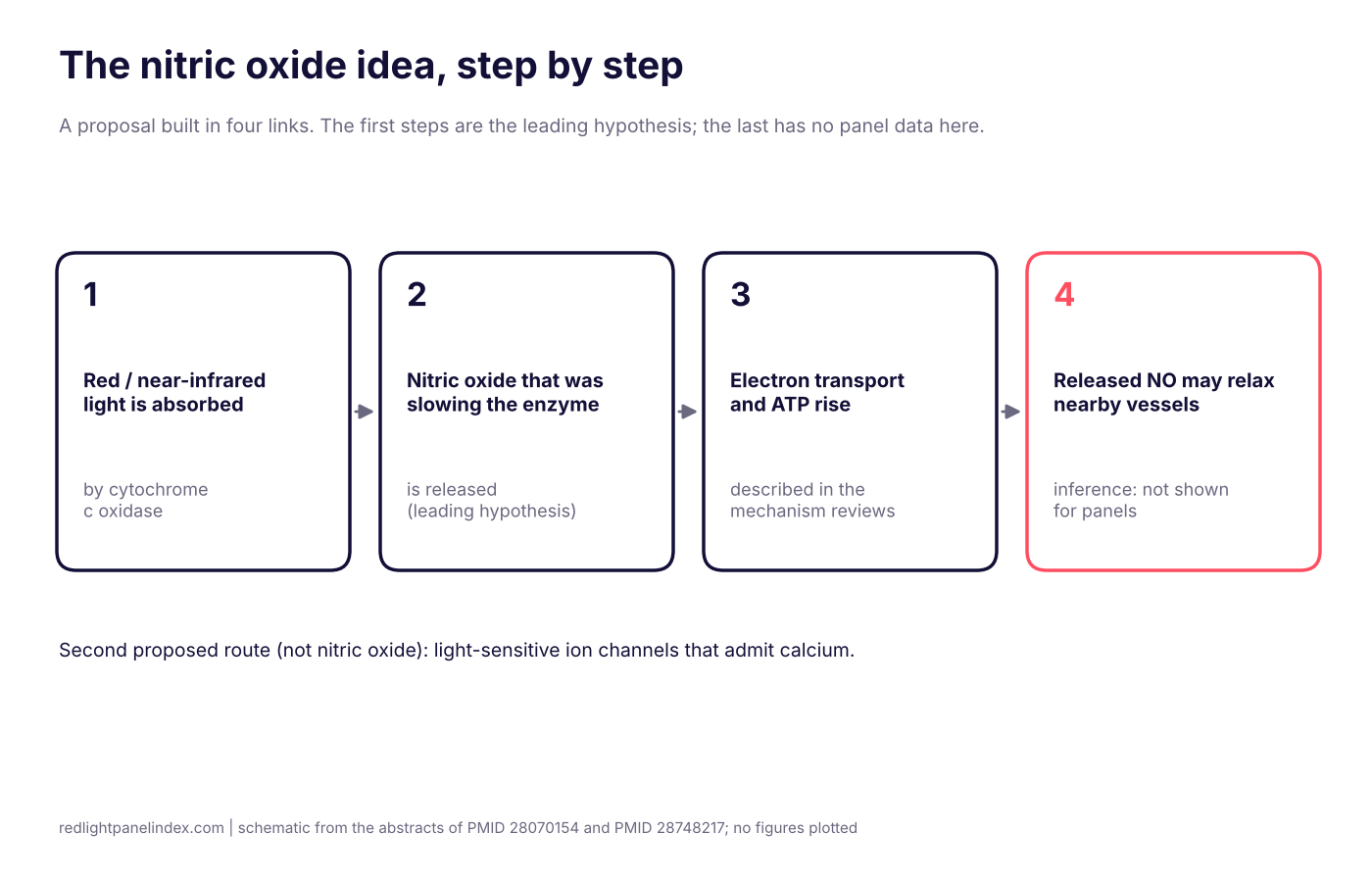
The nitric oxide hypothesis proposes that red and near-infrared light, absorbed by an enzyme in the mitochondria, frees nitric oxide that was holding the enzyme back, and that the freed nitric oxide could also widen blood vessels. The first half is the leading mechanism proposal in the research literature; the blood-flow half is an inference that the reviews state far more cautiously than product marketing does.
Choosing a panel? Our ranking of the best red light therapy panels is computed from published, method-labeled specs across 188 devices. For any mechanism claim, the spec that matters is method-labeled irradiance in the red or near-infrared band, because the idea only applies if enough light reaches the tissue.
The idea in four steps
The site's page on cytochrome c oxidase lays out the enzyme itself. The nitric oxide proposal builds on it as follows.
- Nitric oxide sits on the enzyme. Cytochrome c oxidase is the last enzyme in the mitochondrial chain. Nitric oxide can bind to it and slow it down, acting like a brake.
- Light is absorbed by the enzyme. Red and near-infrared photons are absorbed by the enzyme, as described on the absorption and chromophores page.
- The brake is released. The de Freitas and Hamblin review of proposed mechanisms (PMID 28070154) describes the leading model this way: absorbed photons free the enzyme from the nitric oxide that otherwise inhibits it, and electron transport, mitochondrial membrane potential and ATP production rise as a result. See mitochondria and ATP for what that chain does.
- The released nitric oxide may act elsewhere. Nitric oxide is a small signaling molecule that can diffuse out of the cell. In the body it is known to relax the smooth muscle in blood vessel walls, which is the basis of the vasodilation argument.
The same review also describes a second route that does not involve nitric oxide: light-sensitive ion channels that let calcium into the cell. It lists reactive oxygen species, cyclic AMP, nitric oxide and calcium together as signals that activate downstream pathways. So nitric oxide is one proposed signal among several, not the single explanation.
Where blood flow comes in
If light frees nitric oxide near small vessels, then the local vessels could relax, more blood could arrive, and a tissue could get more oxygen and nutrients. That chain would help explain why people report benefits in sore or stiff tissue. It would also make sense of the "better microcirculation" wording that appears in many descriptions of the effect.
The reasoning is plausible, and it is also a chain of "could" statements. Each link has to hold in living tissue in people, at the doses a panel delivers, for the argument to describe what happens at home. The reviews describe the mechanism proposal; they do not, in the abstracts read for this page, report human blood-flow measurements from a panel. This page does not quote any.
How much is demonstrated
A useful way to sort the claim is by the kind of evidence behind each step:
- The enzyme absorbs red and near-infrared light. Described as established in the mechanism reviews, with the caveat that the exact contribution of each wavelength to a given outcome is still discussed.
- Light can free nitric oxide from the enzyme. Presented as the leading hypothesis. It is the step the site's cytochrome page already calls the most debated.
- Nitric oxide appears among the changes after irradiation. The anti-inflammatory review by Hamblin (PMID 28748217) lists an increase in nitric oxide among the secondary effects of photon absorption, alongside increased ATP, a brief burst of reactive oxygen species and calcium changes. It also reports, from animal models, reductions in reactive nitrogen species and prostaglandins, which is a different direction from "more nitric oxide," and a reminder that the molecule's role depends on context.
- That nitric oxide widens vessels enough to matter for a home panel user. Not shown in the sources used here.
The mismatch in that last list is the honest summary. A mechanism can be well supported at the cell level and still be unproven as the cause of a result in a person. The photobiomodulation overview makes the same point about the field in general.
What the proposal predicts, and what it does not
A strong version of the idea would predict three things. First, the effect should depend on wavelength in a way that tracks the enzyme's absorption. Second, it should show a dose pattern, since too much light can stop helping; the reviews describe a biphasic response in which low doses stimulate and high doses inhibit, covered on the biphasic dose response page. Third, a measurable blood-flow change should appear in tissue exposed to light and not in sham-treated tissue.
The first two are discussed in the literature. The third is the part a reader should look for in any specific claim: it needs a sham-controlled design, which is why the site explains sham-controlled trials separately.
What this means for a home panel
The nitric oxide story does not change how to choose a panel, but it does clarify what to ask.
- Light has to reach the tissue. The idea is local. A vessel under the skin only matters if enough light gets there, and that depends on band and penetration. The penetration depth page covers it, and the 660nm and 850nm pages cover the two most common bands. The wavelengths overview compares them.
- Irradiance needs a method label. A figure with no stated distance or instrument cannot tell you whether you are near the stimulating range. The irradiance explainer shows how to read one.
- More is not automatically better. If the biphasic pattern holds, a longer session can pass the useful range. Use the dose calculator to see what a session delivers at your distance, and treat the result as a rough guide.
- Be wary of blood-flow promises. A page that says a panel "boosts circulation" is relying on the most uncertain step. The site's muscle recovery evidence page is graded on trial outcomes, not on this mechanism, and the mechanism is not what earns the grade.
- Mechanism is not a grade. The evidence grades are based on trials in people, not on how convincing the cell biology sounds.
Cautions
- Nitric oxide and blood flow are not a reason to use light over a new injury, an infection or a lump that has not been assessed. Persistent swelling, heat or pain needs a clinician.
- Anyone with a history of skin cancer over the site, taking photosensitizing medication, or who is pregnant should consult a clinician first. See the safety and side effects page.
- Near-infrared output can be bright to the eye while looking dim. Follow the eye protection guide.
Bottom line
The nitric oxide release idea is a serious proposal about how light acts on mitochondria, and the blood-flow extension is a hypothesis built on top of it. The reviews support the first and are careful about the second. When a product page treats vasodilation as settled, it is going further than the sources do.