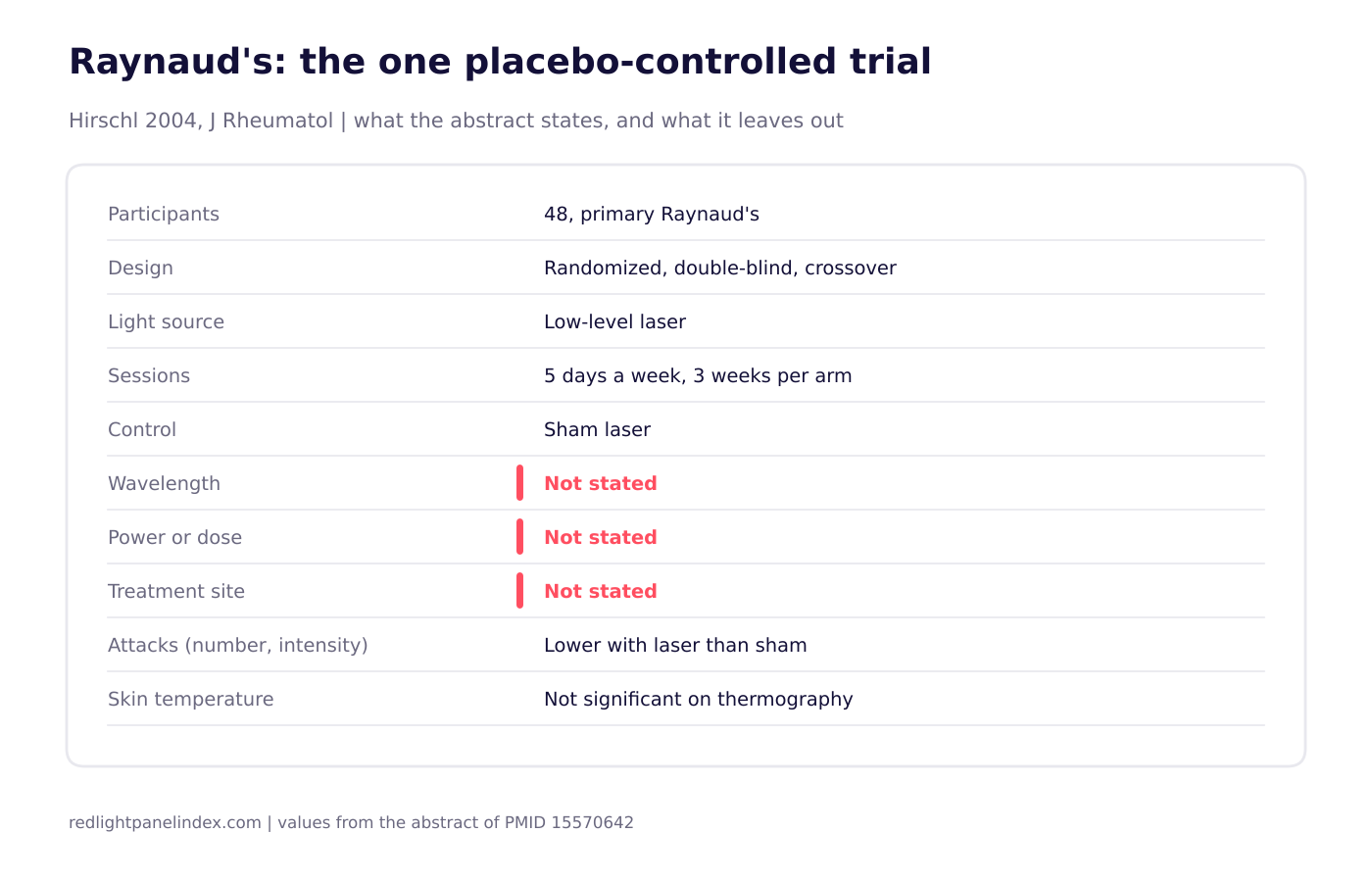
The evidence grade for red light therapy and Raynaud's phenomenon is Limited, because the support is a single placebo-controlled trial: in 48 people with primary Raynaud's, attacks were fewer and less intense during three weeks of low-level laser than during three weeks of sham, while skin temperature on thermography did not change significantly (PMID 15570642). That trial used a clinic laser at settings its abstract does not state, it has not been replicated, and no study has tested a home LED panel for Raynaud's.
Choosing a panel? Our ranking of the best red light therapy panels is computed from published, method-labeled specs across 188 devices. For Raynaud's, the spec that matters is method-labeled irradiance at the distance you would hold your hands, because without a tested dose you need an honest number to know what you are actually applying.
What Raynaud's phenomenon is
Raynaud's phenomenon is an exaggerated narrowing of the small arteries in the fingers and toes, usually set off by cold or emotional stress, which turns the skin white or blue and then red as blood returns, often with numbness, tingling or pain. Primary Raynaud's occurs on its own and is usually mild; secondary Raynaud's is linked to another condition such as scleroderma, lupus or certain medications, and can damage the skin of the fingertips.
The difference between the two matters for this page. The only trial below enrolled people with primary Raynaud's. Nothing here applies to secondary Raynaud's, which belongs with a specialist.
What the trial used
Hirschl and colleagues ran a randomized, placebo-controlled, double-blind crossover trial, published in The Journal of Rheumatology. Every participant had both real laser and sham, in a random order, so each person served as their own comparison. The table is built only from the abstract; our full study review walks through it section by section.
| Parameter | What the abstract states |
|---|---|
| Participants | 48 patients with primary Raynaud's phenomenon |
| Design | Randomized, placebo-controlled, double-blind crossover |
| Light source | Low-level laser |
| Wavelength | Not stated |
| Power, irradiance or dose | Not stated |
| Treatment site | Not stated |
| Sessions | 5 days a week for 3 weeks, for each of laser and sham |
| Control | Sham laser |
| Outcomes | Attack intensity (primary), attack number, infrared thermography |
The empty rows are the most important part of that table. Without a wavelength or a dose, the trial cannot be matched to any band on the wavelengths overview or reproduced with any device, laser or LED.
What the trial found
Participants kept diaries of their attacks throughout. Thermography, a camera that maps skin temperature, was done before the trial started and at the end of each three-week sequence.
- Attack intensity, the primary outcome: significantly lower during laser than during sham.
- Number of attacks: significantly lower during laser than during sham.
- Thermography: the changes did not reach statistical significance.
The abstract reports these as significant but does not give the size of the reduction, so this page does not quote a percentage. The authors also looked for features that predicted who would respond. Triggers other than cold, rewarming time and the temperature drop after a cold challenge were significant predictors. The effect was greatest in people with signs of a lowered threshold for vasospasm, meaning vessels that clamp down easily, and smallest in those with delayed hyperemia, meaning slow return of blood flow after an attack.
Their conclusion was that low-level laser reduces the frequency and severity of Raynaud attacks.
The evidence grade, and why
The site's evidence grades give Limited when the support is a pilot study or a single trial, or a trial run at settings a consumer panel cannot be shown to reach. This condition meets both descriptions.
Points in the trial's favor:
- It had a sham arm and was double-blind. That is the design most able to separate the light from expectation and attention, as our sham-controlled trials guide explains.
- The crossover design suits a small trial, because each person's attacks on laser are compared with their own attacks on sham.
Points that hold the grade at Limited:
- One trial, 48 people, published in 2004, with no replication the site has found.
- Self-reported outcomes. Diaries are the standard measure for Raynaud's, but they are subjective, and subjective outcomes are the most open to placebo response if blinding is imperfect.
- The one objective measure did not move. Thermography showed no significant change, so the trial gives no measured evidence that blood flow improved.
- The device and dose are unknown from the abstract, so the result cannot be tied to a home panel.
A better-powered replication with stated parameters could raise the grade. A large trial finding nothing would lower it.
The nitric oxide hypothesis
The usual explanation offered for red light and circulation runs through nitric oxide. The proposal, set out on our nitric oxide and blood-flow page, is that red and near-infrared light frees nitric oxide bound to cytochrome c oxidase in cells, and that the freed nitric oxide relaxes the smooth muscle in small vessel walls, letting more blood through.
It is a hypothesis, and for Raynaud's it is an untested one. The first step is a mechanism proposal from cell and laboratory work. The second, better blood flow in people, is an inference with little human measurement behind it. The Raynaud's trial did not measure nitric oxide, and its skin-temperature results did not show a significant change. So the trial is compatible with the idea but is not evidence for it. The inflammation evidence page, also graded Limited, makes the related point that more blood flow, where it has been measured, is not the same as a clinical benefit.
What was not studied
- Home LED panels. No trial has tested a panel, a hand pad or any consumer device for Raynaud's.
- Secondary Raynaud's. The trial enrolled only primary Raynaud's. Scleroderma-related Raynaud's, finger ulcers and digital wounds were not studied.
- Toes and feet. The abstract does not say which body sites were treated.
- Duration. The trial measured three-week blocks; it says nothing about whether any effect lasts after treatment stops or holds up through a whole winter.
- Dose and wavelength. Without stated parameters, there is no tested dose to copy and no evidence for red over near-infrared or the reverse.
- Comparison with standard care. The trial compared laser with sham, not with keeping warm, avoiding triggers or the medications clinicians prescribe.
- Related nerve symptoms. Numbness from neuropathy is a different problem with its own evidence, covered on the neuropathy evidence page.
What a home panel can and cannot do
A panel cannot reproduce this trial. A laser delivers a narrow beam to small spots at a set energy, while a panel floods a wide area with LED light from a distance; the LED vs laser explainer covers why the two are not interchangeable. Because the trial's dose is not stated, there is no target to aim for.
What a panel can do is deliver a known dose, if its irradiance is honestly stated. The dose calculator turns a panel's irradiance and your distance and session time into joules per square centimeter, and the irradiance explainer covers why a figure with a stated measurement method is worth more than a headline number. For anyone who decides to experiment, the practical points are:
- Pick a dose deliberately with the calculator, rather than guessing, and keep it the same so you can judge the result.
- Know the bands. Most panels pair red near 660 nm with near-infrared near 850 nm. Nothing in the Raynaud's evidence favors one over the other.
- Keep a diary of attack number and intensity, as the trial did, for a few weeks before and during use, and change one thing at a time.
- Separate warmth from light. A panel feels warm, and warmth eases a cold-triggered attack on its own. The thermal vs photochemical page covers why that makes a home result hard to read.
Cautions
- Get a diagnosis first. Raynaud's that starts in adulthood, affects only one side, causes sores or ulcers, or comes with joint pain, rash, swallowing trouble or fatigue can point to secondary Raynaud's and needs a clinician.
- Do not replace prescribed treatment. Light is not a substitute for medication or for the trigger avoidance and warming a clinician recommends.
- Numb skin feels heat less. Fingers that are cold or numb may not register warmth well, so keep to the panel maker's stated distance and session time.
- Protect your eyes if the hands are held near the face; the safety and side effects page covers eye and skin cautions.
The honest summary is short: one blinded trial in primary Raynaud's reported fewer and milder attacks with a clinic laser, nothing has repeated it, and no home device has been tested.