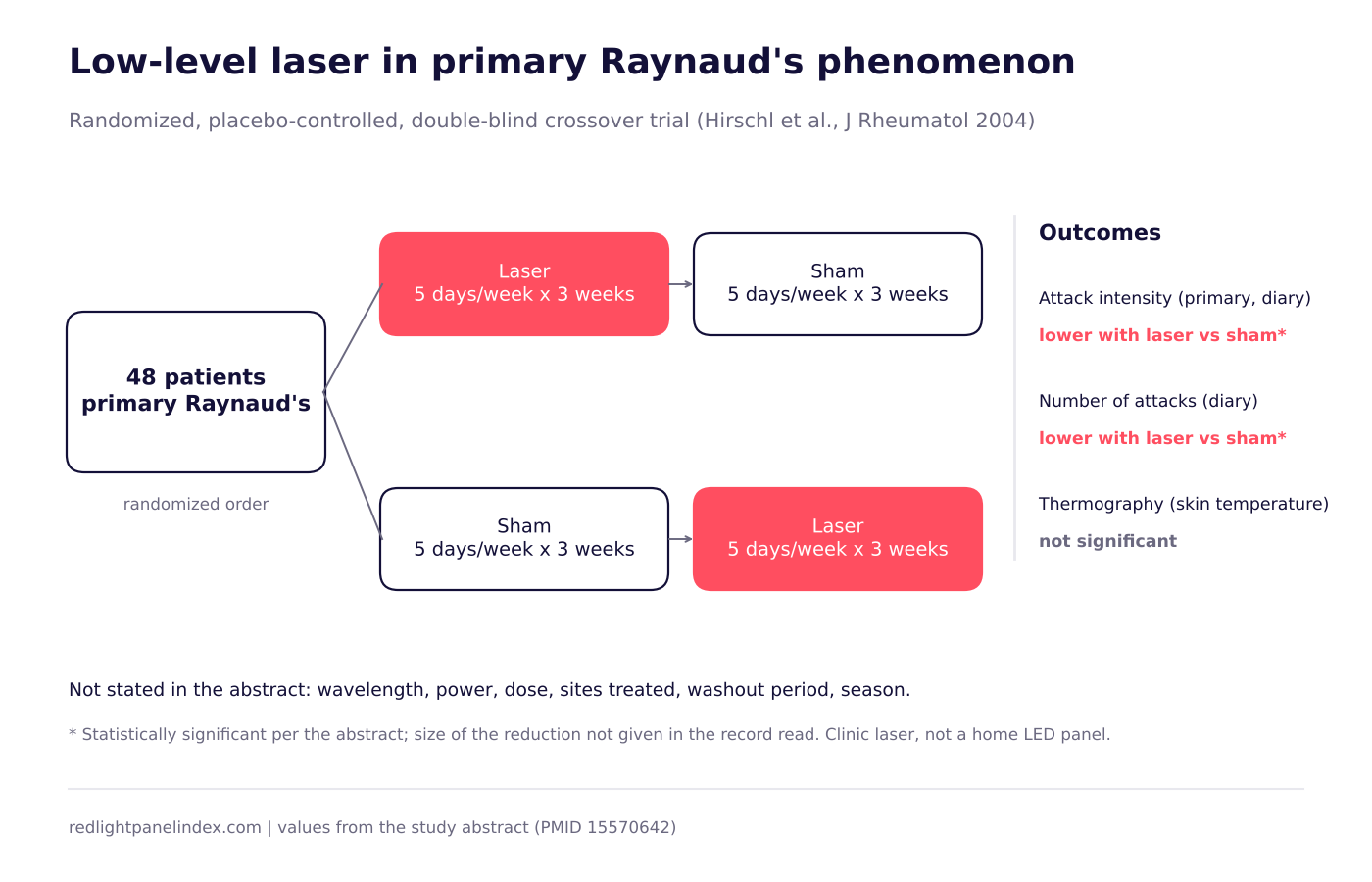
A 2004 randomized, placebo-controlled, double-blind crossover trial in 48 people with primary Raynaud's phenomenon reported that both the number of attacks and their intensity were significantly lower during three weeks of low-level laser therapy than during three weeks of sham treatment, while skin temperature measured by thermography did not change significantly (PMID 15570642). It is one small trial of a clinic laser, and no study has tested a home LED panel for Raynaud's.
Choosing a panel? Our ranking of the best red light therapy panels is computed from published, method-labeled specs across 188 devices. For cold-triggered attacks in the hands, the spec that matters is method-labeled irradiance at the distance you would actually hold your hands, because the trial laser's dose is not stated in the abstract and cannot be matched by guesswork.
Where this fits
Raynaud's phenomenon is an exaggerated narrowing of the small arteries in the fingers and toes, usually triggered by cold or stress. The fingers turn white or blue, then red as blood returns, often with numbness or pain. "Primary" means it occurs on its own, without an underlying disease such as scleroderma or lupus; "secondary" Raynaud's is linked to such a disease and is managed differently.
This trial is the only Raynaud's study the site reviews, and our Raynaud's evidence page grades the condition from it. The closest pages are the nitric oxide and blood-flow explainer, which covers why light is proposed to relax blood vessels and how little of that is shown in people, and the inflammation evidence page, graded Limited. Everything below comes from the abstract, read through its database record. Where the abstract is silent, this page says so.
What the study asked
Hirschl and colleagues, writing in The Journal of Rheumatology, set two aims. The first was "to assess the efficacy of low level laser therapy in patients with primary Raynaud's phenomenon." The second was to "predict the success of laser therapy by clinical characteristics", in other words, to see whether some patients were more likely to respond than others.
Who was studied
The trial included 48 patients with primary Raynaud's phenomenon. The MeSH indexing lists both women and men, but the abstract does not give the split, ages, how long people had had symptoms or how severe their attacks were at the start. It also does not say how the diagnosis was confirmed or how secondary Raynaud's was ruled out.
Device and parameters as stated
The abstract describes a crossover design:
- Design: randomized, placebo-controlled, double-blind crossover. Every participant received both real laser and sham, in a randomly assigned order.
- Schedule: each treatment was applied 5 days a week for 3 weeks, so each person had about six weeks of sessions in total.
- Control: sham treatment, with participants and investigators blinded.
- Light source: low-level laser.
The abstract does not give the wavelength, power, irradiance, dose per point, session length, the body sites treated or whether there was a washout period between the two phases. It also does not say what season the trial ran in, which matters for a cold-triggered condition. The full text is behind a paywall and was not read for this page, so none of those parameters can be filled in here.
That gap is the main reason this result cannot be turned into a home routine. A laser delivers a narrow, focused beam to small spots, while a home panel floods a wide area with LED light at a distance. Without the trial's dose, there is no way to say whether a panel session in the dose calculator would come anywhere near it. The LED vs laser explainer covers why the two devices are not interchangeable.
What was measured and found
Participants recorded the number and intensity of their attacks in diaries. Infrared thermography, a camera that maps skin temperature, was done before the trial began and at the end of each treatment sequence.
- Primary endpoint, attack intensity: significantly lower during laser than during sham.
- Secondary endpoint, number of attacks: significantly lower during laser than during sham.
- Secondary endpoint, thermography: the thermographic parameters did not reach statistical significance.
The abstract states significance but, in the record read for this page, does not give the size of the reduction, a mean difference or a p-value. This page therefore does not quote a percentage.
For predicting response, the authors tested clinical features including age, sex, symptom duration, age at onset, and the temperature drop and rewarming time after a cold provocation test. The abstract names triggers other than cold (stress or wetness), rewarming time and the temperature decrease after cold provocation as significant predictors. The authors linked the best response to signs that a patient's vessels go into spasm more easily.
Their conclusion: "Low level laser therapy reduces frequency and severity of Raynaud attacks."
Limitations
- One trial, 48 people. The site found no replication of this result in a second trial. A single positive trial is a starting point, not a settled effect, which is the point the sham-controlled trials guide makes about any one study.
- Self-reported outcomes. Attack counts and intensity came from patient diaries. Diaries are the standard way to measure Raynaud's, but they are subjective, and subjective outcomes are the most open to a placebo response if blinding is imperfect. The abstract says the trial was double-blind but does not describe how the sham was made to look and feel like the laser.
- The objective measure did not move. Thermography showed no significant change. That does not cancel the diary result, since skin temperature at rest is not the same as how often vessels go into spasm, but it means the trial gives no measured evidence of better blood flow.
- Crossover design. Each person served as their own control, which suits a small trial. Crossover trials can be affected by carryover from the first phase into the second, and by seasonal change in a cold-driven condition. The abstract does not report a washout period or the season.
- Missing parameters. With no wavelength or dose in the abstract, the result cannot be tied to any band on the wavelengths overview or reproduced.
- Primary Raynaud's only. The trial says nothing about secondary Raynaud's, which can involve finger ulcers and needs specialist care.
The mechanism question
It is tempting to explain this result through nitric oxide. The leading proposal is that red and near-infrared light frees nitric oxide bound to cytochrome c oxidase, and that nitric oxide relaxes the smooth muscle in vessel walls. As the nitric oxide release page sets out, the first step is a mechanism proposal in the research literature and the blood-flow step is an inference with little human measurement behind it. This trial does not close that gap. It measured attacks and skin temperature, not nitric oxide, and its one objective measure did not change. So the trial is compatible with the nitric oxide idea, but it is not evidence for it.
What it means for a home panel
- No home-panel trial exists for Raynaud's. This study used a clinic laser at parameters the abstract does not state. Its result does not transfer to an LED panel by default, and the site does not grade red light for Raynaud's.
- Warming is not the same as treatment. A panel's output feels warm on the skin, and warmth can ease a cold-triggered attack for reasons that have nothing to do with photobiomodulation. The thermal vs photochemical page covers that difference.
- Get the diagnosis first. New Raynaud's symptoms in adulthood, attacks on one side only, finger sores or ulcers, or symptoms with joint pain, rash or fatigue can point to secondary Raynaud's and need a clinician, not a light device.
- If you try a panel anyway, treat it as an experiment with no tested dose. Keep a diary of attacks the way this trial did, change one thing at a time and read the safety and side effects page before starting. Light should not replace medication a clinician has prescribed.
The trial is worth knowing about because it was blinded and sham-controlled. It is also a reminder of how thin the evidence is: one older study, an unreported dose and no home-device replication.