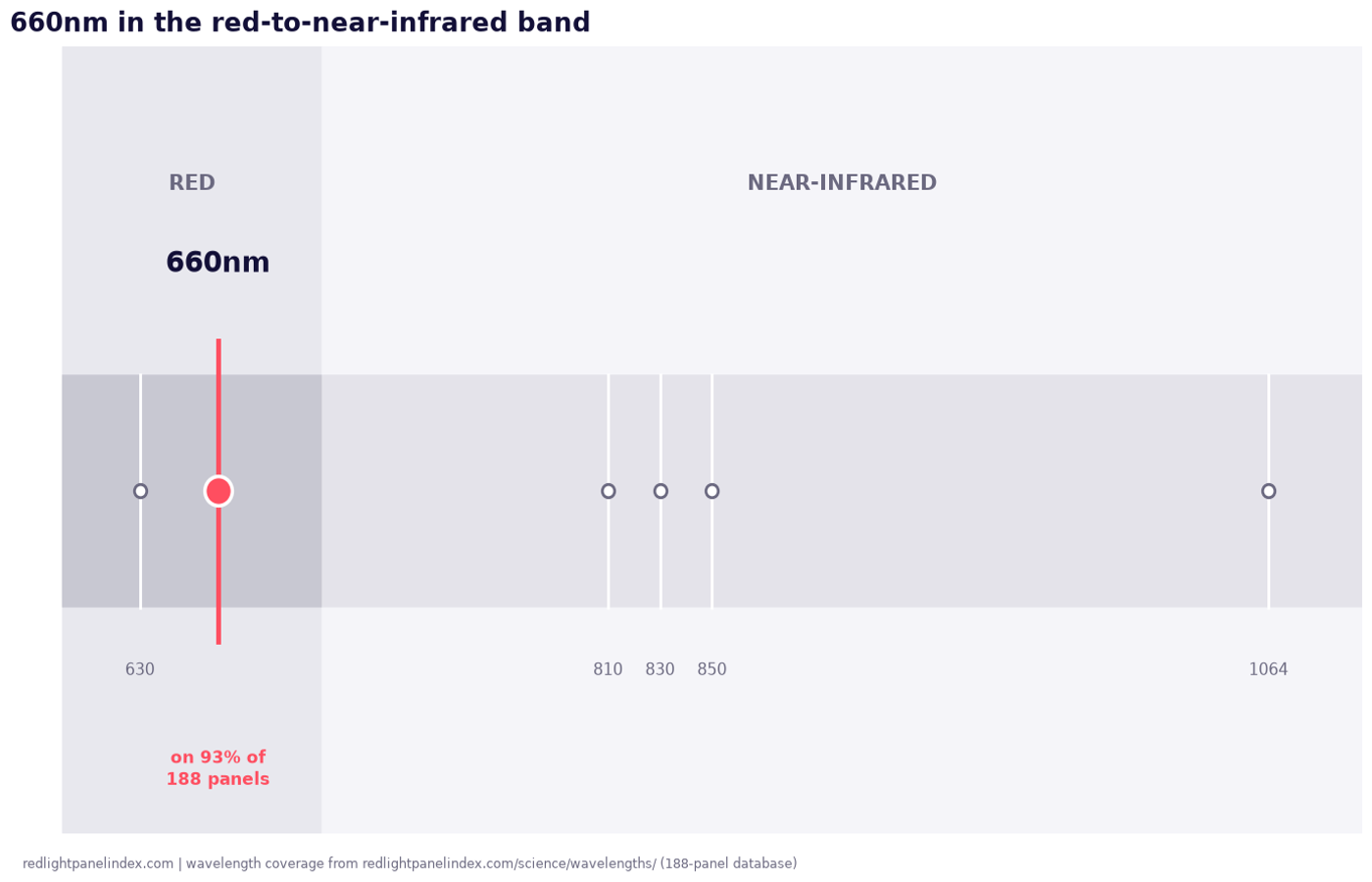
660nm is a wavelength of visible red light, near the far end of the range the human eye can still perceive before it shades into invisible near-infrared. On a red light therapy panel it is the single most common wavelength label in the market: 175 of the 188 panels in this site's database, 93 percent, list it.
Choosing a panel? Our ranking of the best red light therapy panels is computed from published, method-labeled specs across 188 devices. For 660nm specifically, the spec that matters is the published power density at that band, not just whether 660nm appears on the label.
Where 660nm sits in the spectrum
Visible red light runs roughly from 600 to 700nm before it crosses into near-infrared, a boundary this site's red-versus-near-infrared page puts at somewhere between 700 and 750nm depending on the source. 660nm sits well inside the red band, closer to its far edge than its near one, which is part of why it penetrates slightly deeper than shorter red wavelengths like 630nm while still doing most of its work at the skin and just beneath it, the same near-surface behavior the whole red band shares. The diagram above places 660nm against the other bands panels commonly publish: 630nm red, and 810, 830, 850 and 1064nm near-infrared.
Both red and near-infrared light are absorbed by the same mitochondrial enzyme, cytochrome c oxidase, the first step in the chain of reactions this site's photobiomodulation page describes. 660nm is not biologically distinct from 850nm at the cellular level; what differs between the two is how much tissue the light passes through before it is absorbed in useful amounts, which is why 660nm is marketed for skin-level goals and near-infrared for muscle and joint work.
Why 660nm is the market default
Counted across the 188 panels in this site's database, 660nm and 850nm are tied as the two most common wavelengths, each appearing on 93 percent of panels. No other band comes close:
| Wavelength | Panels offering it | Share of database |
|---|---|---|
| 660nm red | 175 of 188 | 93% |
| 850nm near-infrared | 175 of 188 | 93% |
| 630nm red | 114 of 188 | 61% |
| 830nm near-infrared | 103 of 188 | 55% |
| 810nm near-infrared | 98 of 188 | 52% |
| 1064nm deep near-infrared | 33 of 188 | 18% |
The 660-and-850nm pairing is what this site's wavelength breakdown calls the market default: one red band anchored near the skin, one near-infrared band that reaches deeper, packaged together on nearly every panel sold. This site's 850nm page covers what that near-infrared half of the pairing has actually been tested for, mostly exercise recovery and whole-body pain trials rather than the skin-level goals 660nm targets. A panel advertising "seven wavelengths" almost always includes 660nm as one of them, though how much of the panel's total output actually sits at 660nm, rather than spread thin across the other six, is a separate question a bare wavelength list does not answer.
660nm is a peak, not a single color
A diode printed "660nm" on a spec sheet does not emit one pure wavelength; it emits a band centered on that peak, typically 20 to 30nm wide for a red LED. That means a panel labeled 660nm and one labeled 655nm, the wavelength the trial below actually used, are emitting overlapping light rather than two meaningfully different colors. This site's peak wavelength and FWHM page works through that overlap in more detail, including why comparing two panels on their peak label alone, when the labels sit only a few nanometers apart, tells a buyer very little.
Chip design changes how much 660nm you actually get
A panel's LED architecture affects how much of its total output actually lands at 660nm rather than being spread across several labeled bands. This site's chip design breakdown describes single-chip panels, a design used by brands including RLT Home, PlatinumLED and Hooga's HG line, as putting full diode power behind each stated wavelength, producing stronger per-band output at 660nm specifically. Dual- and quad-chip designs, used by brands including Mito and BlockBlueLight, split power across more wavelengths on the same panel for more even surface coverage, which spreads total output more thinly across each individual band, 660nm included, even when the peak label printed on the spec sheet is identical.
Neither approach is simply better; a single-chip panel concentrates 660nm output at the cost of packing in fewer bands per fixture, while a multi-chip panel covers more of the spectrum at the cost of per-band strength. The point that matters for a buyer is that two panels can both list "660nm" and deliver meaningfully different doses at that wavelength, because the chip architecture behind the label, not the label itself, decides how much power actually sits there.
The trials at 655 to 660nm
Three controlled trials in this range illustrate what has actually been tested, across three different goals.
Hair growth. A 2013 sham-controlled trial used a 655nm LED-and-laser helmet on 44 men with androgenetic alopecia, worn every other day for 16 weeks, and found a 39 percent increase in hair count in the active group compared with sham (PMID 24078483). It is the trial this site's hair growth evidence page grades Strong, and the site's full review of that trial covers the device and its gap from a flat panel in detail.
Acne. A 2000 randomized trial split 107 patients with mild to moderate acne vulgaris across four groups, including a combined 415 and 660nm light source used 15 minutes daily, and reported a mean 76 percent improvement in inflammatory lesions after 12 weeks of active treatment, significantly better than blue light alone, benzoyl peroxide, or white light at most comparison points (95% CI 66 to 87) (PMID 10809858). Comedones, the non-inflamed lesions, improved less and the difference from other treatments did not reach significance. This site's acne evidence page grades that trial and a second one together, and explains why the 660nm component alone was not tested in isolation from the 415nm blue light it was paired with.
Periocular wrinkles. A 2023 split-face randomized trial in 137 women aged 40 to 65 compared 660nm red against 590nm amber light-emitting diodes at the same dose, 3.8 J/cm2 per side, across ten sessions over four weeks, and reported significant reductions in periocular wrinkle volume with both wavelengths, 31.6 percent with red and 29.9 percent with amber (PMID 36780572). Skin hydration and elasticity did not improve with either wavelength in this trial. This site's full review of that trial covers why the close amber result makes it hard to credit 660nm specifically, rather than light exposure in general, with the effect.
A fourth line of research at the same wavelength, 670nm exposure aimed at the retina rather than the skin for aging vision and dry macular degeneration, is graded separately on this site's eye health evidence page, since it uses controlled clinical light sources rather than a skin-facing panel.
None of these three skin, hair and acne trials establishes that a home panel reproduces the tested result. The wrinkle trial used a dedicated device at close, controlled range and a near-daily dosing schedule, and its own abstract does not report the irradiance, device model or session length behind that dose, only the total J/cm2 figure. What these trials do establish is that 655 to 660nm is the wavelength most consistently tested across skin-level goals, which is consistent with why panel makers concentrate output there.
What this means for choosing a panel
660nm being on 93 percent of panels makes it close to a given, so it is rarely the wavelength worth comparing panels on. What varies far more between devices is the published power density at 660nm specifically, whether that figure states a measurement method, and how much of a panel's total output the 660nm band actually receives versus being one of several bands sharing a smaller total. If your goal is skin-level, hair, acne, or the kind of surface effect the trials above tested, filter the device database for a panel that publishes a specific 660nm density figure rather than one that simply lists the number on a spec sheet, and use the dose calculator to turn that density and your session length into an actual dose you can hold consistent, since a wavelength this common is a starting point for a panel search, not the deciding factor.