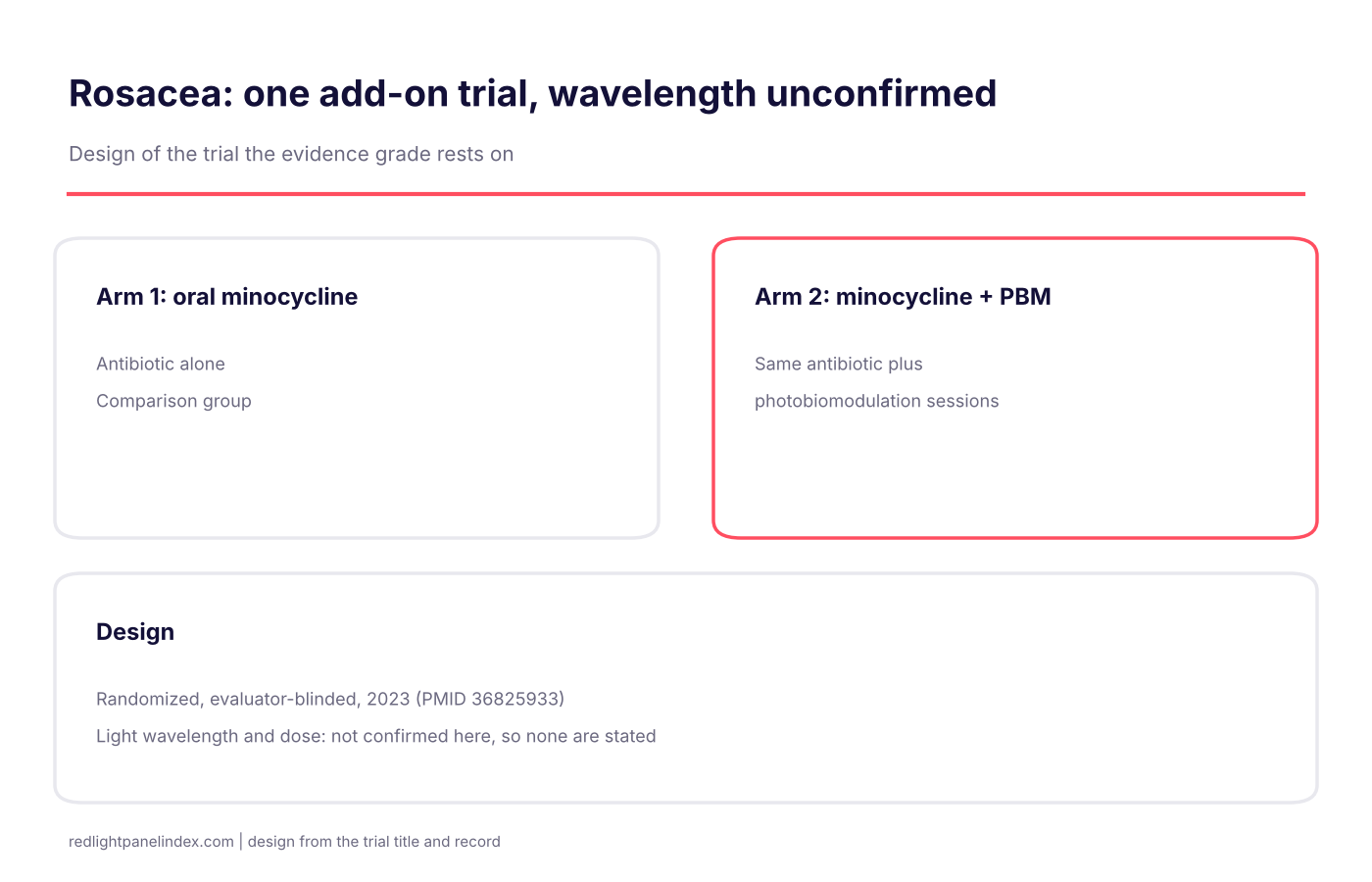
The evidence grade for red light therapy and rosacea is Insufficient: the only randomized trial this site found tested photobiomodulation as an add-on to the antibiotic minocycline, so it cannot show what light does on its own, and no study tested a home panel. The honest reading is that the question is open, not that the answer is no.
Choosing a panel? Our ranking of the best red light therapy panels is computed from published, method-labeled specs across 188 devices. For rosacea, there is no studied spec to chase, so the useful ones are wavelength labeling and a way to control distance and session time.
How this page grades the evidence
The site's evidence grading explainer uses four levels: Strong, Moderate, Limited and Insufficient. Insufficient means there is too little controlled human evidence to say whether a light approach helps, harms or does nothing for the condition. Rosacea lands there because of three facts: there is one trial that fits the question, light was combined with a drug in that trial, and the dose and device details are not confirmed from the source this page could read.
For comparison, the site grades acne as Limited, based on two randomized trials of blue plus red light, and skin and anti-aging as Strong. Rosacea is a neighbor of both conditions in a clinic, but the evidence on this page does not inherit the grade of either. A different condition needs its own trials.
The one randomized trial
The study this page rests on is a 2023 evaluator-blinded randomized controlled trial of oral minocycline combined with photobiomodulation for rosacea, published in Photodermatology, Photoimmunology and Photomedicine (PMID 36825933). Its published record is short, a research-letter format.
What can be said from the title and the trial's registry-style record:
- Design. Randomized and controlled, with the person assessing the skin blinded to the group. Evaluator blinding is useful, but it is not the same as a sham-controlled design where participants cannot tell whether the light is on. See the site's page on sham-controlled trials for why that distinction matters.
- Comparison. Oral minocycline alone versus oral minocycline plus photobiomodulation. The light was an add-on, so any difference between groups reflects light plus drug against drug alone.
- Focus. The associated data record describes rosacea with erythema, meaning the redness type, which is one part of a condition that also has bumps, visible vessels and eye involvement in some people.
What this page cannot report: the wavelength, irradiance, energy dose, number of sessions, sample size and the size of any difference. The abstract and full text were not readable from the research environment used for this page, and a number that was not read is not printed here. Anyone planning to act on this trial should read the full paper, and the wavelength in particular should be confirmed from the methods section before it is described as red, near-infrared or something else.
What the trial can and cannot tell you
If the add-on group did better, the result would support one narrow claim: light plus minocycline may do more than minocycline alone in the studied group over the studied period. It would not support these claims:
- That light works without the antibiotic. The trial was not built to test that.
- That a home panel would reproduce a clinic device's effect. The site has no study linking panel output to the trial's parameters. The dose calculator can convert distance and time into a figure, but only if you know the trial's dose, and that is the number not confirmed here.
- That results hold for the other forms of rosacea, such as the bumpy, pustular type, or for long-term maintenance.
One trial, even a well-run one, is a signal to replicate, not a settled finding. That is why the grade stays Insufficient.
Related skin research
The other source this page cites is a broad narrative review of low-level light therapy in skin (PMID 24049929). It summarizes how skin responds to red and near-infrared light, describing mitochondrial absorption, effects on cell energy, nitric oxide and blood flow, and reported uses in wrinkles, scars, burn healing and inflammatory conditions. The summary of its abstract available for this page names acne and psoriasis among the inflammatory conditions, not rosacea, and the authors call the approach noninvasive with few side effects.
Two cautions about using a review that way. First, a narrative review is the authors' reading of the literature, not a trial, so it cannot grade a specific condition. Second, mechanism is not outcome: that skin cells absorb red light and respond does not show that a rosacea flush will calm. The mechanism pages explain the first idea, and the evidence pages ask the second.
What was not studied
- No trial of light alone against sham light for rosacea that this site found.
- No study of a home LED panel, as opposed to a clinical device, in rosacea.
- No data on whether the warmth a panel produces affects flushing, which people with rosacea often ask about. Heat is commonly discussed as a trigger by patient groups, but this site has no measurement of it from panels.
- No comparison of red against near-infrared bands, or of different doses, for rosacea.
- No long-term follow-up after stopping treatment.
- No data on the eye form of rosacea.
What would change the grade
The grade would move up with the following, in rough order:
- A second randomized trial in rosacea, ideally with sham light and with the wavelength, irradiance, dose and session schedule fully reported.
- A trial of light without a drug in the comparison arms, so the effect is attributable to light.
- A trial using a device whose output can be matched to a home panel, with the method used to measure irradiance stated. The irradiance explainer shows why the method matters.
- Longer follow-up that shows whether any change lasts.
Until then, the page stays Insufficient and will be revisited as trials appear.
Practical section: if you are weighing a panel anyway
Light therapy is not a treatment this page can recommend for rosacea, and anyone with the condition should have a dermatologist in the picture. If you and your dermatologist decide to try a panel alongside standard care, a few practical points follow from what is known and not known.
Wavelength. The site's 660nm page describes the red band used in many skin studies, and the 630nm vs 660nm comparison and wavelengths guide explain the differences. For rosacea there is no confirmed trial wavelength to match, so any wavelength choice here is a guess, not a protocol.
Dose and distance. Use the dose calculator to see what a panel delivers at your distance and session time, and keep to conservative, studied-range sessions rather than escalating. The biphasic dose response page explains why more is not necessarily better, and the session length guide gives typical ranges.
Heat and flushing. Because the site has no data on this, start with short sessions at a comfortable distance and stop if the skin flushes or stings. That is a sensible precaution, not a finding.
Which panel. If you are comparing devices for skin generally, the best panels for skin and anti-aging list ranks on method-labeled specs. It is a ranking for skin tone and texture, not for rosacea, because no device has been tested for that.
Cautions
- Minocycline and other tetracycline-class drugs. The acne page flags this class as photosensitizing. If you take minocycline or a similar antibiotic, ask your prescriber before regular light sessions, and read the photosensitizing medications guide.
- Other rosacea products. Some topical products can irritate skin. Ask whether any should be paused around sessions.
- Eyes. Rosacea can involve the eyes. Use eye protection or closed eyes as described in the eye protection guide.
- Skin reactions. Stop and ask a clinician if redness, burning or swelling gets worse after a session.
- Not a substitute for care. Persistent facial redness, swelling or eye symptoms deserve a clinician's assessment. This page is general information, not medical advice.
The short version
One small trial combined light with minocycline for rosacea with erythema (PMID 36825933), and a broad review describes how skin responds to light in general (PMID 24049929). Neither shows that a home panel helps rosacea. The grade is Insufficient, the gaps are listed above, and the next step for anyone with rosacea is a conversation with a dermatologist, not a purchase.