For most home users the 30 nanometer gap between 630nm and 660nm red light matters far less than the dose a panel delivers and how far from it you sit. Both bands fall in the red range that cytochrome c oxidase absorbs, 660nm is calculated to travel slightly deeper, and 630nm to 633nm is the band several of the better-known skin trials actually used. Panels almost always carry both, so the useful question is not which one to buy but how much of a panel's output each one gets.
Choosing a panel? Our ranking of the best red light therapy panels is computed from published, method-labeled specs across 188 devices. For red-band comparisons, the spec that matters is the published density at each band, not just whether 630nm and 660nm both appear on the label.
The short answer
Within the red band the choice between 630nm and 660nm is a second-order decision. Both wavelengths are absorbed by the same mitochondrial enzyme, which this site's photobiomodulation page describes as the first step in the effect, so a cell does not respond to one band through a different mechanism than the other. A review of mitochondrial signaling by red and near-infrared radiation describes that shared pathway between the respiratory chain and the nucleus (PMID 18651871). What differs is how far each wavelength travels before tissue absorbs it, and 660nm sits closer to the near-infrared boundary, which this site's 660nm page notes is why it penetrates slightly deeper than 630nm. The size of that difference is a fraction of what changes when you move a panel from 6 inches to 12 inches away, as the inverse square law explains.
Where the two bands sit
Visible red runs from roughly 600 to 700 nanometers. 630nm is in the middle of that range and looks orange-red to the eye. 660nm is nearer the far edge and looks a deeper red. Neither is a single sharp line: this site's peak wavelength and FWHM page explains that an LED labeled with one number emits across a band, usually 20 to 30 nanometers wide, so the two bands overlap at their edges. A "630nm" chip and a "660nm" chip are not as cleanly separated as the labels suggest.
What the trials used
The skin trials the site tracks do not point to one red band as the winner. A prospective, randomized, placebo-controlled, double-blinded, split-face study of LED phototherapy for skin rejuvenation compared three different treatment settings, using 830nm, 633nm and a combination of both against a sham light (PMID 17566756). The design matters more than any single number here: it tested 633nm alone and in combination, not 633nm against 660nm, so it cannot say which red band is better. It shows that a 633nm LED was an accepted choice for facial rejuvenation research, which is the main reason 630nm remains common on panels.
A second small study used 830nm and 633nm LED arrays in sequence in nine patients with recalcitrant psoriasis, delivering 60 J/cm² at 830nm and 126 J/cm² at 633nm over two 20-minute sessions across 4 or 5 weeks, with clearance rates at the end of follow-up ranging from 60 to 100 percent (PMID 19764893). With nine patients and no control group the authors themselves called for a controlled study, so it is a signal about a design, not evidence that 633nm outperforms any other band.
On the 660nm side, the trials this site cites cover hair growth, acne and periocular wrinkles, summarized on the 660nm page and the skin and anti-aging evidence page. None of the studies in the register put 630nm and 660nm head to head under the same dose, so the literature supports both bands for skin work without ranking them.
How common each band is
The database shows a real market difference. Of the 188 panels tracked, 175 (93 percent) list 660nm and 114 (61 percent) list 630nm. Near-infrared bands sit between: 850nm is also on 175 panels, 830nm on 103 and 810nm on 98. A panel without 630nm is not unusual, but a panel without 660nm is rare. If you are comparing models on the panels page, 660nm is close to a given and 630nm is a modest differentiator.
How panels split power between the two
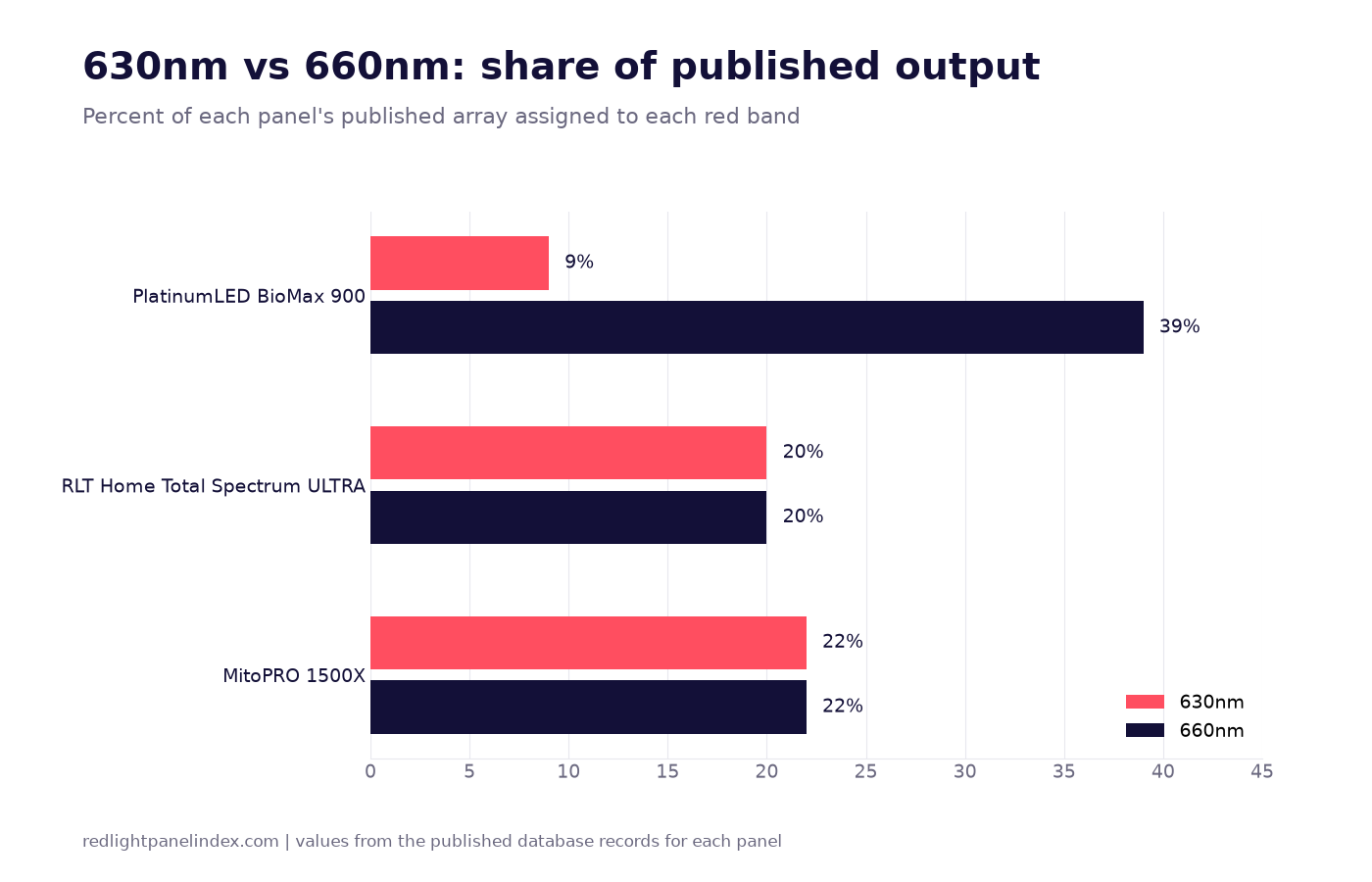
What matters more than presence on the label is the share of the array each band receives. Three examples from the database show how wide the range is.
| Model | 630nm share | 660nm share | Wavelengths published |
|---|---|---|---|
| MitoPRO 1500X | 22% | 22% | 6 |
| RLT Home Total Spectrum ULTRA | 20% | 20% | 7 |
| PlatinumLED BioMax 900 | 9% | 39% | 7 |
The MitoPRO 1500X and the Total Spectrum ULTRA split red output evenly between the two bands, while the BioMax 900 puts about four times as much of its array into 660nm as into 630nm. If a protocol you are following was written around 633nm, the BioMax 900 delivers a much smaller share of its output there. That is a design choice, not a flaw, but it is invisible if you only read the wavelength list. This site's wavelengths page makes the same point: density matters more than band count.
Irradiance figures should be read the same way. The BioMax 900 record shows a spectrometer-based independent measurement of average 90.3 mW/cm² at 6 inches, and the Total Spectrum ULTRA record shows 119.28 mW/cm² at 6 inches from an independent spectrometer test. Those are whole-panel figures, not per-band figures, so multiplying by the band share only gives a rough estimate. See the irradiance page for how method labels change what a number means.
Why dose and distance dominate
Two panels offering the same bands can deliver very different energy to the skin. Irradiance falls with distance, session time sets the total energy, and the same total energy is not equally effective across tissues. A 2018 review of photobiomodulation dosing found that tissues with fewer mitochondria, including skin, tended to need higher light doses than tissues with more, and that over-dosing explained many ineffective results in high-mitochondria tissue (PMID 30550048). For a surface goal the practical lesson is to set session length with the dose calculator using the band shares and distance you actually have, then worry about 630 versus 660 last.
Verdict by use case
- Facial skin with a protocol built on 630 to 633nm: pick a panel with a real 630nm share, such as one at 20 percent or more, and use the calculator to match the dose the protocol used.
- General skin and hair use with no specific protocol: either band is supported; choose on published density and distance, not on a 30nm difference.
- A panel with a small 630nm share: not a problem for general use, but do not assume it matches a 633nm protocol dose.
- Deeper targets such as muscle or joints: neither red band is the main tool; see the 660nm versus 850nm comparison and the penetration depth page.
What was not studied
No trial in the register compared 630nm and 660nm at matched dose in the same population, and none measured how the 30nm difference changes outcomes. The depth difference between the two is a modeled estimate, not a clinical measurement in living skin. For a single-band deep dive, the 630nm page covers which panels offer it and the trials that used it.
Cautions
Red light is generally gentle, but eye safety and photosensitizing medications still apply. Read the eye protection guide and the photosensitizing medications guide before starting, and talk with a clinician about any skin condition you are treating.