Red Light Therapy for Skin and Anti-Aging: What the Evidence Shows
Evidence grade: Strong
How red light therapy acts on skin and anti-aging
Skin aging is driven substantially by a decline in dermal collagen and by accumulated oxidative and photodamage. Red and near-infrared light act on the dermal fibroblasts responsible for producing that collagen. Photons absorbed by cytochrome c oxidase (Hamblin, PMC5523874) raise cellular energy availability and modulate the redox signaling that regulates fibroblast activity, nudging the skin toward a more synthetic, repair-oriented state.
This is the best-studied consumer application of photobiomodulation, and controlled trials have measured the downstream result directly: improved skin roughness, reduced wrinkle depth, and, in at least one study, ultrasound-measured increases in collagen density. Because collagen turnover is slow, the visible payoff is gradual and cumulative over a multi-week course.
What the studies show
| Study | Design | Finding |
|---|---|---|
| PMID 24286286 (Wunsch & Matuschka) | Controlled trial, red/polychromatic light, 2x weekly, 15 weeks | Improved skin roughness, wrinkle depth, and ultrasound-measured collagen density |
| PMID 17566756 | Controlled split-protocol study | Improved texture, fine lines, and elasticity over the course |
| PMID 37522497 | Clinical study, red + NIR | Fibroblast stimulation and collagen support with measured complexion improvement |
| PMID 19764893 | Nine-patient psoriasis trial, 633+830nm | ~90% average clearance in recalcitrant psoriasis; tiny sample, illustrative only |
Wrinkle depth and collagen density (PMID 24286286, Wunsch & Matuschka)
A controlled trial applied red and polychromatic light roughly twice weekly over about 15 weeks. Treated participants showed improved skin roughness and wrinkle depth alongside ultrasound-measured increases in collagen density, one of the cleaner objective demonstrations that the effect is structural rather than cosmetic swelling.
Texture and elasticity (PMID 17566756)
A controlled split-protocol study reported improvements in texture, fine lines, and elasticity over the treatment course, reinforcing the durability of the effect when sessions are sustained.
Fibroblast and collagen support (PMID 37522497)
A clinical study using red plus near-infrared light reported fibroblast stimulation and collagen support with measured improvements in complexion, consistent with the proposed mechanism.
Recalcitrant psoriasis, small sample (PMID 19764893)
A nine-patient trial using 633 and 830nm reported roughly 90 percent average clearance in stubborn psoriasis. The sample is tiny and the result is illustrative rather than definitive, but it points to a broader dermatological reach for the same wavelength pairing.
Which wavelengths do the work
Skin work runs on the reds, 630 and 660nm, which are absorbed in the epidermis and upper dermis where the fibroblasts live, with 830nm added to reach a little deeper into the dermis. This is the one application where a panel heavy in 630 to 660nm output is exactly right; deep 1064nm is not necessary for surface skin goals. A visible blue channel (around 480nm) is a bonus for surface and blemish work but is not the anti-aging engine.
Dosing: distance, time, and frequency
Facial protocols run 3 to 7 sessions per week, 10 to 20 minutes at 6 to 12 inches, judged over 8 to 12 weeks. This is a case where more frequent, moderate sessions beat occasional long ones, but the biphasic ceiling still applies. Consistency is the single biggest predictor of a visible result; the studies that worked all ran for months.
How it compares with conventional options
Against topical retinoids and in-office procedures, at-home red light is gentler, has no downtime, and can be combined with a normal skincare routine. It is also slower and more modest than a clinical laser or a prescription retinoid, and it does not exfoliate or resurface. The sensible framing is a low-irritation maintenance therapy that supports collagen over time, not a replacement for a dermatologist-directed plan where one is warranted.
Which panel features matter for skin and anti-aging
Skin work runs on the reds: 630 and 660nm, with 830nm adding dermal depth. Results are gradual and cumulative; protocols run 3 to 7 sessions weekly for 8 to 12 weeks before judging.
Device picks from the database
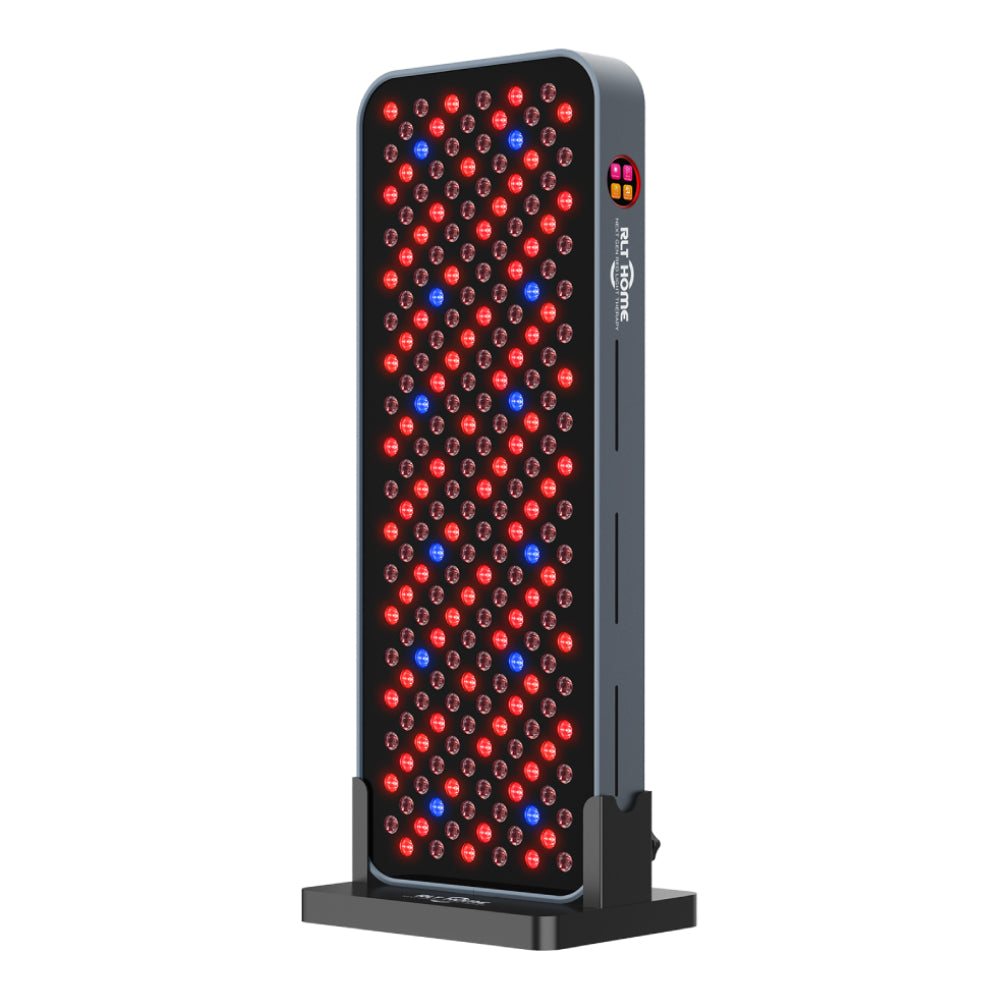
RLT Home Total Spectrum COMPACT
630/660nm at 19% each plus 830nm; blue 480nm channel for surface work.
Full specs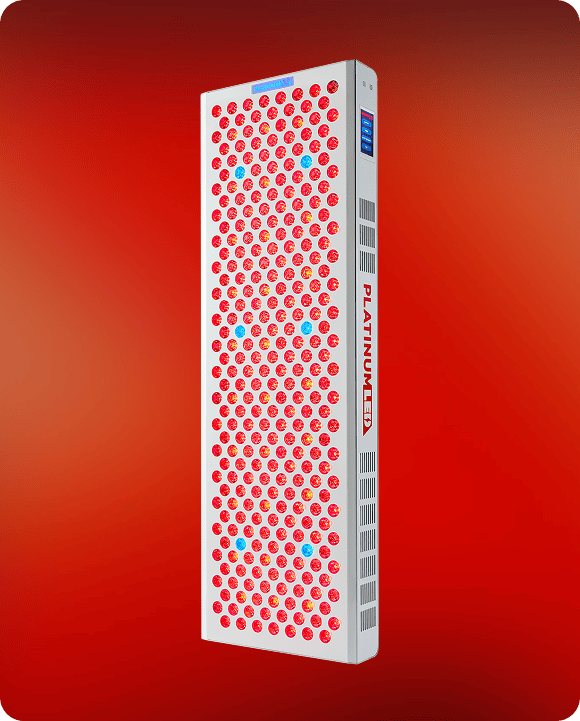
PlatinumLED BioMax 900 (classic 9th gen)
Strong 660nm output; density concentrated in 660/850.
Full specs
What the evidence does not support
Results are gradual and cumulative, and anything promising overnight change is not describing this therapy. Effect sizes vary with device output and adherence, and the psoriasis result in particular rests on a very small sample. Red light does not remove deep static wrinkles, does not replace sun protection, and will not undo damage that keeps accumulating without daily SPF.
Safety and contraindications
Among the safest applications, with the eyes the main consideration: use the supplied protection for bright panels and keep them closed during facial sessions. Photosensitizing medication warrants caution. Anyone with a diagnosed skin condition such as psoriasis should treat light as an adjunct discussed with a dermatologist.
Frequently asked questions
When will I see results?
Study protocols run 8 to 15 weeks. Anything promising overnight change is not describing this therapy.
When will I see skin results?
Study protocols ran 8 to 15 weeks. Judge it at two to three months of consistent use, not sooner.
Which wavelengths are best for anti-aging?
630 and 660nm for the skin, with 830nm to reach a little deeper. Deep 1064nm is not needed for surface goals.
Can I use it with retinol or vitamin C?
Generally yes; light therapy is non-abrasive and layers with a normal routine. Introduce actives on their own schedule and watch for irritation.
The Wunsch and Matuschka trial cited above is the largest single skin study in this site's register: 136 volunteers, two light sources, 30 sessions over about fifteen weeks. Our full review of that trial covers its exact device parameters, what was and was not blinded, and why a broader red-plus-near-infrared spectrum showed no advantage over red light alone.
A separate 2023 trial narrowed the target to the area around the eyes: 137 women, a matched 3.8 J/cm2 dose per side, ten sessions over four weeks, and a significant reduction in periocular wrinkle volume with both 660nm red and a 590nm amber comparison light. Our review of that trial covers why the close result between the two wavelengths makes it hard to credit 660nm specifically, rather than the light exposure itself, with the effect.
For a shortlist of panels ranked on the published wavelength density and irradiance figures that matter for a facial session, see this site's best panels for skin and anti-aging roundup.
For the broader map of LED trials across skin conditions, including how a 31-trial systematic review graded each one, see our study review of LEDs in dermatology.
Several of the skin trials above used 633nm light; our 630nm page lists which panels carry that band, and the 630nm versus 660nm comparison explains why dose usually matters more than the choice between the two red bands.
Two of the trials above paired 633nm with 830nm near-infrared; the 830nm page sets out what those studies tested and how much 830nm output four database panels publish.
The 2007 split-face trial that compared 830nm, 633nm and both together against a sham light has its own page: our study review of the split-face LED photorejuvenation trial covers the design and the limits of the abstract.
Methodology: rankings weigh measured or method-stated irradiance, wavelength coverage and published density, buyer terms (trial, restocking, stand, warranty), and value per LED. No brand pays for a position. Full methodology.