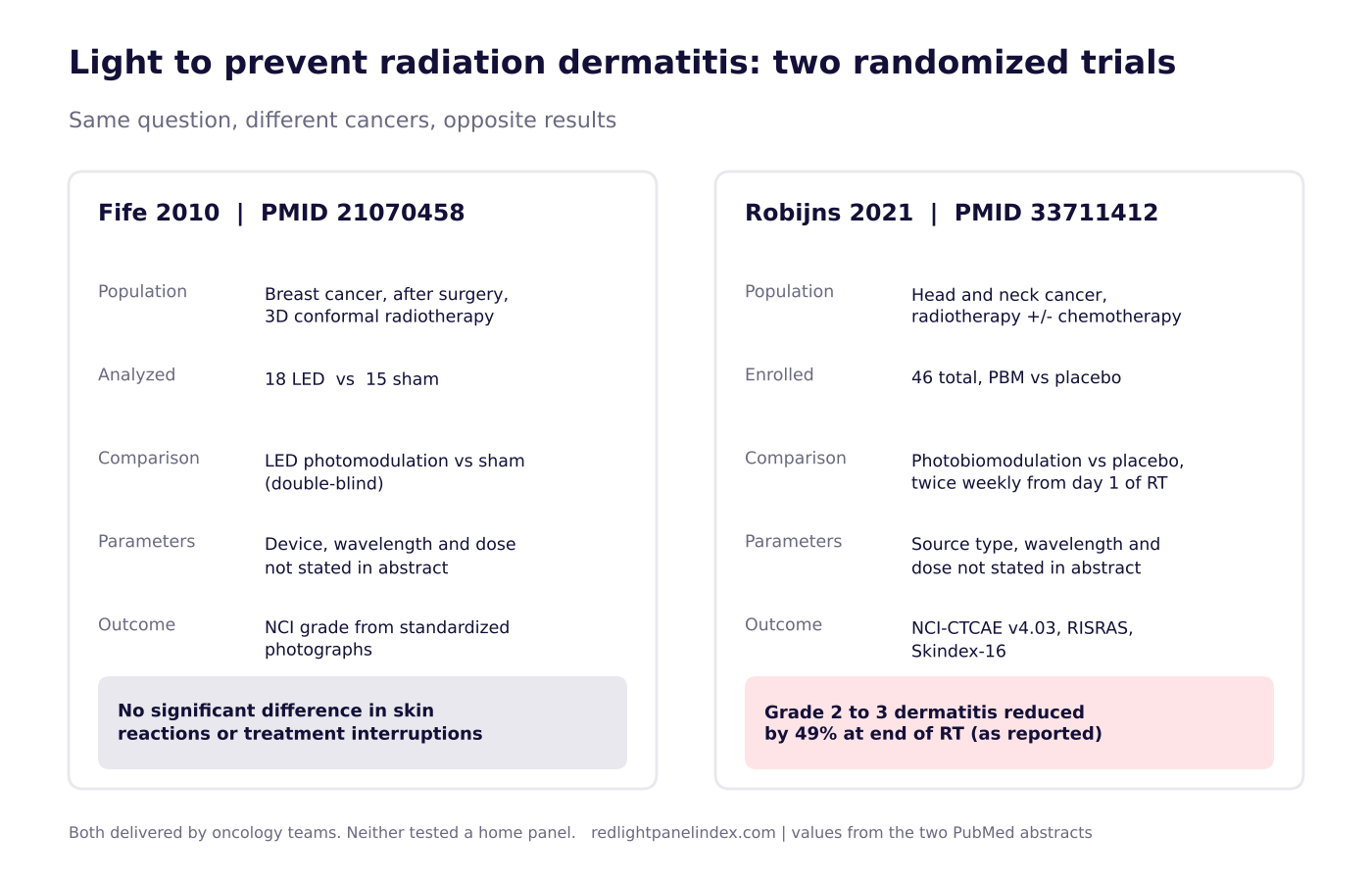
Two randomized trials have tested light for preventing the skin reaction that radiotherapy causes, and they point in opposite directions. A 2010 double-blind trial in breast cancer patients found that LED photomodulation did not reduce radiation skin reactions or treatment interruptions compared with a sham (PMID 21070458), while the 2021 DERMISHEAD trial in head and neck cancer patients reported fewer moderate to severe reactions with photobiomodulation than with a placebo (PMID 33711412). Both were run inside supervised radiotherapy programs, and neither says anything in favor of using a home panel on irradiated skin during treatment.
Choosing a panel? Our ranking of the best red light therapy panels is computed from published, method-labeled specs across 188 devices. For radiation dermatitis, the spec that matters is not on a panel at all, because both trials used protocols delivered by a clinical team; for general skin use, wavelength and irradiance with a named method are the figures to check.
What the studies asked
Acute radiation dermatitis is the redness, dryness and peeling, sometimes progressing to moist breakdown, that develops in the skin inside a radiotherapy field. The Fife abstract describes it as affecting most breast cancer patients who receive radiation, and notes that LED photomodulation had been reported to reduce it in earlier work. The 2010 trial set out to test that report under randomized, double-blind conditions.
The DERMISHEAD trial asked the same basic question in a different setting: whether photobiomodulation therapy, started on the first day of radiotherapy, could prevent acute radiation dermatitis in patients treated for head and neck cancer.
Read together, the two studies are a useful case of why this site does not grade a question on one positive trial. A 2021 meta-analysis that pooled seven trials on the same question is covered in our review of the radiation dermatitis meta-analysis. The same idea, tested twice by different groups, produced one null result and one positive one.
Who was studied
Fife and colleagues, 2010 (Dermatologic Surgery). Women with breast cancer who had undergone surgery and were scheduled for three-dimensional conformal radiotherapy. They were randomized to LED photomodulation or a sham treatment. The abstract reports results for 18 patients in the LED group and 15 in the sham group; it does not give the number originally randomized, so dropout cannot be judged from the abstract.
Robijns and colleagues, 2021 (Radiotherapy and Oncology). 46 patients with head and neck cancer receiving radiotherapy, with or without chemotherapy, randomized to photobiomodulation or placebo. The abstract does not give the split between arms.
Both samples are small. Neither trial was large enough on its own to settle the question, which the sham-controlled trials explainer flags as the first thing to check in any light therapy study.
Device and parameters as stated
This is where the abstracts are thinnest, and it matters for anyone trying to relate the results to a device at home.
- Fife 2010: the abstract names the intervention as LED photomodulation against a sham, with standardized photographs used for grading. It does not state the device, the wavelength, the irradiance, the dose per session or the schedule.
- DERMISHEAD 2021: the abstract states that sessions were given twice a week from the first day of radiotherapy, alongside the hospital's standard skincare. It does not state whether the source was a laser or LEDs, nor the wavelengths, power or dose.
Because neither abstract gives a wavelength or a dose, there is no figure here to put into the dose calculator, and no way to say from the abstracts that either protocol resembles a consumer panel session. Both were clinic protocols run by radiotherapy teams, timed against the radiation schedule, and the delivery almost certainly differed from standing in front of a home LED panel. The results should not be assumed to transfer.
What was measured and found
The 2010 breast cancer LED trial
Skin reactions were graded from standardized photographs using National Cancer Institute criteria. The abstract reports the following distribution at the end of treatment:
| Reaction grade | LED group (n=18) | Sham group (n=15) |
|---|---|---|
| Grade 0 | 0 | 1 |
| Grade 1 | 6 (33.3%) | 4 (26.7%) |
| Grade 2 | 12 (66.7%) | 9 (60.0%) |
| Grade 3 | 0 | 1 |
Treatment interruptions occurred in 2 LED patients (11.1%) and 1 sham patient (6.7%). The authors report that none of these differences was statistically significant and conclude that LED photomodulation did not reduce the incidence of radiation-induced skin reactions or treatment interruptions. The abstract gives no p-values.
The 2021 DERMISHEAD trial
Skin reactions were graded with the NCI-CTCAE version 4.03 scale and the Radiotherapy-Induced Skin Reaction Assessment Scale, and quality of life was measured with the Skindex-16 questionnaire. The abstract reports that photobiomodulation significantly reduced grade 2 to 3 acute radiation dermatitis by 49% at the end of radiotherapy, and the authors conclude that it is an effective way to prevent severe reactions in this group. The abstract does not report a p-value for that figure or a separate quality-of-life result.
Limitations
- Small samples on both sides. 33 analyzed patients in one trial and 46 enrolled in the other. A real effect can be missed in a trial this size, and a chance result can look significant.
- Different cancers, different fields. Breast and head and neck radiotherapy irradiate different skin, at different doses and with different reaction rates, so the two trials do not test exactly the same thing.
- Parameters missing from the abstracts. With no wavelength or dose in either abstract, it is not possible to tell from them whether the negative trial simply used a weaker or different protocol than the positive one.
- Unclear dropout in the 2010 trial. The abstract reports analyzed numbers only.
- Blinding with visible light. As the sham-controlled trials page explains, a sham that feels or looks different can let patients and assessors guess their group. Grading from standardized photographs, as the 2010 trial did, helps on the assessment side.
Why a negative LED trial matters for the grade
A null result from a double-blind trial is not a failure to report; it is evidence. If only the positive head and neck trial were counted, the picture would look better than it is. Under the approach set out in the evidence grades explainer, two small trials that disagree, in different patient groups and with protocols the abstracts do not describe, would not support a grade above Limited for this question, and would support Insufficient for any home device, since neither trial tested one.
The same pattern appears elsewhere on this site. The oral mucositis evidence page grades clinician-delivered photobiomodulation as Strong for specific cancer-treatment settings, because a guideline review drew on many trials, but Insufficient for home panels. The broader skin pages, skin and anti-aging and wound healing, rest on trials of healthy aging skin and of wounds, not irradiated skin, and their grades should not be read across to radiotherapy.
On tumor safety, the safety and side effects page covers a 2019 systematic review of photobiomodulation in cancer supportive care, including radiodermatitis, which found no evidence of tumor safety problems across the pooled studies. That is reassurance about the clinical protocols that were studied, not permission to self-treat.
What it means for a home panel
Very little directly, and that is the honest answer.
- Do not self-treat during radiotherapy. Both trials were delivered and timed by oncology teams, with the light given around a radiation schedule and standard skincare. Irradiated skin is fragile, and adding heat, pressure or an unplanned light exposure is a decision for the radiotherapy team, not a buyer.
- Ask your oncology team if you are interested. Some radiotherapy departments run photobiomodulation programs. That is the route the evidence supports, not a home device.
- After treatment, the general cautions still apply. For anyone with a cancer history considering a panel later, the safety and side effects page and the related pages on lymphedema and chemotherapy-induced neuropathy set out what has and has not been studied.
The takeaway from these two trials is narrow: one well-blinded LED trial in breast cancer found no benefit, one placebo-controlled trial in head and neck cancer reported fewer severe reactions, and neither tells a home user what to do with a panel.