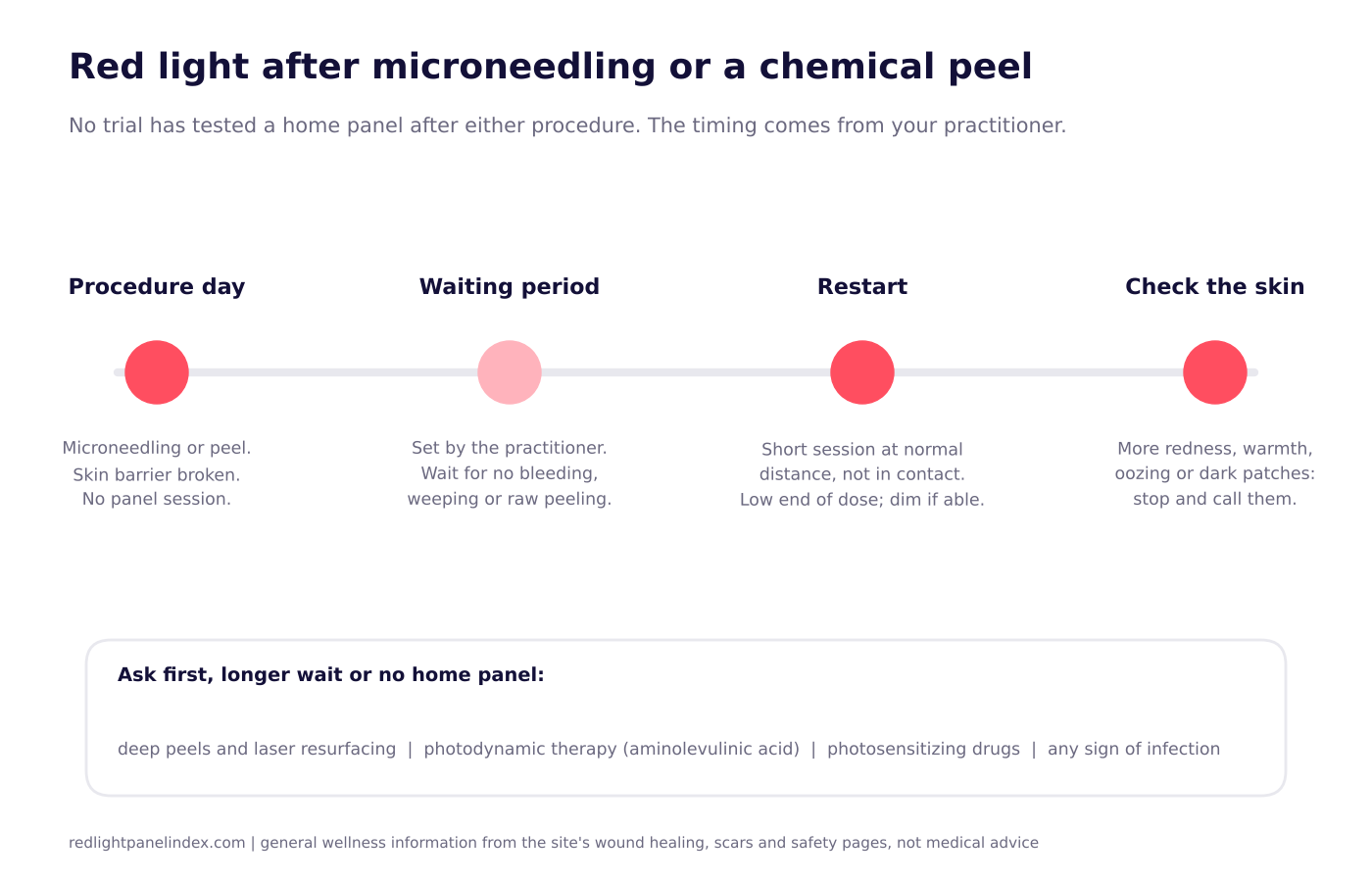
Wait until the person who did your microneedling or chemical peel says the skin can take light again, and if they give no instruction, wait until the skin has closed over: no pinpoint bleeding, no weeping, no raw or actively peeling patches. Then restart with a short session at your panel's normal distance and check the area afterward. This site has no trial of a home panel after microneedling or a peel, so the timing comes from the practitioner and from general wound care, not from a tested protocol.
Choosing a panel? Our ranking of the best red light therapy panels is computed from published, method-labeled specs across 188 devices. For sessions on recently treated skin, the spec that matters is dimming or a method-labeled irradiance figure, so you can keep the first sessions at a known, low dose.
What the evidence does and does not cover
Microneedling and peels both work by injuring the skin on purpose. Microneedling makes many tiny punctures; a chemical peel dissolves the outer layers to a depth that depends on the acid and its strength. Either way, for a period afterward the barrier that normally sits between the panel and living tissue is thinner or broken.
Whether red light, with its long record in wound repair, helps that skin recover is not something the site's evidence answers directly:
| Question | What this site can say |
|---|---|
| Does a home panel speed recovery after microneedling? | Not studied in any trial on this site |
| Does a home panel speed recovery after a chemical peel? | Not studied in any trial on this site |
| Does red light help wounds heal in general? | Graded Strong, but in clinical wounds under supervision |
| Has light been used on skin right after a resurfacing procedure? | One small case series, after scar revision |
| Is a session on freshly broken skin safe at home? | Not established; the site's pages advise asking a clinician |
The wound healing evidence page grades red and near-infrared light as Strong for wound repair, based on controlled studies of surgical wounds, ulcers and burns. But those studies used light under clinical supervision, as an addition to dressings and infection control, and the page's advice for home use on anything beyond minor cuts is to ask a clinician first. A fresh peel or a microneedled face is a controlled injury over a large area, exactly where that advice applies.
The scars evidence page is graded Limited. Its closest study is a case series in which near-infrared light at 805nm was applied at home for 30 days after surgical or CO2 laser scar revision, and the near-infrared-treated scars improved without significant treatment-related adverse effects (PMID 20662038). That is the nearest thing in the register to light after resurfacing, but it was a small, unrandomized series on revised scars, not a study of cosmetic microneedling or peels. The same page says not to apply light to an open or newly closed wound without the managing clinician's advice.
Some clinics add an LED session to a microneedling or peel appointment. That is the clinic's choice, made with the skin in front of them, and not a reason to run a home panel against your practitioner's instructions.
Why practitioners give a waiting period
Aftercare for microneedling and peels commonly asks you to keep the skin clean, avoid heat and sweating, skip actives and exfoliants, and protect it from the sun for a period that depends on the depth of the treatment. The length varies by procedure, product and skin, which is why this guide does not give a number of days. The reasons apply to a light panel in a general way:
- Open skin and infection. Punctures and peeled areas are entry points. Anything that touches the face, including an LED mask pressed against it, needs to be clean, and the cleaning and maintenance guide covers how to wipe a panel or mask.
- Warmth. A panel is not a heat lamp, but at close range you feel warmth, mostly from the LEDs and electronics, as the thermal versus photochemical page explains. Practitioners keep heat away from inflamed skin.
- Dose on compromised tissue. Light follows a biphasic dose response: a moderate dose is associated with benefit and a higher one can reverse it (PMID 22461763). The wound healing page notes that overdosing compromised tissue can cause harm. Skin without its outer layer may respond differently from the intact skin that panel doses are usually worked out for.
- Pigment changes. Inflamed skin can darken after a procedure, especially in darker skin types. The skin phototype and dosing page covers how melanin changes what skin absorbs.
Practical steps
- Ask before your appointment. Tell the practitioner you use a red light panel, which wavelengths it emits and how often, and ask when you can resume. Name any near-infrared or blue channels, since they may treat them differently.
- Follow their window. If they give a waiting period, use it. If they have no instruction about light, wait until there is no bleeding, weeping or raw skin and any peeling has finished.
- Restart at a distance, not in contact. Use the panel at its normal working distance. Keep masks and wands that press on the skin until the area is fully healed. The guide to distance from a panel explains how distance changes what reaches the skin.
- Start short and low. Use the low end of your usual session, and dim the panel if it allows. The dose calculator turns your panel's irradiance at your distance into a dose; the session length guide covers why the short end is the sensible starting point.
- Keep the routine order. Clean, dry skin first, then the session, then the products your practitioner recommended, as in where red light fits in a skincare routine. Hold off on retinoids and exfoliating acids for as long as your aftercare says; the retinol and acids guide covers spacing once you add them back.
- Check the area afterward. More redness, warmth, stinging, swelling, oozing or new dark patches after a session are reasons to stop and contact the practitioner.
- Protect the eyes. Face sessions need eye protection; see the eye protection guide.
The exceptions
- Deep peels and laser resurfacing. Medium and deep peels and ablative laser treatments take longer to heal and are usually followed up in clinic. Follow that clinician's plan; do not add a home panel without asking.
- Photodynamic therapy. A peel or microneedling session is sometimes combined with aminolevulinic acid, a photosensitizer activated on purpose by light, including red light. After photodynamic therapy, follow the clinic's light-avoidance instructions exactly. This is a known light reaction, not general irritation.
- Photosensitizing medication. If you take a drug associated with light sensitivity, the photosensitizing medications guide applies on top of the aftercare.
- Panels with a blue channel. Blue light sits closer to where some photosensitizers absorb, as the 480nm blue light page explains. On recently treated skin, a red and near-infrared only mode is the conservative choice.
- Complications. Spreading redness, increasing pain, crusting, pus or fever need a clinician, not a session. Do not use a panel on an area that is being assessed for infection.
- Diagnosed skin conditions. If you are treated for rosacea, acne or eczema, plan sessions with your dermatologist.
- Same-day injections. Clinics sometimes bundle peels or microneedling with injectables; see red light after Botox or fillers and ask about each treatment separately.
What was not studied
- No trial on this site tested a home panel after microneedling or a chemical peel.
- No study compared different restart times after either procedure.
- No study measured whether light changes how a peel or microneedling result develops, or how post-procedure products are absorbed.
- The skin anti-aging evidence comes from trials on intact skin with clinical devices, so it does not describe a panel used on freshly treated skin.
The safety and side effects page found no serious adverse events in the trials this site reviewed, but none of those trials looked at skin in the days after a procedure. Your practitioner's instructions come first. This is general wellness information, not medical advice.