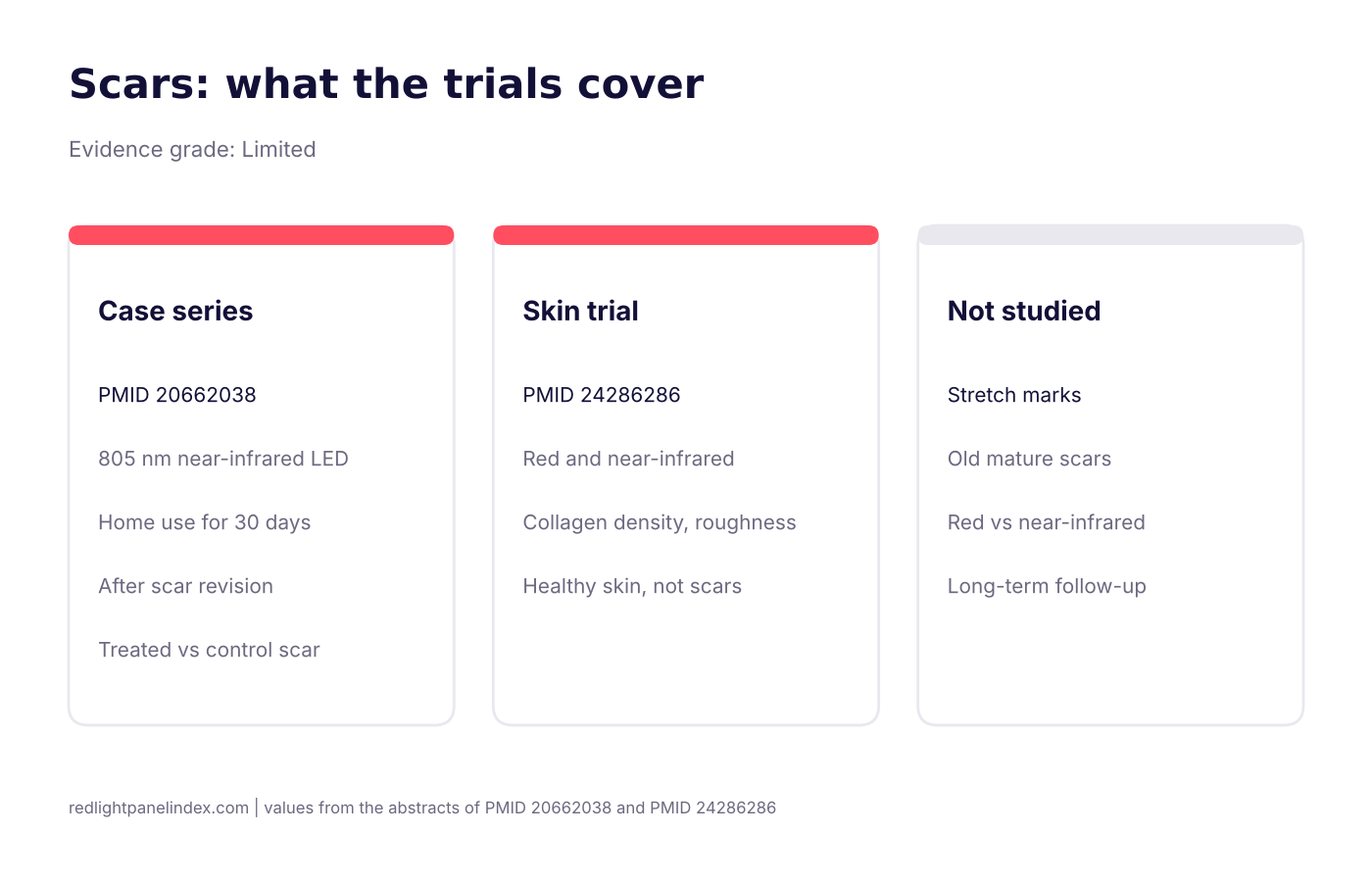
The evidence for red and near-infrared light on scars is graded Limited: it rests on one small case series of hypertrophic scars and keloids (PMID 20662038), with no control group of the kind a randomized trial would give, plus collagen findings from skin trials that were not scar studies. There is enough to say the idea is plausible and worth studying, and not enough to say a home panel changes how a scar heals.
Choosing a panel? Our ranking of the best red light therapy panels is computed from published, method-labeled specs across 188 devices. For scar work, the spec that matters is the wavelength mix, because the one scar series used near-infrared light.
How this page grades the evidence
Limited means a small number of human studies with real design weaknesses, pointing in a consistent direction. The same grade is used on our acne page. For scars, the weaknesses are plain: the key study is a case series, the people in it were recovering from scar-revision procedures, and no trial compared different doses or wavelengths on scars.
Study 1: a case series on hypertrophic scars and keloids
The case series by Barolet and Boucher in Lasers in Surgery and Medicine is titled "Prophylactic low-level light therapy for the treatment of hypertrophic scars and keloids: a case series" (PMID 20662038).
Device and wavelength. The abstract describes a near-infrared LED at 805 nm. This is outside the 630 to 660 nm red band most skin protocols use; our wavelength guide explains where each band is absorbed.
Who and how. The light was applied at home for 30 days after surgical or CO2 laser scar revision. In other words, the question was prevention of recurrence in scars that had already been revised, not treatment of an old, settled scar.
What was reported. Significant improvements were seen on the near-infrared-treated scar compared with the control scar in all efficacy measures. No significant treatment-related adverse effects were reported. The authors suggested that suppression of TGF-beta I may be one mechanism and called for larger studies.
Why the grade stays at Limited. A case series has no randomization. The abstract describes a comparison between treated and control scars, which is more informative than a before-and-after look, but the sample is small and the design cannot rule out that the scars were already going to improve. The population was scars after revision procedures, so the result does not transfer to an acne scar from years ago or to a stretch mark. We did not find a dose in joules per square centimeter that we could quote with confidence, so none is given here.
Study 2: collagen findings from a skin trial
Scar tissue is, in part, a collagen problem, so skin trials that measured collagen are relevant context, though they are not scar studies. Wunsch and Matuschka published a controlled trial of red and near-infrared light in Photomedicine and Laser Surgery (PMID 24286286).
The abstract reports that treated subjects had improved skin complexion and skin feeling, lower profilometric roughness and higher ultrasonographic collagen density, and that blinded photo assessment favored the light groups over controls. The authors concluded that broadband polychromatic light had no advantage over a red-only spectrum. Our skin and anti-aging page describes the same trial as running about twice a week for 15 weeks in 136 volunteers.
What this does and does not show. Higher collagen density in healthy skin does not show that a raised, thick scar will flatten, or that a depressed scar will fill. Collagen in a hypertrophic scar is already overproduced and disorganized. In that setting "more collagen" is not obviously the goal, which is why the two studies do not combine into a firm claim. The two studies are best read as separate pieces: one scar series that suggests a prevention signal after revision, and one skin trial that shows light can change measurable skin properties.
The wound-healing backdrop
Scars form after a wound closes, so the broader wound healing evidence matters. The mechanism proposed for photobiomodulation, light absorbed by mitochondria with downstream effects on inflammation and repair, is covered in our photobiomodulation explainer. That page is a mechanism summary. It does not establish that light improves the final appearance of a scar, and the biphasic dose response means that more light is not automatically better.
What was not studied
- Stretch marks (striae). We did not find a controlled trial of red light on stretch marks, so we make no claim about them.
- Acne scars. The acne evidence concerns active lesions, not the marks left behind.
- Old, mature scars. The case series dealt with the period right after revision.
- Dose and wavelength comparisons. No study compared red with near-infrared on scars, or compared session counts.
- Long-term follow-up. The scar series is a 30-day application, so durability is unknown.
- Dark skin tones. Scarring patterns, including keloids, vary by skin type, and we found no scar study here that lets us say how results differ.
Practical use with a home panel
If a clinician has cleared you to try light on a healed scar, treat it as an experiment with a defined end point rather than an open-ended routine.
- Match the wavelength to the evidence. The scar series used 805 nm, so a panel with near-infrared output in the 800 to 850 nm range is the closest match. Red at 630 to 660 nm is the better-supported band for general skin, per our skin page.
- Work out the dose. Use the dose calculator with your panel's method-labeled irradiance at your treatment distance, and keep sessions moderate. Our irradiance explainer shows how to read those numbers, because a figure with no stated method cannot be used for dosing.
- Photograph the scar. Take a photo in the same light every two weeks. Without a record, a slow change is impossible to judge.
- Set a stop date. If nothing has changed in 8 to 12 weeks, the evidence gives no reason to continue.
- Do not apply light to an open or newly closed wound without asking the clinician who is managing it.
Cautions
- This page is general information, not medical advice. A raised, growing or painful scar, or a keloid, deserves an assessment from a dermatologist or surgeon, who have treatments with far better-documented results.
- Light does not replace sun protection. Fresh scars are more prone to darkening in sunlight.
- Photosensitizing medications, including some acne and antibiotic drugs, can change how skin reacts to light; see the cautions on the rosacea page.
- Protect your eyes with the eyewear supplied or by keeping them closed during facial sessions.
- Stop if the area becomes more red, hot, painful or starts to ooze.
Bottom line
One small case series, in people recovering from scar revision, reported improvement with 805 nm near-infrared light and no significant treatment-related adverse effects. A separate skin trial reported higher collagen density with red and near-infrared light. Neither study tested a home panel on an established scar or a stretch mark. That is a plausible lead rather than a result, and it is why this page sits at Limited.