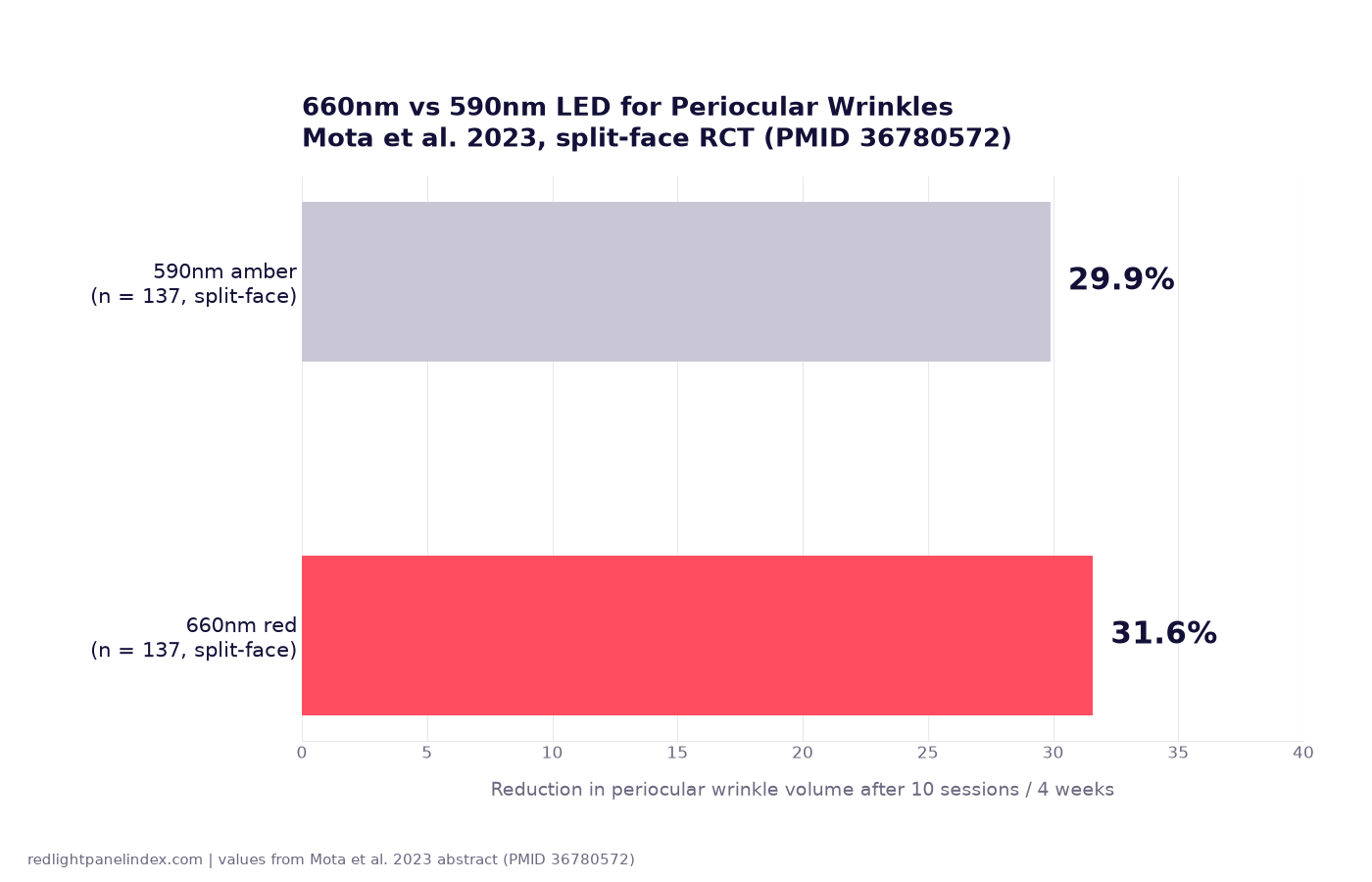
A 2023 split-face randomized trial in 137 women aged 40 to 65 compared 660nm red against 590nm amber LED light at a matched dose and found both wavelengths reduced periocular wrinkle volume by a similar, statistically significant amount over four weeks, 31.6 percent with red and 29.9 percent with amber (PMID 36780572). Neither wavelength improved skin hydration or elasticity in this trial.
Choosing a panel? Our ranking of the best red light therapy panels is computed from published, method-labeled specs across 188 devices. For periocular wrinkles specifically, the spec that matters is the published irradiance at 660nm, since it is what turns a session length into the dose this trial actually tested.
What the study asked
Periocular wrinkles, the fine lines and volume loss around the eyes, are one of the earliest visible signs of facial aging, and light-based treatments are marketed for the area with limited head-to-head evidence on which wavelength does the work. The Mota trial asked a specific comparative question: at a matched light dose, does 660nm red LED light outperform 590nm amber LED light for reducing periocular wrinkle volume, or do the two wavelengths perform about the same. Amber light in the 590nm range is sometimes marketed for skin alongside red, so testing the two head to head, on the same volunteers, at the same dose, was the trial's way of isolating wavelength from everything else a light-therapy session involves.
Who was studied
The trial enrolled 137 women between the ages of 40 and 65. It used a split-face design: rather than randomizing whole volunteers to one wavelength or the other, each woman's face was divided and the two sides randomized separately, so every participant received both treatments on herself, one side treated with 660nm and the other with 590nm. That design controls for the biggest source of noise in a skin trial, the person, since age, skin type, sun history and baseline wrinkle depth are identical on both sides of the same face. The abstract does not report skin type, ethnicity, prior cosmetic procedures or menopausal status, so the population beyond "women aged 40 to 65" is not specified further here.
Device and parameters as stated
Both sides received LED light at a matched dose of 3.8 J/cm2 per side, delivered across 10 sessions over four weeks, roughly two to three sessions a week. That dose is well below the approximately 9 J/cm2 used in the largest general skin trial this site reviews, and the session count and four-week window are shorter than the twice-weekly, fifteen-week schedule that trial ran. The abstract does not state the irradiance in mW/cm2, the device model, the distance from skin, or the individual session length in minutes; it reports the dose target and the wavelengths, not the inputs that produced it. That gap matters for translating the trial to a home panel: without a stated irradiance, this site's dose calculator can convert the 3.8 J/cm2 target into a session length for a given panel, but it cannot confirm the trial's own session ran anywhere near a typical home-panel distance or duration.
The image above charts the two arms' outcome rather than any of the device parameters, since irradiance, distance and device type are simply not in the abstract to plot.
What was measured and found
The trial measured periocular wrinkle volume before and after the four-week course and found a significant reduction on both sides: 31.6 percent with 660nm red and 29.9 percent with 590nm amber. The two figures sit close enough together that the trial's own framing treats them as broadly comparable rather than one wavelength clearly beating the other. Skin hydration and elasticity were also measured, and neither improved significantly with either wavelength in this trial, a narrower result than the wrinkle-volume finding and worth noting before assuming a periocular light session improves every skin metric at once. The authors also noted the approach may suit people for whom more inflammatory cosmetic procedures are contraindicated, including those with diabetes or a history of keloid scarring, though that is a stated rationale for testing the treatment, not a separate outcome the trial measured.
Limitations
The split-face design is a real strength for controlling individual variation, but it also means the trial has no untreated, fully sham side: both sides of every face received active light at a matched dose, so the comparison is red versus amber, not light versus no light. That leaves open how much of the 30-percent-range reduction either wavelength would have produced against a true no-treatment control, a comparison this specific trial was not built to make. The population is limited to women aged 40 to 65, so the result does not establish anything about men or about other age ranges. The abstract gives no irradiance, device model, distance or per-session duration, which limits how precisely a home panel user can reproduce the protocol beyond matching the 3.8 J/cm2 total dose. And because the two wavelengths performed so similarly, 31.6 versus 29.9 percent, the trial does not show a clear mechanistic advantage for 660nm specifically at this site or dose; a larger effect gap would have made a wavelength-specific case more strongly than a narrow one does.
What this means for a home panel
The honest read is that this trial supports periocular light exposure generally, at a modest 3.8 J/cm2 dose delivered ten times over four weeks, more than it supports 660nm specifically over other visible wavelengths, since amber performed almost as well. This site's 660nm page covers where that wavelength sits relative to the rest of the red band and what else has been tested at it, and the skin and anti-aging evidence page rounds up this trial alongside the other controlled skin studies this site tracks, including the larger Wunsch and Matuschka trial, which used a considerably higher 9 J/cm2 dose over a much longer fifteen-week course and reported collagen density gains this trial did not measure. Anyone trying to approximate the Mota protocol on a home panel would need a method-labeled 660nm irradiance figure and the dose calculator to solve for the session length that reaches 3.8 J/cm2 at their working distance, kept to roughly ten sessions across a month, while recognizing that the trial's own device, distance and exact session length are not published, so any home reproduction is an approximation of the dose alone, not the full protocol. This site's best panels for skin and anti-aging roundup ranks candidates on exactly that published irradiance and wavelength density. A different 660nm trial on this site, Papageorgiou's foundational acne study, paired the same wavelength with a blue channel rather than testing it alone, a useful reminder that 660nm's role varies by which condition and which combination a given trial actually tested.