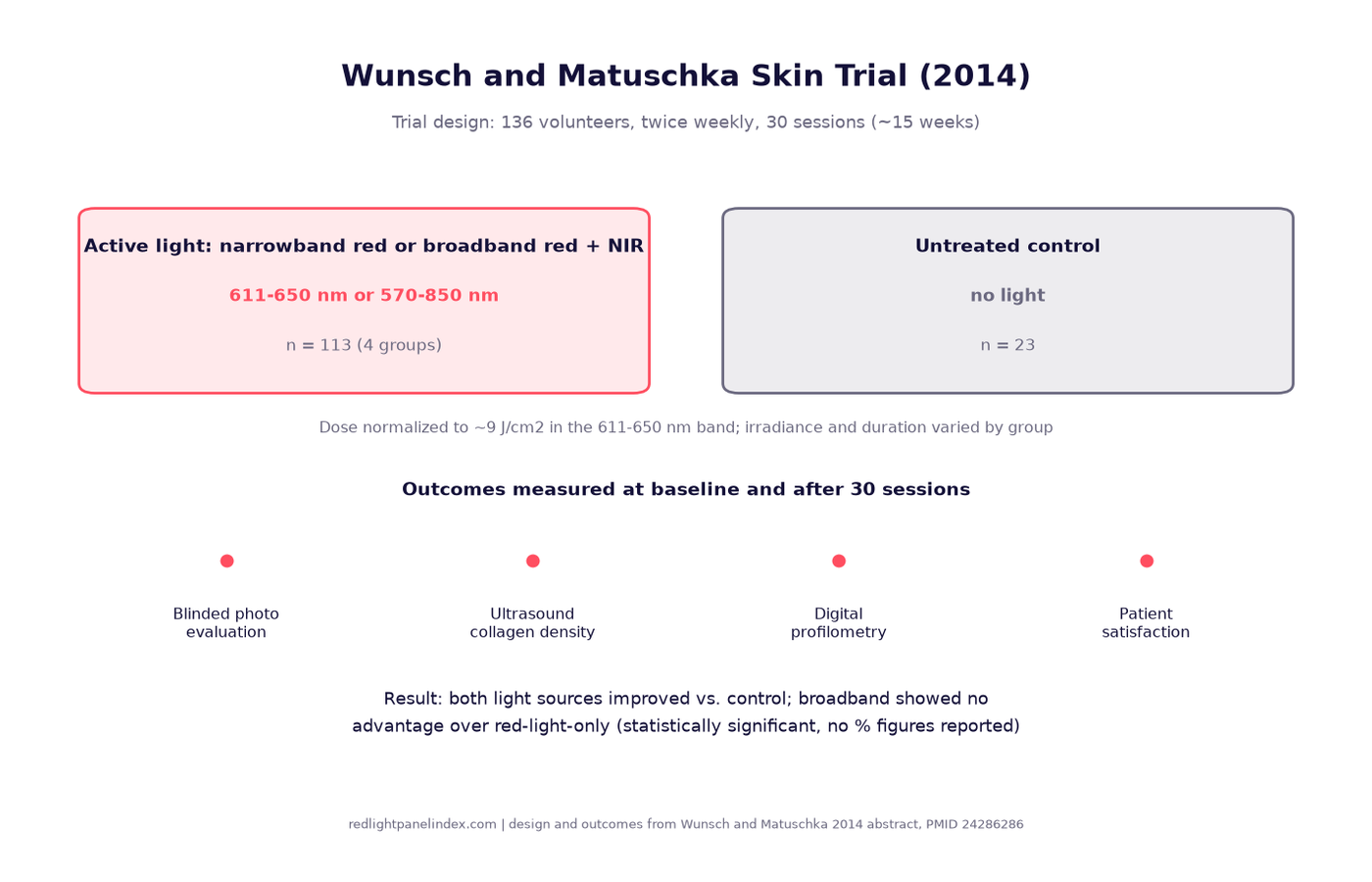
A 2014 controlled trial is the largest single skin study in the red light therapy literature: 136 volunteers, two light sources, 30 sessions over about fifteen weeks, with collagen density measured by ultrasound rather than judged by eye (PMID 24286286). It found that both a narrowband red source and a broader red-plus-near-infrared source improved skin roughness, complexion and collagen density against untreated controls, with no advantage for the broader spectrum.
Choosing a panel? Our ranking of the best red light therapy panels is computed from published, method-labeled specs across 188 devices. For skin work, the spec that matters is the published density at 660nm, the band closest to what this trial's red-only arm tested.
What the study asked
The researchers, Wunsch and Matuschka, set out to test two light sources built for large-area or full-body use rather than a small treatment spot, and to answer a specific design question: does spreading photobiomodulation across a broader spectrum, rather than concentrating it in the red band alone, produce a better skin result. Narrow-spectrum lasers and LEDs were already established as safe and effective for non-thermal photorejuvenation, but their narrow bandwidth and small, dot-shaped emission were seen as limitations for treating a large area evenly. The trial compared a narrowband red source against a broadband source that extended from red into near-infrared, to see whether the wider spectrum added anything.
Who was studied
The trial enrolled 136 volunteers. Of these, 113 were randomly assigned into four active treatment groups; the remaining 23 served as untreated controls. The paper does not report the age range, sex distribution or skin type of the cohort in the abstract, so the population beyond "volunteers" is not specified here.
Device and parameters as stated
Two novel, non-thermal, polychromatic light sources were tested, both designed for large-area or full-body application rather than the spot-sized handhelds or lasers used in earlier skin trials. One source covered a narrow red band, 611 to 650 nanometers. The other covered a much broader range, 570 to 850 nanometers, spanning green light through red and into near-infrared. Dose was normalized to approximately 9 J/cm2 in the 611 to 650 nanometer range across groups, though the abstract states that irradiance and treatment duration varied within each of the four groups rather than following one fixed protocol. Subjects were treated twice a week for 30 sessions, which works out to roughly fifteen weeks. That twice-weekly, thirty-session rhythm is the same one this site's guide to how often to use red light therapy singles out as the most tested skin schedule.
What was measured and what was found
Outcomes were collected at baseline and again after all 30 sessions: blinded evaluation of clinical photographs, ultrasonographic measurement of collagen density, computerized digital profilometry to quantify skin roughness, and a patient satisfaction assessment. Treated subjects showed significant improvement in skin complexion and skin feeling, profilometrically measured roughness, and ultrasound-measured collagen density, compared with the untreated control group. The blinded clinical evaluation of photographs also confirmed significant improvement in the treatment groups relative to controls. The abstract reports these results as statistically significant improvements but does not give specific percentage changes or effect sizes for collagen density or roughness, so no numeric figure is quoted here beyond what the paper states in words.
On the specific question the trial was designed to answer, the broadband 570 to 850 nanometer source showed no advantage over the narrowband 611 to 650 nanometer red-only source. Both sources worked; neither beat the other. That result runs against the assumption behind a lot of panel marketing, that stacking more wavelength bands onto one device should produce a better outcome than a narrower, well-targeted spectrum. Here, widening the spectrum by more than 250 nanometers, deep into wavelengths well outside where most consumer panels concentrate output, added no measurable benefit over the red band alone.
What was and was not blinded
The photograph evaluations were explicitly blinded, meaning the assessors scoring before-and-after images did not know which group a given photograph came from. The instrument readings, ultrasonographic collagen density and digital profilometry, are objective measurements rather than judgment calls, so blinding matters less for those two outcomes than for the photo scoring. What the abstract does not describe as blinded is the subjects themselves: the design compared two active light sources against an untreated control group, and an untreated control by definition cannot be blinded to whether they received light exposure. That leaves open the possibility of a placebo or expectation effect specifically in the self-reported satisfaction outcome, though it does not explain the ultrasound and profilometry results, which do not rely on what a subject believed about their treatment.
Limitations
The trial used two purpose-built, large-area light sources, not a commercial flat panel of the kind sold today, and the abstract does not report their irradiance in mW/cm2 or their distance from skin, only the resulting dose target in one band. The four treatment groups had varying irradiance and duration within them, which the abstract does not break out group by group, so the exact protocol behind the reported average is not fully recoverable from the summary. No numeric effect sizes are given for the main outcomes, only that improvements were statistically significant, which limits how precisely this trial can be compared with others that do report percentages. The population is described only as "volunteers," with no age, sex or skin-type breakdown in the abstract. And because the control arm was untreated rather than sham-treated, subject-level blinding was not possible, which the paper does not address as a limitation but is worth flagging for the satisfaction outcome specifically.
What this means for a home panel
The red-only arm's 611 to 650 nanometer band sits close to, but does not exactly match, the 660nm peak most home panels ship today; this site's 660nm page covers where that specific wavelength sits in the red band and how common it is across the database. The trial's headline finding, that adding a broader 570 to 850 nanometer spread of wavelengths did not outperform red light alone, is a useful data point against the common panel marketing claim that more wavelength labels automatically mean a better result: at least for this particular skin outcome and this particular pair of sources, it did not. A separate, smaller 2023 trial targeting the periocular area specifically used a much lower 3.8 J/cm2 dose and found red performed close to, not clearly ahead of, an amber comparison wavelength, which this site's review of that trial covers in more depth. The 9 J/cm2 red-band dose target and twice-weekly, thirty-session schedule are concrete enough to replicate on a panel; enter your device's published irradiance at 660nm and your working distance into the dose calculator to find the session length that gets you there, and expect to commit to roughly fifteen weeks, not fifteen days, before judging the result the way this trial did. This site's results timeline guide lines that fifteen-week wait up against the other trials in this index's register, since none of them report a visible change any earlier either. For a ranked shortlist of panels built around the wavelength density and irradiance this kind of trial calls for, see this site's best panels for skin and anti-aging. Unlike this trial's red-and-near-infrared-only sources, the foundational acne trial reviewed in this site's Papageorgiou study review paired 660nm with a blue channel, a different combination aimed at a different skin question.