The skin trials this site tracks concentrate their light in two places: the 630 to 660nm red band and, in some protocols, 830nm near-infrared, so a panel built for facial and skin use is ranked here on how much of its published output actually sits in that range, alongside method-labeled irradiance at a 6 to 12 inch face distance, coverage, price and buyer terms. Four panels from this site's database cover the range from a fully spec-transparent mid-size panel to a compact budget option.
Choosing a panel? Our ranking of the best red light therapy panels is computed from published, method-labeled specs across 188 devices. For skin and face use specifically, the spec that matters most is the published share of output in the 630 to 660nm and 830nm bands, not total irradiance alone.
How these picks are ranked
Every model here is scored on the same four database fields this site uses for every best-of list, read with a face-use lens: a panel that publishes exactly where its power goes and backs its irradiance figure with a named instrument and distance ranks ahead of one that states a single combined number with no breakdown. See how rankings work for the full method behind every list on this site.
| Criteria | What it measures for skin and face use |
|---|---|
| Published wavelength density | Share of stated output in 630-660nm plus 830nm, and whether the brand publishes a per-wavelength breakdown at all |
| Method-labeled irradiance | mW/cm2 at 6in and, where available, 12in, with the measuring instrument named |
| Coverage | Panel dimensions relative to a face-sized treatment area, not a full-body area |
| Price and buyer terms | Verified price, warranty length, trial window and restocking terms |
The picks
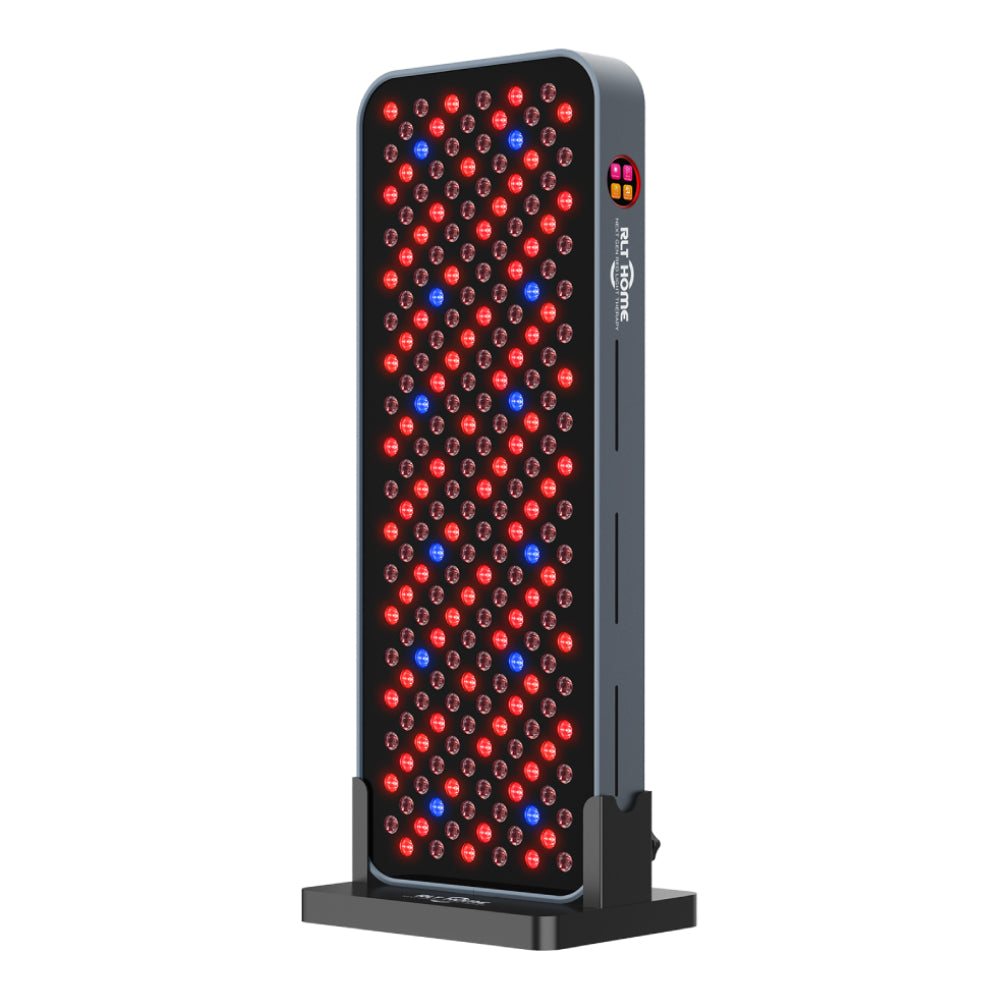
1. RLT Home Total Spectrum COMPACT publishes a full seven-band breakdown, 19 percent of output at 630nm, 19 percent at 660nm and 14 percent at 830nm, a combined 52 percent in the two bands the skin trials used, measured with a named spectrometer (Electropossible Ltd, HP350IR) at 99.0 mW/cm2 at 6 inches. At $1,095 (verified 2026-09-12), it carries a 3-year warranty and a 60-day trial with no restocking fee, the cleanest buyer terms of the four panels here. Its 30.3 by 11.8 inch array is larger than a dedicated face mask but covers a face and neck easily at a 6 to 12 inch working distance, and the fully published breakdown is the deciding factor for the top spot: it is the only panel here where the 630-660nm-plus-830nm share comes from the brand's own stated numbers rather than an independent reconstruction.
2. BlockBlueLight PowerPanel MEGA publishes the highest target-band share of the four, a brand-stated 10 percent at 630nm, 40 percent at 660nm and 5 percent at 830nm, 55 percent combined, backed by a dual solar-meter-and-spectrometer irradiance claim of 167 mW/cm2 at 6 inches. Independent testing by Light Therapy Insiders measured a flatter distribution across bands and a lower peak-and-average irradiance than the brand figure, a gap worth weighing against the strong published density. At $1,500 (verified 2026-09-12) it is the most expensive pick here, and it carries the longest warranty, 5 years, but the shortest trial window, 30 days, with no restocking fee but customer-paid return shipping, and discount codes over 15 percent make a purchase exchange-or-credit-only rather than refundable.
3. PlatinumLED BioMax 900 (classic 9th gen) does not publish its own wavelength breakdown; the roughly 48 percent combined 630-660nm share and the 830nm slice come from Light Therapy Insiders' independent array-blend reconstruction, not a brand-stated figure. Its independently measured irradiance holds up better at a longer working distance than the other picks here, averaging 90.3 mW/cm2 at 6 inches and still about 75 mW/cm2 at 12 inches, useful if a face session at the far end of that range matters. At $1,299 (verified 2026-08-13) it carries the weakest return terms of the four, a 20 percent restocking fee plus customer-paid shipping on an elective return, alongside a 3-year warranty and 60-day trial.
4. Hooga HG300 is the budget pick and the most face-appropriate size, at 12.2 by 8.2 inches, but it is the only panel here with no published wavelength density breakdown at all, listing only that it emits 660nm and 850nm without stating the split between them. Its claimed 73 mW/cm2 at 6 inches irradiance also has no stated measurement method, and independent testing found roughly half that figure, so this site's own database page recommends halving the claim for dosing purposes. At $199 (verified 2026-09-12), with a 3-year warranty and a 60-day trial where the return shipping label cost is deducted from the refund, it is the clear choice for a buyer who wants a compact face panel at a fraction of the other prices and can accept the weaker spec transparency that comes with it.
What a skin-focused dose looks like
The controlled trials behind this site's skin and anti-aging evidence page used three different protocols, none of them identical to a typical home routine:
- The largest trial, reviewed in full on this site's Wunsch and Matuschka study page, targeted about 9 J/cm2 in the 611 to 650nm range, twice weekly for 30 sessions, roughly 15 weeks (PMID 24286286).
- A smaller 2007 trial tested 633nm alone, 830nm alone, and the two combined, twice weekly for four weeks, and reported wrinkle reductions up to 36 percent and elasticity gains up to 19 percent, with the abstract not stating a J/cm2 dose figure (PMID 17566756).
- A 2023 trial used 630nm light at 15.6 J/cm2, 12 minutes per session, twice weekly for three months, in 20 women, with improvements in wrinkle depth, firmness and elasticity that the researchers reported persisting up to a month after stopping (PMID 37522497).
None of these protocols were run on the panels listed above; they used purpose-built research devices, and only the 2023 trial states a clean J/cm2 figure alongside a session length. To approximate any of these doses on a panel from this list, enter its published irradiance at the relevant wavelength and your working distance into the dose calculator and solve for session length, then match the session frequency, twice weekly across the studies above, rather than assuming a single session will approximate months of twice-weekly treatment.
Where the evidence is strong and where it is not
This site's skin and anti-aging evidence page grades the overall evidence Strong, built mainly on the two trials above plus a related periocular-wrinkle trial covered in this site's review of that study, which found 660nm performed close to, not clearly ahead of, a 590nm amber comparison light. That closeness matters for panel selection: none of the trials isolate 660nm or 630nm as uniquely responsible for the results, so a panel's exact peak wavelength within the 630-660nm red band matters less than whether it publishes a verifiable wavelength mix and a method-labeled irradiance figure a buyer can actually check.
Picking between these four
A buyer who wants the most defensible spec sheet and the least buyer-term risk gets the best combination from the RLT Home COMPACT. A buyer chasing the single highest published red-and-near-infrared density, and willing to pay the most and accept the shortest trial window for it, gets that from the BlockBlueLight PowerPanel MEGA. A buyer who plans to sit farther back than 6 inches, whether for comfort or to treat a wider area of the face and neck at once, gets the most irradiance at 12 inches from the PlatinumLED BioMax 900, at the cost of the weakest return policy here. And a buyer on a tight budget who wants a panel sized for a face session specifically, and can live without a published wavelength breakdown, gets that from the Hooga HG300. None of the four is disqualifying on its own; the tradeoffs above are the actual differences a spec sheet shows, not a single best answer for every buyer.