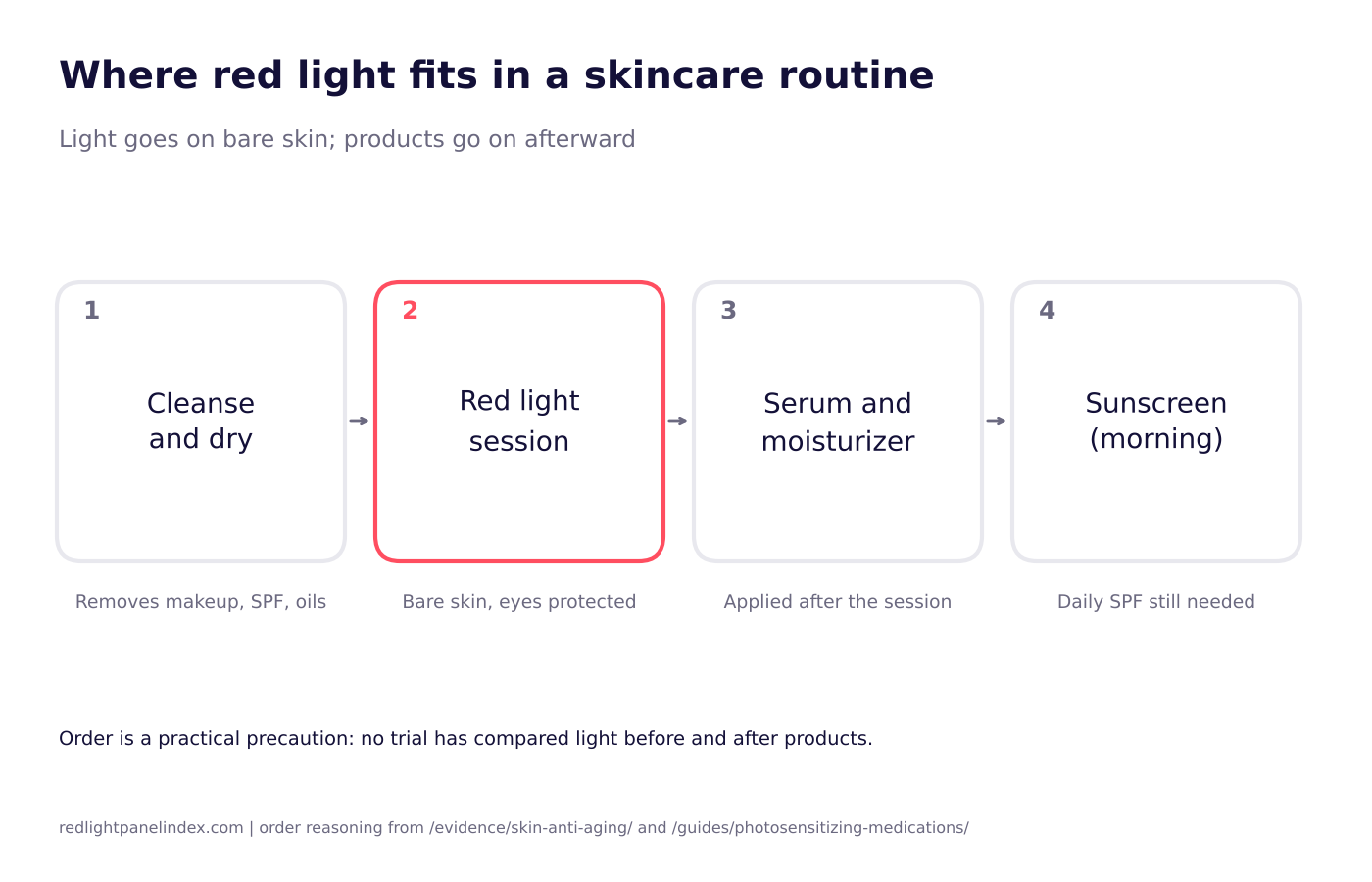
Use red light on clean, dry, bare skin, and apply serums, moisturizer and sunscreen after the session, not before. No trial has tested the order of a skincare routine around a light session, so this is a practical precaution built on how light reaches skin, not a studied protocol.
Choosing a panel? Our ranking of the best red light therapy panels is computed from published, method-labeled specs across 188 devices. For a skincare routine, the spec that matters is a working distance and coverage that suit a face-sized area, since the routine only helps if the light actually lands on clean skin.
The short version of the order
| Step | What to do | Why |
|---|---|---|
| 1 | Cleanse and dry your face | Removes makeup, sunscreen and oils that could sit between the panel and your skin |
| 2 | Skip serums, SPF and thick creams for now | Anything opaque or reflective is a plausible barrier; none of this has been measured on a panel |
| 3 | Run the session with eyes protected | Face sessions at close range are where eye protection matters most |
| 4 | Apply serum, moisturizer and sunscreen afterward | Keeps the skin barrier supported and gets daily SPF on, which light therapy does not replace |
Why clean skin comes first
The skin response to red and near-infrared light that the research describes starts when mitochondrial chromophores in skin cells absorb the light, which then drives changes such as increased ATP production, nitric oxide release and blood flow (PMID 24049929). That review is a narrative overview, not a trial, but it states the premise every skin protocol rests on: the photons have to reach the cells. Makeup, a layer of mineral sunscreen, a thick occlusive balm or heavy oil can reflect or absorb some of the light before it gets there.
How much they block has not been measured for the panels on this site's database, and no skin trial this site tracks compared treated skin with and without a product layer. So treat the advice as sensible precaution: if a product costs you nothing to apply afterward, there is no reason to put it between the light and your skin. A lightweight, fully absorbed moisturizer is a lower worry than a visible film, but the simple rule of bare skin is easier to follow than a judgment call every night.
Where sunscreen goes
Sunscreen is the product most people ask about. The skin anti-aging evidence page is clear that red light does not replace sun protection and does not stop damage that continues without daily SPF. That means the answer is not to skip sunscreen, only to move it.
- Morning session: cleanse, run the session, then apply moisturizer and SPF before you leave the house.
- Evening session: cleanse, run the session, then apply your night products. SPF is not needed indoors at night, so the evening is the easy time to run a session without any product on your face. No trial has compared morning with evening skin sessions; the morning vs evening guide covers what is known about timing.
If your session is in the morning and you are in a hurry, it is still better to wipe off sunscreen and reapply than to run light through a film of it on a regular basis. If that is not practical, move the session to the evening instead.
Retinoids and other photosensitizing products
Retinoids are the other common question. This site's guide to photosensitizing medications lists retinoids among the drug classes associated with increased light sensitivity, with a different mechanism from most of the list: a retinoid thins and speeds the turnover of the outer skin layer, so the sensitivity comes from having less of a barrier, not from the drug reacting to photons. Nearly all documented photosensitivity reactions involve ultraviolet light, which a red and near-infrared panel does not emit, and no trial has tested the combination directly.
The practical steps from that guide apply:
- Ask whoever prescribed a retinoid, especially a prescription-strength one, before starting regular sessions.
- Keep the retinoid and the light session apart, for example light in the morning and retinoid at night, so the two do not stack irritation on the same skin barrier.
- Start at the low end of a session length and check the skin after the first few sessions. Redness beyond the usual mild warmth, or anything that looks like a sunburn, is a reason to stop and call the prescriber.
Exfoliating acids and similar actives are not on the medication lists but can leave skin more reactive, so the same spacing logic is reasonable. It is a judgment call, not a finding.
What the sessions themselves should look like
The routine order matters less than doing the sessions consistently. This site's skin page describes facial protocols of 3 to 7 sessions per week, 10 to 20 minutes each, at 6 to 12 inches, with results judged over 8 to 12 weeks, and it flags a biphasic dose response, meaning more light is not always better. Use the dose calculator to turn your panel's irradiance at your chosen distance into a dose, and the results timeline guide for what to expect and when. For how wavelength choice fits skin goals, the 630nm vs 660nm comparison and the 830nm page cover the bands the skin trials used, and skin phototype and dosing covers the starting dose for different skin types.
Panel size is also a routine question. A compact panel such as the Hooga HG300, at 12.2 by 8.2 inches, is closer to face-sized than the 30.3 by 11.8 inch array of the RLT Home Total Spectrum COMPACT, but either can cover a face at a 6 to 12 inch working distance. The best panels for skin and anti-aging page ranks four panels on the same database fields, and how rankings work explains the method.
Light before or after other routines
If you also use red light around exercise or recovery, the same bare-skin logic holds for the face: wash off sweat and sunscreen first. See red light before or after a workout and combining red light with sauna and cold plunge for how timing works for the rest of the body.
What was not studied
- Product layers. No trial this site tracks compared light delivery through sunscreen, makeup, serums or creams with delivery to bare skin.
- Order effects. No study compared light before products against light after products on a skin outcome.
- Retinoids with panels. No trial tested a retinoid together with a red or near-infrared panel in either direction.
- Home panels in the skin trials. The skin studies reviewed on this site used clinical devices, so the exact dose from a home panel needs the calculator, not the trial's headline numbers.
Cautions
Protect your eyes. Wear the goggles your panel supplies for any face session and do not look at the LEDs while the panel is running; the eye protection guide explains why close-range face use is the case that matters most. If you have a diagnosed skin condition, treat light as an adjunct and talk to a dermatologist before changing your routine. This is general wellness information, not medical advice.