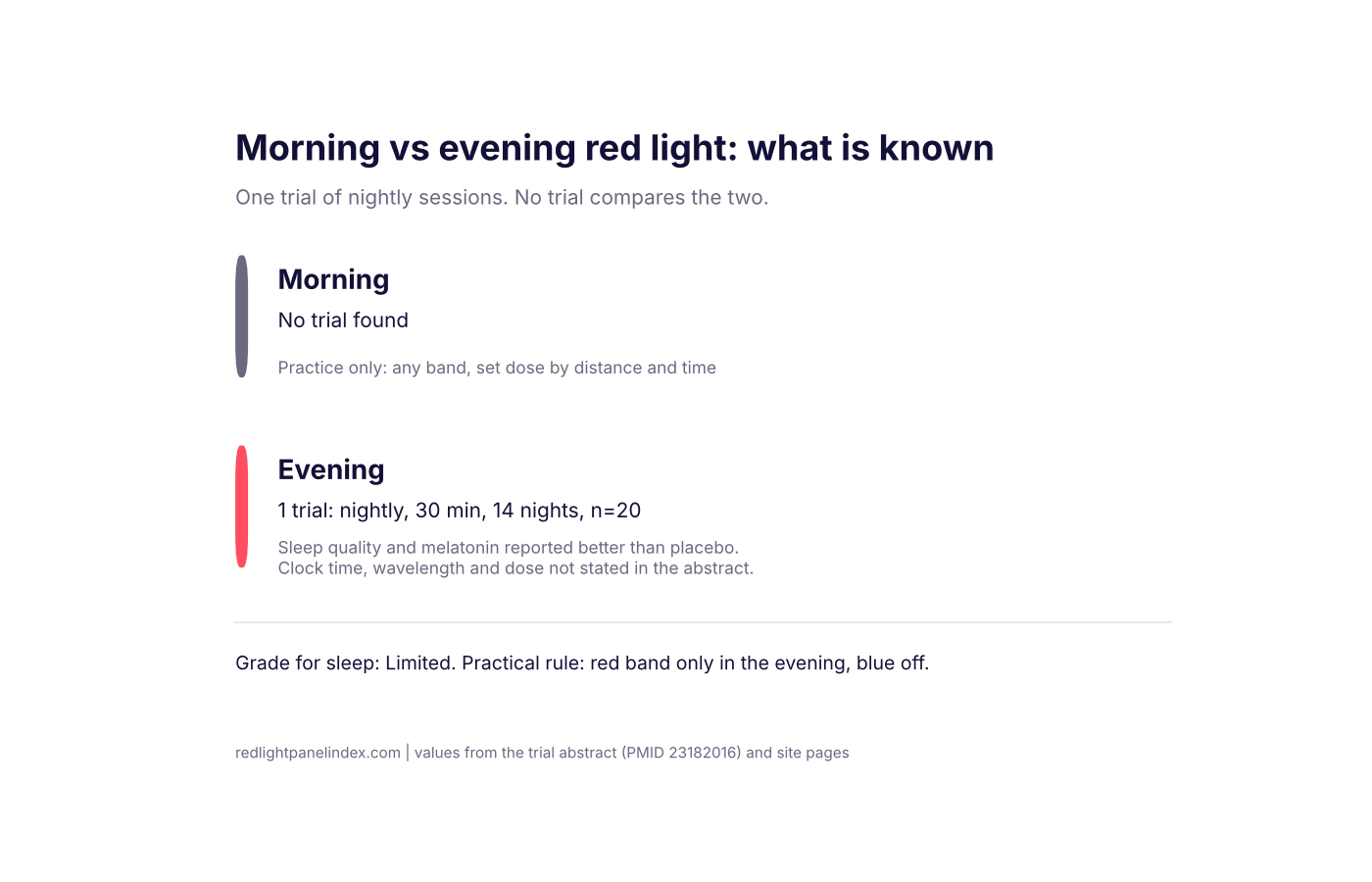
No trial has compared morning with evening red light sessions, so nobody can say that one time of day works better; the timing advice that follows is reasonable practice, not evidence. The one trial that bears on timing at all gave whole-body red light every night for 14 nights and reported better sleep and higher melatonin than placebo, which is a reason evening use is plausible and not a finding that evening beats morning.
Choosing a panel? Our ranking of the best red light therapy panels is computed from published, method-labeled specs across 188 devices. For choosing a session time, the spec that matters is whether you can run the red band on its own, because that lets you keep evening sessions free of blue.
What the evidence actually says about timing
The site's sleep evidence page grades the sleep literature Limited. The relevant study is a small placebo-controlled trial in 20 elite female basketball players, who received 30 minutes of whole-body red light exposure nightly for 14 days (PMID 23182016). Compared with placebo, the red-light group was reported to have better Pittsburgh Sleep Quality Index scores, higher serum melatonin and better 12-minute run performance. The abstract gives no exact numbers for those outcomes.
Three limits matter for the timing question:
- There was no morning arm. Every session was at night, so the trial cannot show that night is better than morning.
- The clock time is not stated. The abstract describes nightly sessions, not a specific hour, so "30 to 90 minutes before bed" is not a trial finding.
- The device is not described. The abstract does not state a wavelength, irradiance or dose, which is covered in our study review of the trial.
Beyond sleep, the frequency guide notes a 2015 meta-analysis of exercise studies in which the clearest results came when phototherapy was used before a workout rather than after. That concerns timing relative to exercise, not time of day.
Why evening red-only use is plausible
Red and near-infrared wavelengths do not suppress melatonin the way blue-enriched light does. That is a statement about wavelength, not a sleep benefit: it explains why a red-only panel is a reasonable thing to use at night, where a bright white or blue source would not be. A red panel is also not a clock-setting light. The comparison with SAD lamps explains that a light box acts through the eyes on the body clock, while a panel's target is tissue.
Practical guidance, framed as practice and not evidence
Evening.
- Use the red band only, with any blue channel off. Panels that let you control channels separately make this easy; see our best panels for sleep and evening use.
- Keep it short. Set the session length from dose, using the dose calculator and the session length guide, not from habit.
- Use the panel as the main light in the room instead of adding it to bright overhead lighting.
- Protect your eyes as the eye protection guide describes. Facing a bright panel late in the evening is a reason to be careful, not relaxed.
Morning or daytime.
- Near-infrared bands carry no known penalty at any hour, so nothing in the evidence argues against using them in the morning or afternoon.
- If the goal is skin, the skincare routine order guide covers where a session fits among cleansing and products.
- If the goal is training, the recovery stack covers how sessions fit around workouts.
Any time.
- Distance changes the dose more than the hour does; see the distance guide.
- Consistency matters more than the clock. The frequency guide lists the tested schedules, including nightly use for 14 days in the sleep trial.
Verdict by use case
- You want better sleep. Evening red-only sessions are the only timing with any trial behind it, and that evidence is Limited, from one small trial in athletes. Treat it as worth trying, not as proven.
- You want skin or recovery results. The trials behind these goals did not test time of day. Pick the slot you will keep, and let dose and frequency guide the rest.
- You are sensitive to light at night or have trouble falling asleep after sessions. Move sessions earlier. No trial has tested this either way, so follow what you observe.
- You use a panel with a blue channel. Keep blue off in the evening. Blue-enriched light is the kind that suppresses melatonin, and red is not.
How to test timing on yourself
Because no trial has settled this, a simple personal comparison is the most honest approach. It is not a study and it cannot prove anything, but it can show whether a slot suits you.
- Pick one goal and one measure, such as how long it takes to fall asleep, how rested you feel, or how your skin looks in a weekly photo taken in the same light.
- Hold dose and frequency steady, using the dose calculator to fix distance and time, so the clock is the only thing that changes.
- Run evening sessions for about two weeks, matching the length of the sleep trial, then switch to a daytime slot for another two weeks.
- Write down what you notice. Expect noise: sleep varies with stress, caffeine and season, so a small difference in a short log means little.
If both slots feel the same, choose the one you will actually keep. If evening sessions leave you more alert and you sleep worse, move them earlier. That is a personal observation, not a general rule.
Frequently asked questions
Does red light at night keep you awake? Red and near-infrared wavelengths do not suppress melatonin the way blue-enriched light does. Individual responses vary, and no trial has tested whether a given session length changes how quickly people fall asleep.
Is morning better for energy? No trial has tested it. The SAD lamp advice for morning use applies to bright white light acting through the eyes, which is a different mechanism from a red panel acting on tissue.
Should I use the panel before or after a workout? The exercise meta-analysis noted in the frequency guide found the clearest results with use before exercise. It did not compare morning with evening.
What is not known
No trial compared morning with evening sessions. No trial tested whether the time of day changes skin, pain or recovery outcomes. The one sleep trial does not state a clock time, a wavelength or a dose, and it studied young elite athletes, not a general adult at home. The separate page on red light, melatonin and circadian rhythm covers why a red-only panel is not a body-clock light and what the one melatonin trial did and did not show.
Bottom line
Timing is an open question. Use the red band at night if sleep is the aim, keep sessions short, and choose any other slot by what you can keep up. Check the methodology page for how this site researches and grades claims.