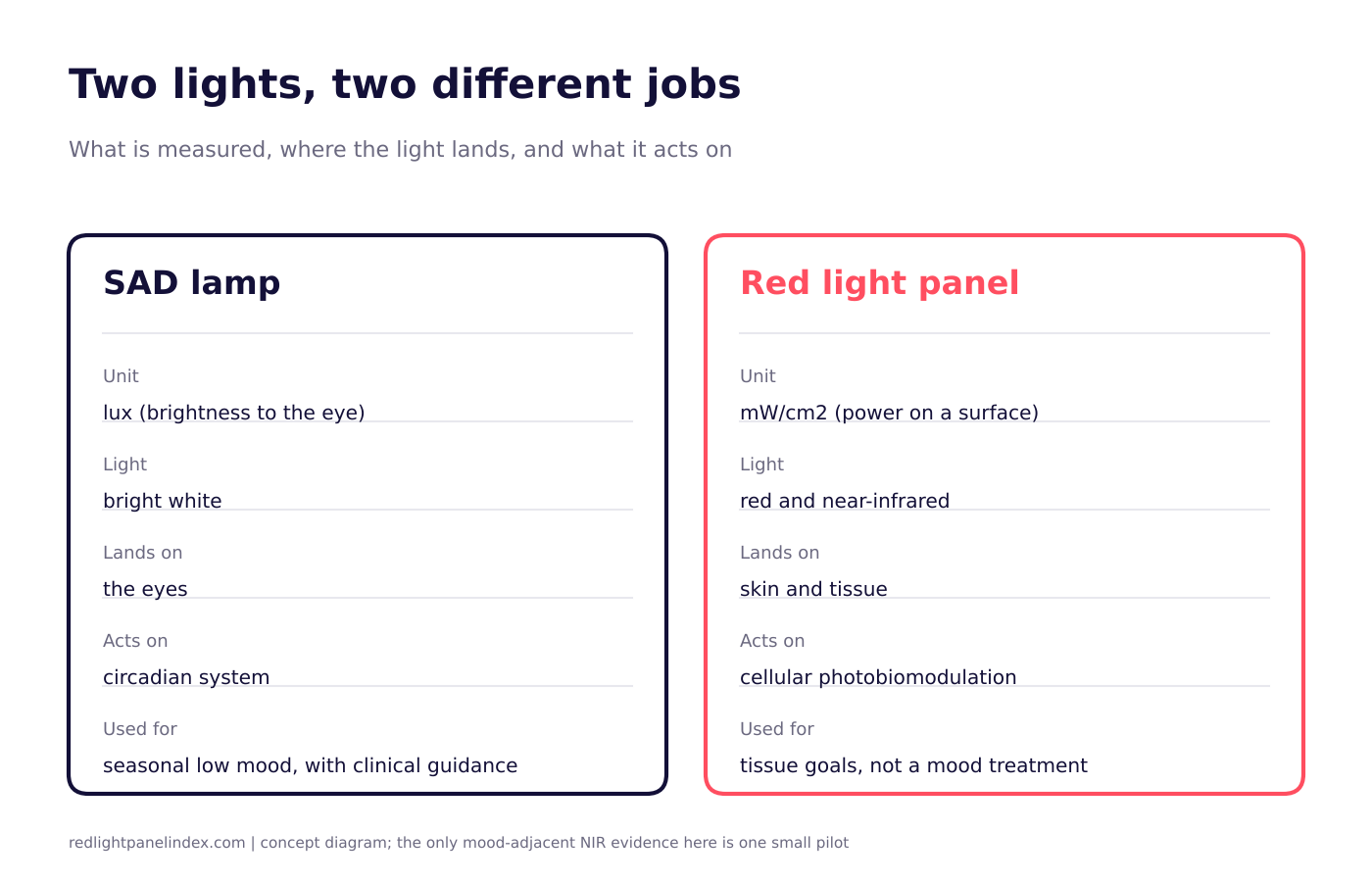
A SAD lamp and a red light therapy panel are different tools: a SAD lamp delivers bright white light to the eyes to act on the body clock, while a red panel delivers red and near-infrared light to skin and tissue to act on cells. A red panel is not a substitute for a SAD lamp, and it is not a treatment for seasonal low mood.
Choosing a panel? Our ranking of the best red light therapy panels is computed from published, method-labeled specs across 188 devices. For comparing light devices of any kind, the spec that matters is the unit: lux describes brightness to the eye, while mW/cm2 describes power delivered to a surface.
What a SAD lamp is built to do
SAD stands for seasonal affective disorder, a pattern of depression that tracks the seasons. The light box used for it is a bright white lamp. The standard regimen described in the clinical literature is sitting near a box that emits about 10,000 lux for about 30 minutes a day, preferably in the morning. The reasoning is that the dose of bright light has to be well above ordinary indoor lighting to shift circadian timing.
The key point is the route. A SAD lamp works through the eyes. Light reaches the retina, which signals the brain's clock, and that is the system the treatment is designed to influence. The lamp is judged by how bright it looks to a human eye, which is what lux measures. Many consumer light boxes also advertise ultraviolet filtering, because the eyes are the target and unfiltered UV near the face is not wanted. Whether a particular box is suitable for a particular person is a question for a clinician, particularly because seasonal depression is a medical condition and not a wellness goal.
What a red light panel is built to do
A red light panel emits narrow bands of red light (commonly around 630 to 670 nm) and near-infrared light (commonly 810 to 850 nm). The mechanism proposed for it is photobiomodulation, in which light absorbed by components of the mitochondria, notably cytochrome c oxidase, changes cellular signaling. Our photobiomodulation explainer covers that mechanism and its open questions.
The target is tissue. You place the panel at a set distance from the skin, over a muscle, a joint, a scar or a patch of skin. The number that matters is irradiance in mW/cm2 at that distance, and how long you stay there. The site's irradiance guide explains why every figure must be tied to a measurement method and a distance, and the dose calculator turns a panel's measured irradiance into minutes per session.
Red light is also not designed to be stared at. The eye protection guide explains why panel sessions are normally done with the eyes closed or protected, which is close to the opposite of how a SAD lamp is used.
Why lux and mW/cm2 cannot be compared
Lux is a photometric unit. It weights light by how sensitive the human eye is across the spectrum, peaking in the green-yellow. Deep red light and near-infrared sit at the edge of or outside that sensitivity, so a panel that is physically very powerful can read a modest number on a lux meter, and near-infrared light can read close to zero lux while delivering substantial energy.
mW/cm2 is a radiometric unit. It counts the power arriving on each square centimeter regardless of how visible the light is. That is the right quantity for a therapy that acts on tissue, which is why panel specifications use it. The mismatch runs both ways: a lux reading says almost nothing about photobiomodulation dose, and an irradiance reading says nothing about how well a lamp resets the body clock.
For a feel of how irradiance figures behave on panels, the irradiance page shows brand claims set against independent spectrometer readings at 6 inches, and the irradiance vs total power explainer separates what a panel emits overall from what lands on a given spot.
Side by side
| SAD lamp | Red light panel | |
|---|---|---|
| Unit on the spec sheet | Lux | mW/cm2 at a stated distance |
| Light | Bright white | Red and near-infrared |
| Where the light is aimed | The eyes | Skin and tissue |
| System acted on | Circadian system | Cellular photobiomodulation |
| Typical session setting | Morning, seated at a light box | At a set distance, eyes closed or protected |
| Condition it is used for | Seasonal depression, with clinical guidance | Tissue goals such as skin, muscle and joints |
Is there any evidence connecting red light to mood?
There is one small piece of mood-adjacent research on near-infrared light, and it is a different setup from a home panel. A 2009 pilot (PMID 19995444) gave single near-infrared treatments to the forehead of 10 patients with major depression, nine of whom also had anxiety, using an 810 nm LED array held close to the skin. The authors reported improvement in depression and anxiety ratings at 2 and 4 weeks. The follow-up was not placebo-controlled and not blinded, the group was very small, and the authors themselves called for larger randomized trials. Our study review of the pilot walks through the design and limits.
Three things set it apart from using a panel at home:
- The array was applied to the forehead at very close range, not a panel used at a distance.
- The condition studied was major depression and anxiety, not a seasonal pattern.
- It was a pilot. It generates a hypothesis; it does not establish that the light worked.
The site grades this area Insufficient. The brain and mood evidence page and the transcranial light for depression page explain why and what larger studies would need to show. The short version is that no home panel protocol has been validated for mood, and a claim that a panel treats depression goes well beyond the evidence.
What was not studied
The research summarized on the site does not compare a red panel with a SAD lamp, does not test a red panel as a seasonal depression treatment, and does not test whether adding red light to a light box changes anything. It also does not show that a panel used at body-surface distances affects mood. If a product page implies any of those, treat it as unsupported.
Practical guidance
If you are thinking about either device because of low mood in the darker months, the sensible order is:
- Talk to a clinician first. Seasonal and non-seasonal depression are treatable conditions with established care, and light is one option among several that a professional can help you weigh. Transcranial light is not a replacement for that care.
- Pick the device for the job. A purpose-built light box is the tool designed for seasonal low mood. A panel is the tool for tissue goals. Buying a panel in the hope it will do the work of a light box is the mismatch this article is about.
- Do not combine them by guesswork. If you use both, keep their roles separate: the light box in the morning for the eyes, the panel on the body part you actually want to target, with the eyes protected.
- If you buy a panel anyway, size it for the area you will treat rather than for a headline number; the targeted vs full panel guide shows how coverage changes session time, and the best panels ranking compares method-labeled specs across brands.
Cautions
- Bright light can cause headaches, eye strain, jitteriness or nausea in some people, and light exposure can matter for people with bipolar disorder or eye conditions. A clinician should guide anyone in those groups.
- Some medications increase light sensitivity; see the photosensitizing medications guide and check before starting either device.
- Do not stop or delay any prescribed treatment for depression in favor of a light device of either kind.
- If you are in crisis or having thoughts of harming yourself, contact a crisis line or emergency services in your area.
Bottom line
The two devices share the word "light" and little else. One is calibrated in lux for the eyes and the circadian system, the other in mW/cm2 for tissue. The small amount of mood-adjacent near-infrared research is a single early pilot with a different method. For seasonal low mood, a red panel is not the right tool; for tissue-level goals, a SAD lamp is not either.