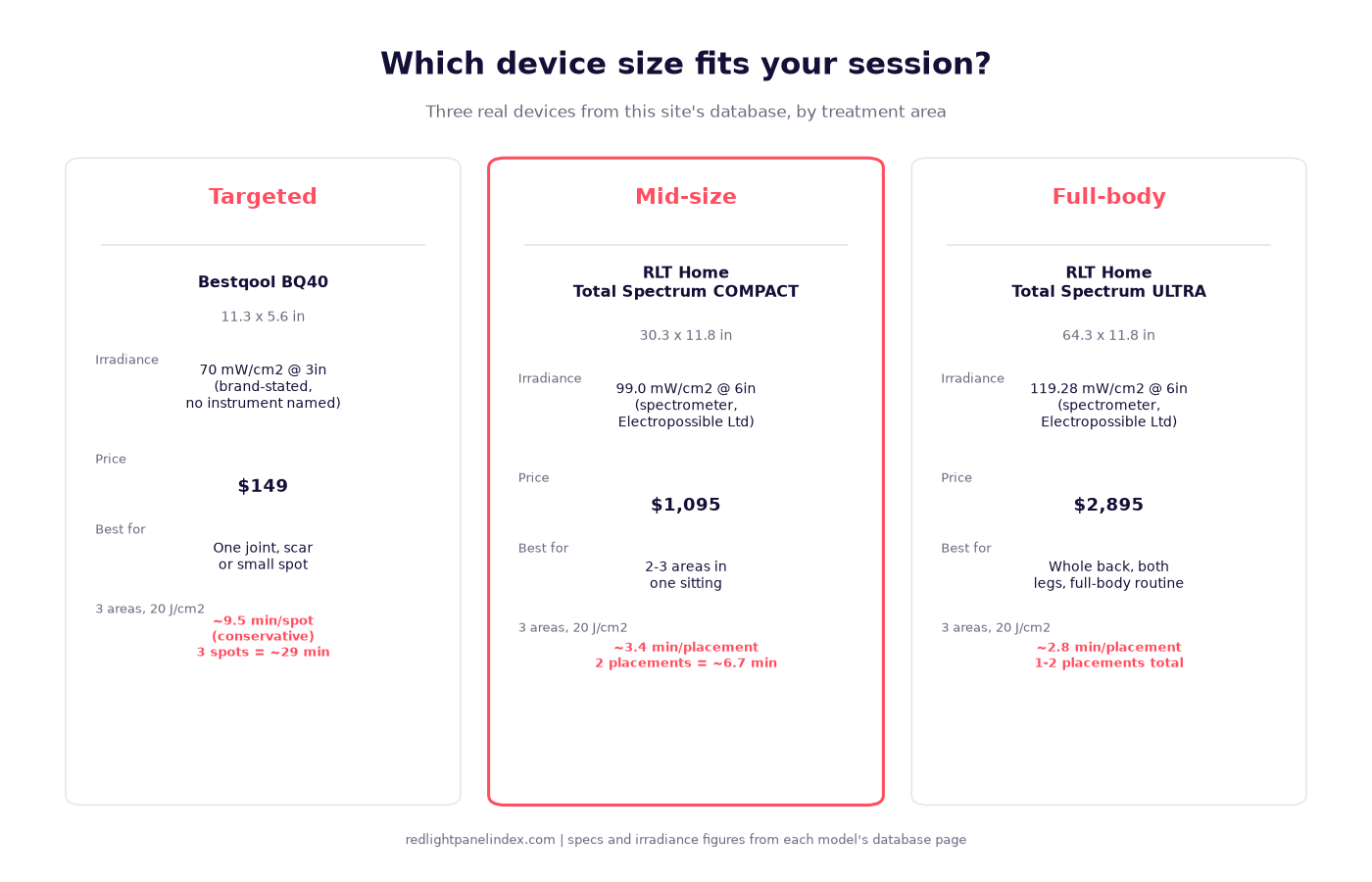
A small targeted device is enough when the job is one joint, one scar or one small patch of skin at a time, and a session that stays under ten minutes; a full panel earns its price and its footprint once more than one area needs light in the same sitting, or the goal is to cover a shoulder-to-hip stretch of skin at once rather than move a smaller light around. The size that fits depends on how many areas you treat per session, not on which device has the biggest number on its spec sheet, and the database examples below, priced from $149 to $2,895, make the actual time difference concrete rather than a guess.
Choosing a panel? Our ranking of the best red light therapy panels is computed from published, method-labeled specs across 188 devices. For device size specifically, the spec that matters is coverage area against your own treatment area, not the largest panel on the page.
Three sizes, three real devices
This site's database of 188 panels does not track handheld wands or torches; every brand in it, including the smallest models, builds a flat LED panel, just in different sizes. That still spans a useful range. At the small end, the Bestqool BQ40 is 11.3 by 5.6 by 1.3 inches, 40 dual-chip LEDs at 660 and 850nm, with a brand-stated 70 mW/cm2 at 3 inches that names no measurement instrument, at $149 (verified 2026-08-12). In the middle, the RLT Home Total Spectrum COMPACT is 30.3 by 11.8 inches, seven wavelength bands from 480 to 1064nm, with an independently spectrometer-measured 99.0 mW/cm2 at 6 inches, at $1,095 (verified 2026-09-12). At the full-body end, the RLT Home Total Spectrum ULTRA is 64.3 by 11.8 inches, the same seven-band mix, independently measured at 119.28 mW/cm2 at 6 inches, at $2,895 (verified 2026-09-12).
Those three are a size ladder, not a brand endorsement; the same tiers exist across other brands in the database at similar prices. The point of listing real models is that "small," "mid" and "full-body" map to specific, purchasable dimensions and specs, not to marketing categories.
Mounting is part of the size decision too, not an afterthought. The BQ40 ships with no stand, so it is meant to be handheld or propped against something at the treatment site; the COMPACT and ULTRA both include a stand, which matters once a panel is too large to comfortably hold in place for several minutes at a stretch. A device that has to be held also limits how long a session can realistically run, which is one more reason a small device suits short, single-spot sessions better than a longer whole-body one.
This is a different question from device type. A red light panel and an infrared sauna differ in what they are built to do at all, photons versus heat; the choice covered here, small panel versus full panel, only decides how much of a red light panel's own coverage a given session needs.
The math: treating three areas with a small device
Say the plan is to treat three separate spots, both knees and a shoulder, at a common 20 J/cm2 target dose, the range this site's dose calculator works from. The BQ40's spec sheet states 70 mW/cm2 but does not name the instrument behind that number; following the same convention this site applies to every unlabeled figure, treat it conservatively as roughly half, about 35 mW/cm2. At the calculator's own formula, dose equals irradiance times seconds divided by 1000, that works out to about 9.5 minutes per spot at the conservative figure, or about 4.8 minutes per spot if the brand's stated number holds up. Three spots, treated one at a time because the device is too small to cover more than one, comes to roughly 14 to 29 minutes of light-on time before repositioning, depending on which of those two figures is closer to reality.
A panel wide enough to span both knees at once changes that math directly. The Total Spectrum COMPACT's independently measured 99.0 mW/cm2 reaches the same 20 J/cm2 in about 3.4 minutes; if its 30.3-inch width covers both knees in one placement, that is one 3.4-minute session for two of the three spots, plus a second 3.4-minute placement for the shoulder, about 6.7 minutes total against the small device's 14 to 29. The full-body ULTRA, at 119.28 mW/cm2, reaches the same dose in about 2.8 minutes per placement and, at 64.3 inches, could plausibly cover both knees and a shoulder in one or two placements depending on body position. The gap is not about which device is more powerful per square centimeter; it is about how many separate placements a session needs, and a wider panel needs fewer.
When a full panel is worth it
A full-body panel makes sense once a routine regularly covers more than one region, a documented case in this site's ranking of full-body panels, which requires roughly 64 inches of height to lie flat under and cover a body in one placement. Athletes rehearsing a whole-body recovery protocol, or anyone treating overlapping regions like the low back, both hips and the hamstrings in one sitting, spend less total time under light with one wide panel than repositioning a small one three or four times, the same arithmetic worked through above. The tradeoff is upfront cost and footprint: a full-body panel needs floor or wall space a small device does not, and every model in that size tier in this database costs more than $1,700.
When a targeted device is enough
The other direction holds just as well. Someone treating a single joint covered by this site's joint pain evidence page, a frozen shoulder, one knee, tennis elbow, gets no benefit from a panel wide enough for a torso; the light does not reach any further into that one joint for being surrounded by more LEDs treating empty space. A small device is also easier to hold at an angle a wide panel cannot manage, useful for a joint that does not sit flat against a wall-mounted or floor-standing panel. Budget matters here too: the BQ40 costs a fifteenth of the ULTRA, a real consideration for someone who only ever needs to treat one area.
Coverage and the distance problem
Small devices are also commonly used closer to skin than the 6-inch distance most of this site's panel specs are measured at, and that changes the numbers in a way worth flagging rather than glossing over. The BQ40's own figure is stated at 3 inches, not 6, so it is not directly comparable to the COMPACT's or ULTRA's 6-inch numbers even before accounting for measurement method; this site's spectrometer-versus-solar-meter explainer covers why an unlabeled or brand-only figure like the BQ40's needs that same caution regardless of distance. Whichever device is under consideration, check that its irradiance figure names both a distance and an instrument before comparing it to another model's number.
Verdict by use case
For one joint, one scar or one small patch of skin, in short sessions and on a tight budget, a small device like the BQ40 covers the job without paying for coverage that goes unused. For two or three areas treated in the same sitting, a mid-size panel like the Total Spectrum COMPACT cuts total session time roughly in half compared to moving a small device between spots, at a price still well under the full-body tier. For a whole-body routine, or regularly overlapping regions in one sitting, a full-body panel like the Total Spectrum ULTRA turns what would be three or four small-device placements into one or two, at the highest upfront cost of the three. None of the three is the universally correct pick; the areas treated per session decides it.