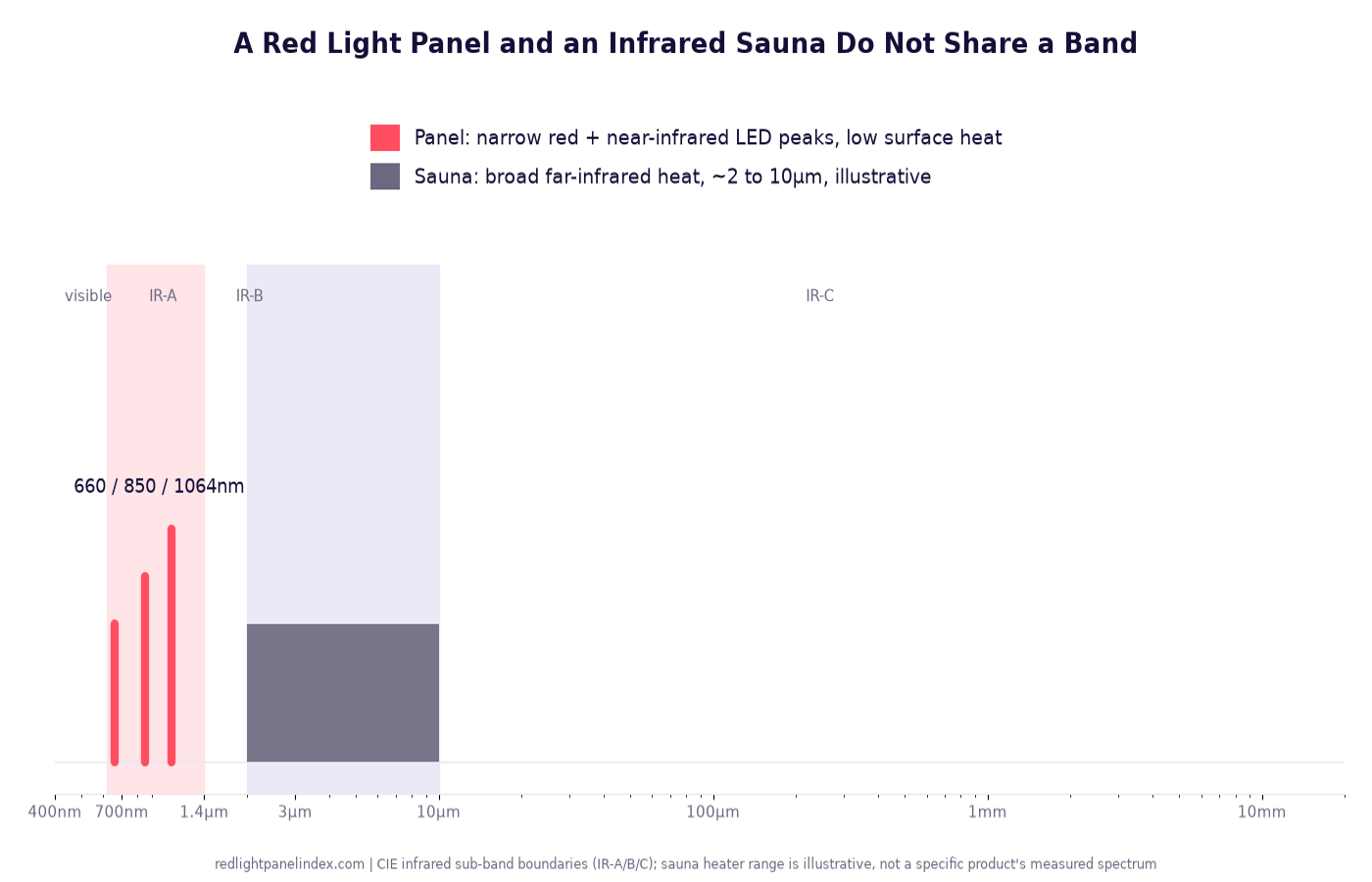
A red light panel and an infrared sauna both use light outside the visible range, but they are not two versions of the same tool: a panel emits narrow bands of red and near-infrared light aimed at triggering a cellular response with almost no surface heat, while a sauna emits broad-spectrum far-infrared radiation whose job is to heat the skin and raise core body temperature, the same physics an infrared heat lamp or a space heater relies on. Confusing the two leads to a common but avoidable mistake: expecting a sauna session to deliver a photobiomodulation dose, or expecting a panel session to work up a sweat.
Choosing a panel? Our ranking of the best red light therapy panels is computed from published, method-labeled specs across 188 devices. For this comparison, the spec that matters is wavelength, not power: a panel's narrow LED peaks and a sauna's broad heating band sit in genuinely different parts of the infrared spectrum.
Two different bands, not two strengths of the same thing
The international lighting standard (CIE) splits infrared light into three sub-bands by wavelength: IR-A runs roughly 700 to 1,400 nanometers, IR-B runs about 1,400 to 3,000 nanometers, and IR-C covers everything from 3,000 nanometers out to 1 millimeter. A red light panel's near-infrared output, typically centered around 850nm with some models adding 810, 830 or 1064nm, sits inside IR-A, right next to the visible red band it pairs with at 660nm. This is the band this site's red-vs-near-infrared explainer covers: wavelengths chosen because they reach mitochondria in skin and shallow tissue without being absorbed and scattered away before they arrive, the mechanism this site's penetration-depth guide works through in more detail.
An infrared sauna heater, by contrast, is built to sit further out on the spectrum, generally in the multi-micrometer range that spans IR-B into IR-C, illustrated in the chart above. That is a deliberate design choice, not an oversight: those longer wavelengths are absorbed almost immediately at the skin's surface, converting to heat within a fraction of a millimeter rather than reaching into tissue the way a panel's shorter near-infrared wavelengths do. A sauna heater is optimized to warm skin and, through that surface heating, raise core body temperature and trigger sweating; it is not selected for a wavelength that reaches deep tissue, because reaching deep tissue with heat that intense would be uncomfortable rather than useful.
What that band difference means for the mechanism
Photobiomodulation, the mechanism a red light panel relies on, works through photon absorption by specific chromophores in cells, chiefly cytochrome c oxidase in the mitochondrial electron transport chain. A broad review of that mechanism describes downstream effects that follow from this photon-driven process: a rise in ATP production, a brief pulse of reactive oxygen species, increased nitric oxide, and activation of transcription factors that affect cell survival and inflammation, with one of the most consistently reported outcomes being a reduction in inflammatory markers across joint, tissue and even brain models (PMID 28748217). That chain of events depends on a photon of a specific wavelength being absorbed by a specific molecule; it is a photochemical event, not a thermal one, and a panel's low output heat is a side effect of running LEDs, not the mechanism doing the work.
A sauna's effect is thermal from the start. Raising skin and core temperature triggers the body's own heat-stress response: increased skin blood flow, sweating, and cardiovascular effects that come from being warm, the same category of response a hot bath or a traditional dry sauna produces, since none of those routes depend on a specific wavelength being absorbed by a specific molecule. That is common, well-established physiology rather than a claim specific to infrared saunas as a device category, and this article does not attempt to grade infrared sauna use the way this site grades red light therapy claims, since saunas and their evidence base sit outside what this site's database and evidence register track.
Session experience: what you actually feel
The two devices feel different to use, which is a useful shorthand for the mechanism difference. A red light panel session run at a typical working distance produces little to no perceived heat; this site's dose calculator computes session length from a panel's own published irradiance and a target dose in joules per square centimeter, and that math has nothing to do with temperature, because the panel is not meant to warm you. An infrared sauna session, by design, raises skin temperature noticeably within minutes and typically continues until the user is sweating, with session lengths commonly run in the 15 to 45 minute range specifically to sustain that thermal load, not to deliver photons to a target dose.
That also means the two devices carry different practical considerations. A sauna session requires attention to hydration, heat tolerance and cardiovascular status the way any heat-stress exposure does; a panel session does not carry that same heat burden, which is part of why this site's how-often guide discusses session frequency for panels in terms of dose and skin exposure rather than heat tolerance.
Why "infrared" on a spec sheet does not mean one thing
Part of the confusion between the two device categories comes from the word "infrared" doing double duty. A panel's spec sheet lists near-infrared wavelengths in nanometers, 810, 830, 850 or 1064nm, because that precision matters for matching a device to the wavelengths trials actually tested; this site's wavelength explainers cover why a 20 to 60 nanometer difference in peak wavelength changes how deeply light reaches. A sauna's marketing, by contrast, usually just says "far infrared" without a specific peak wavelength in nanometers or micrometers, because the heating effect does not depend on hitting one precise wavelength the way a photobiomodulation trial's outcome does; a heater running anywhere across a broad multi-micrometer range still heats skin. That looser labeling convention is a real source of the mix-up: a shopper skimming both categories for "infrared" can come away assuming the two devices are variations on the same idea, when the wavelength precision each category depends on for its own stated purpose is fundamentally different.
Can you get both from one device?
No device in this site's database is built to deliver both a photobiomodulation-grade near-infrared dose and sauna-grade far-infrared heat from the same panel; the two require different LED or heating-element wavelengths, and a panel's LEDs are chosen and driven specifically to stay in the IR-A band a photobiomodulation trial actually tested, not to widen into the far-infrared range a sauna heater occupies. Some people do use both, typically a panel session for the photobiomodulation target and a separate infrared sauna session for the heat-stress target, on different days or as two distinct parts of a routine, the way an athlete might combine a panel session with other recovery tools. A moderate-grade evidence review on red and near-infrared light for muscle recovery covers what a panel specifically is tested for in that context, and this site's ranking of panels for athlete recovery ranks devices on the same published, method-labeled irradiance and wavelength fields this site uses everywhere, not on any sauna-adjacent claim.
Verdict by use case
If the goal is a specific photobiomodulation outcome tested in a trial, joint pain, skin, hair growth or muscle recovery, a red light panel is the tool with trial evidence behind it, and a sauna session will not substitute for it, since the wavelengths and mechanisms do not overlap. If the goal is the general heat-stress response people use saunas for, whether traditional or infrared, a panel session will not substitute for that either, since it is not designed to raise core temperature. For someone who wants both effects, using each device for what it is actually built to do, rather than expecting either one to cover for the other, is the straightforward answer: they are complementary tools in different parts of the infrared spectrum, not competing versions of the same one.