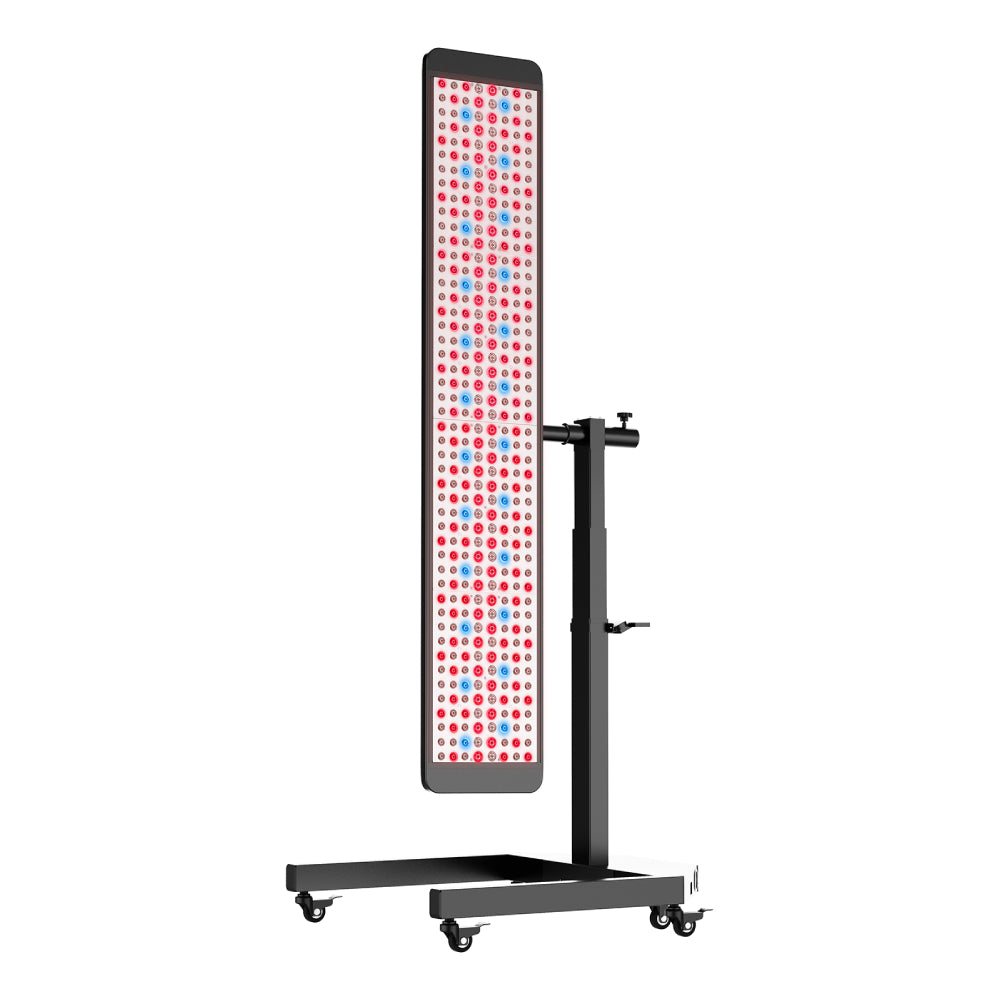
For treating the muscle groups athletes actually train, quads, hamstrings, the back, in one standing session, the panels that rank highest here combine a published near-infrared share in the 810 to 850nm band, a method-labeled irradiance figure at a real standing distance, and coverage wide enough to avoid stepping side to side mid-session. Four panels from this site's database meet that bar, from a fully spec-transparent large-format panel to a compact budget pick better suited to one muscle group than a full leg.
Choosing a panel? Our ranking of the best red light therapy panels is computed from published, method-labeled specs across 188 devices. For athlete recovery specifically, the spec that matters most is the published near-infrared share in the 810 to 850nm band at a standing 6-inch distance, not total irradiance alone.
How these picks are ranked
Every model here is scored on the same four database fields this site uses for every best-of list, read with a training and recovery lens: a panel that publishes exactly where its power goes and backs its irradiance figure with a named instrument and distance ranks ahead of one that states a single combined number with no breakdown. See how rankings work for the full method behind every list on this site.
| Criteria | What it measures for athlete recovery use |
|---|---|
| Near-infrared density | Share of stated output in the 810-850nm band, and whether the brand publishes a per-wavelength breakdown at all |
| Method-labeled irradiance | mW/cm2 at 6in, a realistic standing distance, with the measuring instrument named |
| Coverage | Panel dimensions relative to treating a standing quad, hamstring or back in one session, not a single joint |
| Price and buyer terms | Verified price, warranty length, trial window and restocking terms |
The picks
1. RLT Home Total Spectrum ULTRA publishes a full seven-band breakdown: 20 percent of output at 810nm, 13 percent at 830nm and 8 percent at 850nm, a combined 41 percent in the near-infrared band most muscle-recovery trials target. Irradiance is backed by two independent, spectrometer-based readings: Electropossible Ltd measured 119.28 mW/cm2 at 6 inches, and LightLab International measured 85.7 mW/cm2 center-average (up to 111.2 mW/cm2 peak) at the same distance. Its 64.3 by 11.8 inch array ships with a motorized stand and is wide enough to cover a standing quad or the width of a back in one session. At $2,895 (verified 2026-09-12) it is the most expensive pick here, but it carries a 3-year warranty and a 60-day trial with no restocking fee, the cleanest buyer terms of the four panels listed.
2. Helio Cure Helio Blaze publishes the highest nominal near-infrared share of the four: 20 percent at 810nm, 13.3 percent at 830nm and 10 percent at 850nm, a combined 43.3 percent, plus a 16.7 percent slice at 1064nm that most panels on this site lack entirely. Its published 71 mW/cm2 at 6 inches irradiance figure does not carry a stated measurement method for most bundle tiers; only the top Glow configuration has been independently spectrometer-tested, so the figure is best read as an estimate rather than a verified reading. At 64.3 by 11.8 inches it matches the ULTRA's coverage, and at $2,799 (verified 2026-09-12) it slightly undercuts the ULTRA while matching its 3-year warranty and 60-day, no-restocking-fee trial.
3. PlatinumLED BioMax 900 (classic 9th gen) does not publish its own wavelength breakdown; Light Therapy Insiders' independent reconstruction puts roughly 36 percent of output at 850nm, with the remaining 810nm, 830nm and 1060nm sharing a smaller combined slice, and 39 percent at 660nm accounting for most of the rest. What it does offer is the strongest independently verified irradiance of the four at both distances: an LTI-measured peak of 113 mW/cm2 and an average of 90.3 mW/cm2 at 6 inches, still around 75 mW/cm2 at 12 inches, useful for a standing session where leaning back from the panel is more realistic than a fixed 6 inches. At 36 by 12 inches it is narrower than the two panels above and needs a separately purchased stand for hands-free full-body use. At $1,299 (verified 2026-08-13) it carries the weakest buyer terms here, a 20 percent restocking fee plus customer-paid return shipping on an elective return, alongside the same 3-year warranty and 60-day trial window.
4. Hooga ULTRA360 is the budget pick, and the one clear tradeoff to weigh: at 12.7 by 8.6 inches it is sized for a single muscle group, a forearm or a calf, not a standing quad-and-hamstring session, and it publishes no wavelength density breakdown at all beyond listing 630nm, 660nm, 810nm and 850nm as present. Its claimed 132 mW/cm2 at 6 inches has no stated measurement method; independent testing by Light Therapy Insiders measured roughly 74 mW/cm2, about half the claim, and this site's own database page recommends dosing from that lower, verified figure. At $399 (verified 2026-09-12), with a 3-year warranty and a 60-day trial, it is the panel to pick only if the plan is to treat one joint or muscle at a time rather than a full leg in one session.
What the research says about photobiomodulation and exercise recovery
The panels above are ranked on near-infrared share because that is where most of the underlying trial evidence sits, not because it is the only wavelength studied. A 2015 meta-analysis pooling 13 higher-quality trials found that phototherapy applied before exercise increased time to exhaustion by 4.12 seconds and repetitions completed by 5.47, both versus placebo, with the most consistent results coming from red or infrared light delivered before rather than after the workout (PMID 24249354); a full review of that meta-analysis's methods and limitations is on this site's Leal-Junior study review. A larger 2018 systematic review and meta-analysis pooled 39 randomized trials across 861 participants, searched through March 2017, and reported positive results from both laser and LED phototherapy at wavelengths between 655 and 950nm; the most favorable outcomes came from energy doses of 20 to 60 joules for smaller muscle groups and 60 to 300 joules for larger ones, delivered at up to 200mW per diode (PMID 29090398). A 2016 review covering 46 of 533 identified studies (1,045 participants) found that phototherapy, using red light in the 630 to 660nm range and near-infrared light from 808 to 950nm, was associated with greater muscle mass gained after training and lower inflammation and oxidative stress markers in muscle biopsies, with effective doses ranging from 20 to 80 joules for an upper-limb muscle like the biceps up to 56 to 315 joules for a lower-limb muscle like the quadriceps and 360 to 510 joules for whole-body treadmill protocols (PMID 27874264).
This site's muscle recovery evidence page grades the overall evidence Moderate: the pattern across these reviews is consistent, but the underlying trials mostly used clinical laser probes and LED clusters reporting a total power figure in milliwatts delivered to one point, not the mW/cm2 irradiance a home panel's spec sheet shows, a gap this site's irradiance versus total power explainer covers in detail.
Timing and dosing for a recovery session
None of the trials above were run on the panels ranked here, and none reports a mW/cm2 irradiance figure the way a home panel's spec sheet does. To approximate a trial's dose on one of the picks above, take that panel's published irradiance figure at your working distance and enter it into the dose calculator to solve for session length at a target joules figure, keeping in mind the reviews above found effective doses ranging from roughly 20 joules for a small muscle up to 300 joules for a large one, not a single number that applies to a whole leg at once. The most consistent timing signal across this research is applying light before exercise rather than only after it, though several of the underlying trials also tested and found benefit from post-exercise sessions aimed at soreness and recovery rather than performance. Athletes stacking a panel session with heat-based recovery tools like an infrared sauna should treat them as two separate exposures rather than one combined dose; our panel versus infrared sauna guide covers why the two work through different mechanisms and cannot substitute for each other.
Picking between these four
A buyer who wants the best combination of verified near-infrared share, confirmed irradiance and buyer terms gets that from the RLT Home Total Spectrum ULTRA. A buyer who wants the single highest published near-infrared share, plus a deep 1064nm band the other three lack, and can accept an irradiance figure that is mostly an estimate, gets that from the Helio Blaze. A buyer who cares most about the strongest independently verified irradiance number at both 6 and 12 inches, and is willing to buy a stand separately and accept the weakest return terms here, gets that from the PlatinumLED BioMax 900. And a buyer who only needs to treat one muscle group at a time, not a full standing leg session, gets a working panel at a fraction of the price from the Hooga ULTRA360. None of the four is disqualifying on its own; the tradeoffs above are the actual differences a spec sheet shows, not a single best answer for every buyer.