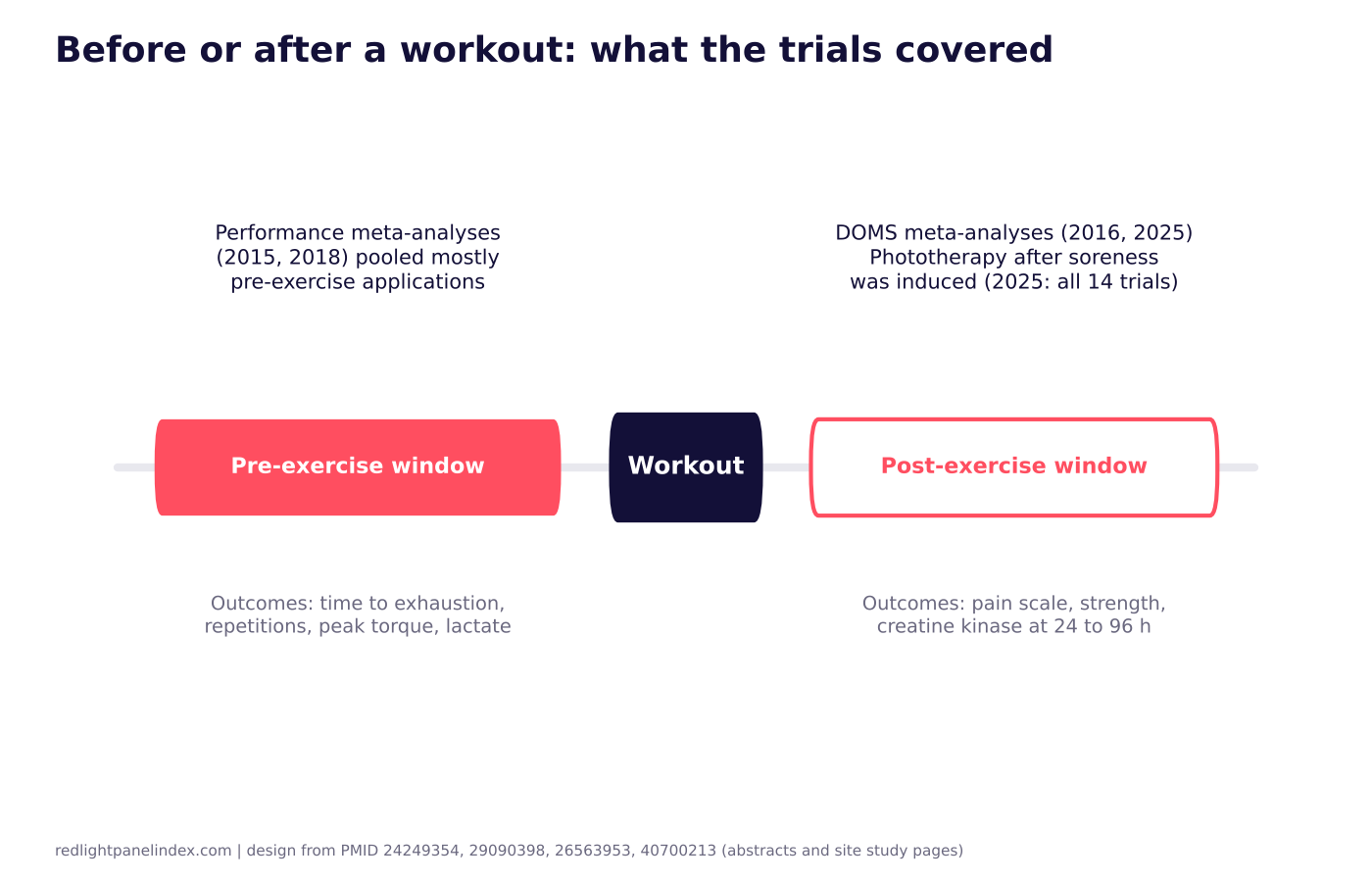
Both timings have trial support, but for different questions. Meta-analyses of exercise performance pooled mostly pre-exercise applications and reported benefits in time to exhaustion, repetitions and fatigue markers, while post-exercise data come mainly from soreness trials and are thinner and less consistent. If your goal is performance in the session itself, the evidence points to before; if your goal is soreness afterward, the evidence is smaller and mixed.
Choosing a panel? Our ranking of the best red light therapy panels is computed from published, method-labeled specs across 188 devices. For exercise timing, the spec that matters is measured irradiance at your working distance, because it sets how long each session must run.
What the pre-exercise evidence covers
The strongest timing statement in the literature comes from the performance reviews. The 2015 Leal-Junior meta-analysis (PMID 24249354) pooled 13 randomized trials and reported that the most consistent results came from red or infrared light applied before exercise rather than during or after. Our study review of that paper lists the figures it reported: time to exhaustion up by 4.12 seconds and repetitions up by 5.47 against placebo. These are small, laboratory-scale changes in healthy people, not a promise about your next training block.
The 2018 Vanin review (PMID 29090398) looked at 39 randomized trials with 861 healthy participants, and 28 of them went into the meta-analysis. It reported modest benefits across time to exhaustion, repetitions, isometric peak torque and blood lactate, with evidence quality ranging from very low to moderate. Details are in our Vanin 2018 study review, and the wider picture is on the sports performance evidence page.
What the post-exercise evidence covers
Post-exercise trials mostly ask a different question: does light after hard exercise change soreness? The 2016 Nampo meta-analysis (PMID 26563953) pooled 15 trials with 317 participants. It reported a reduction in creatine kinase, a muscle damage marker, only when laser therapy was applied before exercise. It found no between-group difference in edema, range of movement or strength whether phototherapy was applied before or after exercise, and the authors concluded that low-level phototherapy may not have a substantial effect on muscle injury and pain from exercise.
The 2025 Tsou meta-analysis (PMID 40700213) updated the picture. It included 14 studies, all of which applied photomodulation after soreness was induced, at wavelengths from 660 to 950nm on one to six points of the affected muscle. Four studies had enough data to pool. Against placebo, the pooled pain scores were lower at 72 hours and 96 hours (standardized mean differences of -0.55 and -0.56), and strength was higher at 24 hours and 48 hours (0.97 and 0.99). The authors listed variable parameters and a pooled analysis of only four trials among their limitations, and one heterogeneity statistic they report is above 80 percent. Our delayed onset muscle soreness evidence page grades this body of work.
So the two timings are not rival answers to one question. Pre-exercise data speak to performance and fatigue. Post-exercise data speak to soreness and recovery, and the two soreness reviews disagree on how much it matters. The muscle recovery evidence page takes the more cautious position, that consistency across weeks matters more than exact timing, and nothing in the trials contradicts that.
A pre-exercise protocol from the trial parameters
Use the parameters the performance reviews say were most consistent, then convert them to panel time.
- Wavelength: red or near-infrared. The Vanin review pooled trials from roughly 655 to 950nm; see our wavelengths guide for what each band is thought to do.
- Energy: Leal-Junior's review associated doses of 5 to 6 joules per irradiated point with positive results. Vanin's review suggested 20 to 60 joules for smaller muscle groups and 60 to 300 joules for larger ones, delivered before exercise at up to 200mW per diode.
- Timing: before the session, as in the trials. The trials differ in the gap between light and exercise, so the exact gap is your choice.
The catch is that trial doses are in joules per point from a handheld laser or small cluster, while a panel's output is spread over a large area. The two do not convert directly, which is why we use the dose calculator in J/cm2 for panels and treat the trial figures as a guide to order of magnitude, not a prescription.
A post-exercise protocol from the trial parameters
The DOMS trials in the Tsou review used a wide range of settings. Examples from the paper's table: an 830nm device at 210mW applied to six quadriceps points for 10 minutes per point, and an 810nm device at 400mW applied to six quadriceps points for 125 seconds per point. Others used 660 to 950nm with outputs from 10mW to a few hundred mW, and applied one to six points. No single parameter set stands out, and the authors say the variability complicates comparison.
A practical reading for a panel:
- Wavelength: near-infrared in the 810 to 850nm range covers most of the trials, with red alongside it. Deeper muscle sits beneath more tissue; the penetration depth page explains the limits.
- Coverage: put the sore muscle group in the working field. The reviews treated one to six points per muscle, so the panel's whole-area coverage roughly maps onto the multi-point trials.
- Timing: after the workout, as in the trials. All of the Tsou trials began after soreness was induced; the 2016 review also covered pre-exercise application, so neither timing was studied exhaustively.
From trial dose to panel minutes
The dose calculator uses dose in J/cm2 equal to irradiance in mW/cm2 times seconds, divided by 1,000. The site notes that most studied protocols fall between 10 and 60 J/cm2 per area, which is where published protocols sit, not a prescription. Using the independently measured irradiance at 6 inches for three panels on our athlete recovery ranking, here is what an illustrative target looks like in minutes:
| Panel (measured at 6 inches) | Measured irradiance | Time for 10 J/cm2 | Time for 20 J/cm2 |
|---|---|---|---|
| Hooga ULTRA360 (Light Therapy Insiders) | about 74 mW/cm2 | 2 min 15 s | 4 min 30 s |
| RLT Home Total Spectrum ULTRA (LightLab center-average) | 85.7 mW/cm2 | 1 min 57 s | 3 min 53 s |
| PlatinumLED BioMax 900 Classic (LTI average) | 90.3 mW/cm2 | 1 min 51 s | 3 min 41 s |
The targets here are illustrations, not trial doses, and the figures use the measurement method each database page labels. Brand-claimed irradiance often runs well above what a spectrometer reads; see spectrometer versus solar meter for why. Prices on the ranking at last check were $399 (verified 2026-09-12) for the Hooga ULTRA360, $2,895 (verified 2026-09-12) for the Total Spectrum ULTRA and $1,299 (verified 2026-08-13) for the BioMax 900. All three carry a 3-year warranty and a 60-day trial, though the PlatinumLED trial has a 20 percent restocking fee. The joules per cm2 explainer covers the unit in more detail.
Cautions that apply to either timing
- More is not better. Dose follows a biphasic pattern, so stacking long sessions can blunt the effect; see the biphasic dose response explainer.
- Trial devices are not home panels. Most trials used clinical lasers or LED clusters with a stated power in milliwatts. The honest gap to a panel is the area and distance, not just the wavelength.
- Small effects. The performance gains are measured in seconds and a few repetitions. The soreness benefit is moderate in size in a pool of four trials.
- Eyes and meds. Follow our eye protection guidance and check the photosensitizing medications page if you take any.
Verdict by use case
- You want to perform better in the session: use the panel before exercise. This is where the evidence is most consistent, and the dose range in the Vanin review is the best anchor.
- You are sore after hard training: use it after exercise, near-infrared with red, covering the muscle, and expect a modest effect at most. The 2025 pooled result is encouraging; the 2016 pooled result was not.
- You train most days and want one routine: pick one timing you will keep. Our 30-day protocol fixes frequency, distance and session length for four weeks and does not ramp up, which fits the consistency argument.
- You only own one panel and little time: a short pre-workout session is the better-supported choice for performance, and a post-workout session is the reasonable choice for soreness. Neither is established as better for recovery overall.