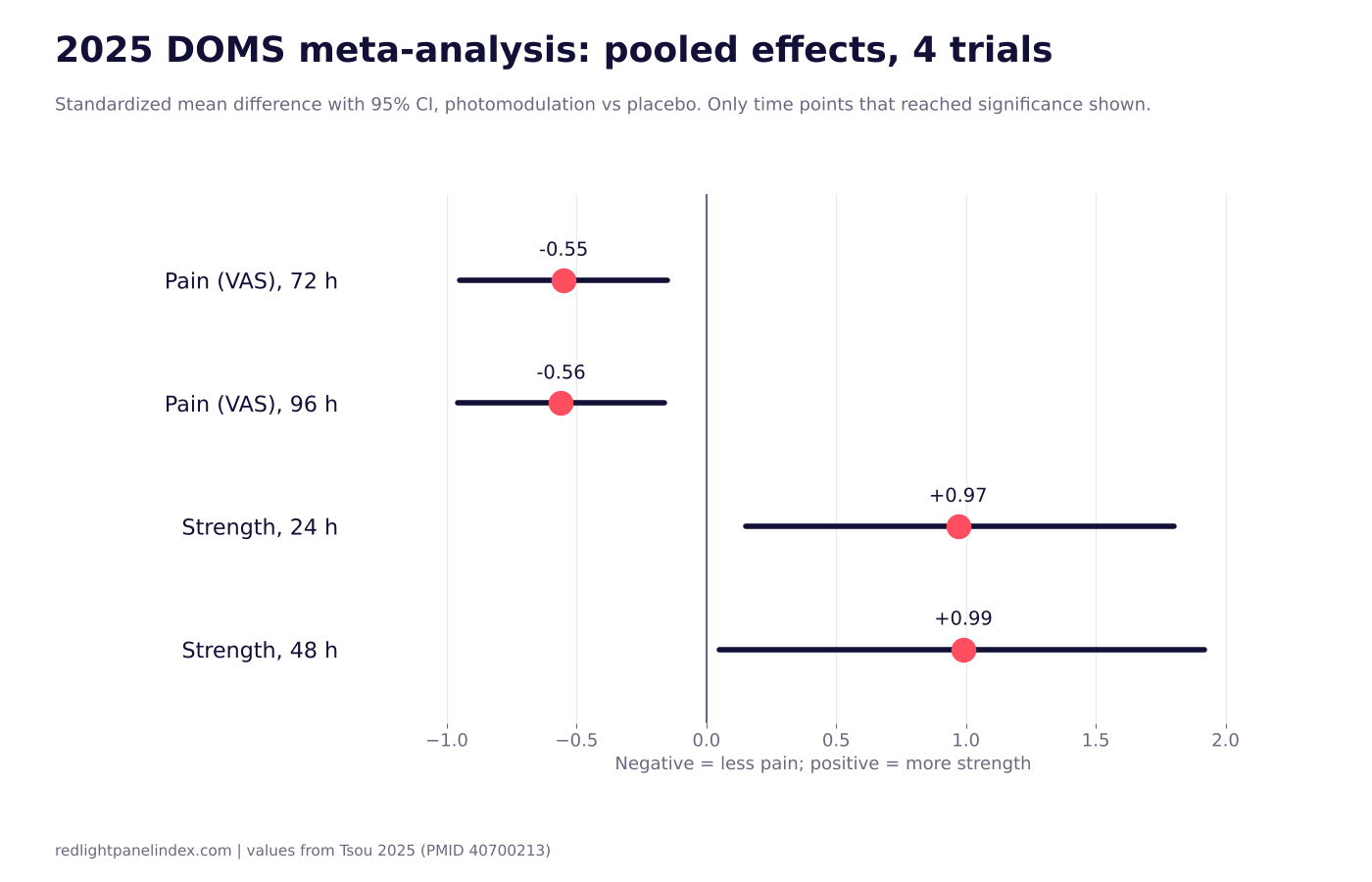
The evidence grade for delayed onset muscle soreness (DOMS) is Limited: the two meta-analyses on the question reached different conclusions, and the more favorable 2025 pooled result rests on only four trials with high heterogeneity. A 2016 review of 15 trials found minimal benefit (PMID 26563953), while a 2025 review of 14 trials reported lower pain at 72 and 96 hours and higher strength at 24 and 48 hours (PMID 40700213).
Choosing a panel? Our ranking of the best red light therapy panels is computed from published, method-labeled specs across 188 devices. For soreness, the spec that matters is measured near-infrared irradiance at your working distance, because it sets how long each session must run.
Why the grade is Limited
Our grading scheme reserves Strong for results that replicate across controlled trials at doses a home panel can plausibly deliver. Here, the controlled trials exist, but the pooled analyses disagree, the latest pools only four trials, and the trial devices were mostly clinical lasers and LED clusters applied at a few points on the muscle, not wide-field panels. That fits Limited better than Moderate. The grade describes the evidence, not any device, and it can move as new trials arrive. The broader muscle recovery evidence page carries a Moderate grade for recovery support overall, which includes performance trials that this page does not cover.
The 2016 meta-analysis: minimal benefit
Nampo and colleagues (PMID 26563953) reviewed 15 randomized trials with 317 participants testing LED or laser phototherapy on pain, muscle injury markers (creatine kinase and edema) and function (range of movement and strength) around exercise. They reported a reduction in creatine kinase only when laser therapy was applied before an exercise protocol. There was no between-group difference in edema, range of movement or strength when phototherapy was applied before or after exercise. The authors concluded that low-level phototherapy may not have a substantial effect on skeletal muscle injury and pain caused by exercise, and named small trial numbers, heterogeneity and modest sample sizes as limits.
The 2025 meta-analysis: pain and strength at specific time points
Tsou and colleagues (PMID 40700213) searched PubMed and EMBASE and found 14 controlled studies, all of which applied photomodulation therapy after DOMS was induced. Wavelengths ranged from 660 to 950nm, applied to one to six points on the affected muscles. Four studies had enough data to pool against placebo, for visual analog scale (VAS) pain and muscle strength at 24, 48, 72 and 96 hours.
| Outcome | Time point | Pooled SMD | 95% CI |
|---|---|---|---|
| Pain (VAS) | 72 h | -0.55 | -0.95 to -0.15 |
| Pain (VAS) | 96 h | -0.56 | -0.96 to -0.16 |
| Muscle strength | 24 h | 0.97 | 0.15 to 1.80 |
| Muscle strength | 48 h | 0.99 | 0.05 to 1.92 |
Pain showed no significant difference at 24 or 48 hours, and strength showed none at 72 or 96 hours. The authors reported a moderate effect on pain and a large effect on strength, and said the findings suggest photomodulation may be an effective intervention for managing DOMS. The confidence intervals are wide, and the heterogeneity statistics reported ranged from about 46 to 81 percent, so the pooled numbers should be read as a direction, not a precise size. The authors listed variability in parameters and assessments, insufficient outcome data and a meta-analysis limited to four articles among their limitations.
What the individual trials used
The paper's table shows how much the settings varied. Examples: an 830nm device at 210mW on six quadriceps points for 10 minutes per point; an 810nm device at 400mW on six quadriceps points for 125 seconds per point; a 650nm device at 200mW on six quadriceps points for 30 seconds per point; and several 808nm and 660 to 850nm devices at 10 to 100mW applied to biceps or hamstring points for 10 to 70 seconds. Some used continuous output, others pulsed at 10 Hz and up. This variety is the main reason there is no single standard protocol, and why the two meta-analyses can both be correct about the trials they included.
Why the conclusions differ
Three plausible reasons, none of which we can settle from the abstracts alone. First, the 2025 review includes trials published after the 2016 search, several in 2017 to 2022. Second, the two reviews pooled different outcomes at different time points, so a null result at one point and a positive result at another can coexist. Third, both reviews pooled small trials with high heterogeneity, where one added study can move the estimate. The 2025 paper is newer, but it is not proof that the 2016 paper was wrong.
What was not studied
- Home panels. None of the trials in these reviews used a wide-field consumer panel. They used point-applied lasers or LED clusters, so panel irradiance at 6 to 12 inches is an extrapolation.
- Trained athletes in competition. The pooled trials measured lab soreness protocols, not competitive performance or injury rates.
- Long-term outcomes. Time points ended at 96 hours. Nothing here speaks to training adaptation over months.
- Optimal wavelength or dose. The pooled analysis does not compare 660nm against 830nm or one dose against another.
- Timing relative to exercise. All 14 trials in the 2025 review applied light after DOMS induction, so this review cannot say whether pre-exercise application changes soreness. Our before versus after guide sets out what each timing has behind it.
A practical section: using a panel for soreness
The calculator is the bridge between trial parameters and a panel. The dose calculator converts measured irradiance and time to J/cm2, and the joules per cm2 explainer covers the unit. For a panel measured at 85.7 mW/cm2 at 6 inches, such as the RLT Home Total Spectrum ULTRA, 10 J/cm2 takes about 1 minute 57 seconds, and 20 J/cm2 about 3 minutes 53 seconds. Those are illustrative targets, since trial doses are reported in joules per point and do not convert directly to J/cm2.
- Wavelength: near-infrared in the 810 to 850nm range appears in many of the trials, alongside red. See the wavelengths guide and the 850nm profile.
- Coverage: place the sore muscle group in the working field, at the distance your measured irradiance applies to. The distance guide covers working range.
- Frequency: treat the sessions as a short routine over the 24 to 96 hour window the trials measured, not an extended daily marathon; the biphasic dose response page explains why more is not simply better.
- Choosing hardware: our athlete recovery ranking compares panels on method-labeled irradiance and wavelength mix.
Cautions
Soreness that is sharp, localized, one-sided, accompanied by swelling or dark urine, or does not ease over several days is not ordinary DOMS and needs a clinician, not a panel. Red light does not replace rest, graded return to training or medical care. Protect your eyes with the steps in our eye protection guide and check the photosensitizing medications page if you take any. Findings are written as reported by the authors, with language such as "was associated with" and "reported", because the pooled evidence supports a direction, not a guarantee.