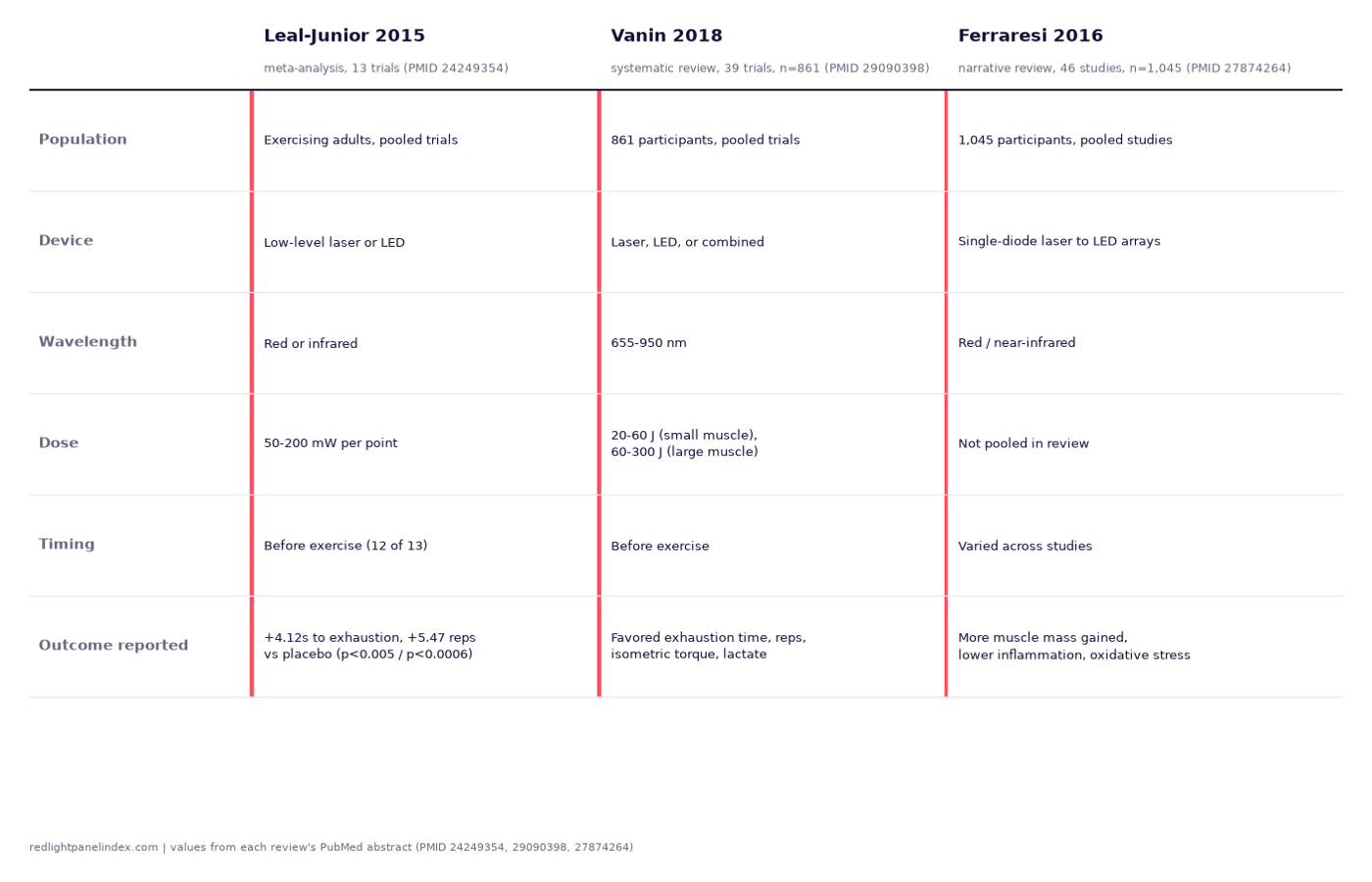
Moderate is the right grade here: two systematic reviews and one narrative review, pooling dozens of randomized trials between them, consistently report that phototherapy applied before exercise improves time to exhaustion, repetition count and fatigue markers, but the pooled devices are clinical lasers and LED arrays rather than consumer panels, and much of the biochemical evidence is reported as a vote count rather than a single combined effect size.
Choosing a panel? Our ranking of the best red light therapy panels is computed from published, method-labeled specs across 188 devices. For sports performance, the spec that matters is total optical power delivered to the muscle, not the irradiance density number printed on the box.
The proposed mechanism is the same one behind this site's muscle recovery evidence page: near-infrared light is absorbed by mitochondrial cytochrome c oxidase, which is associated with higher ATP output and lower reactive oxygen species in the treated tissue. For a performance question specifically, that translates into a hypothesis that a muscle primed with light before a set has more readily available energy and less oxidative load going into the effort, rather than a claim about healing damage after the fact. Which wavelengths are doing that work, and how far each one reaches into muscle versus skin, is covered on the site's wavelengths explainer.
The studies
Leal-Junior and colleagues, 2015 pooled 13 higher-quality randomized trials (of an original 16, after excluding three for low methodological quality, scored on the ten-item PEDro scale) that tested phototherapy timed around exercise (PMID 24249354). Twelve of those 13 trials applied light before exercise rather than during or after. Across the pooled trials, time to exhaustion increased by a mean of 4.12 seconds versus placebo (95% CI 1.21 to 7.02, p<0.005), and repetitions completed increased by a mean of 5.47 (95% CI 2.35 to 8.59, p<0.0006), both statistically significant. Differences in how individual trials measured creatine kinase, a blood marker of exercise-induced muscle damage, were too heterogeneous to pool into one effect size, so the authors instead counted comparisons: 13 of 16 favored phototherapy over placebo on that marker. The trials used low-level laser or LED devices delivering 50 to 200 mW of total optical power at each point on the muscle, doses this site's dose calculator cannot convert directly to a panel's mW/cm2 claim without knowing the treated spot size, which is why total power and irradiance density are tracked as separate figures here. A full walkthrough of this trial's methodology and limitations is on the site's dedicated study review.
Vanin and colleagues, 2018 ran a larger systematic review and meta-analysis, searching the literature through March 2017 and pooling 39 randomized trials covering 861 participants (PMID 29090398). The review found positive results with both low-level laser therapy and LED therapy, or a combination of the two, across a wavelength range of 655 to 950nm, spanning the visible red into near-infrared light. Optimal outcomes were associated with energy doses of 20 to 60 joules for small muscle groups and 60 to 300 joules for larger muscle groups, delivered before exercise. The review reported varying-quality evidence favoring phototherapy for time to exhaustion, repetition count, isometric torque and blood lactate, while explicitly calling for more standardized dosing protocols across future trials, since the 39 pooled trials did not all use the same wavelength, dose or timing.
Ferraresi, Huang and Hamblin, 2016 published a narrative review covering 46 studies and 1,045 participants on photobiomodulation and athletic performance (PMID 27874264). Rather than pooling a single effect size, the review summarized a consistent pattern across the literature: phototherapy was associated with increased muscle mass gained after a training program, and with reduced markers of inflammation and oxidative stress measured directly in muscle biopsies. The review spanned multiple delivery methods, from single-diode lasers to LED arrays, covering outcomes for fatigue, exercise-induced muscle damage and post-exercise recovery in addition to performance itself. The authors also raised the question of whether phototherapy should be regulated as a performance-enhancing method in competitive sport, a policy question this article does not attempt to answer.
What was not studied
None of the three reviews evaluated a standing, full-body consumer panel of the kind this site tracks; the pooled trials used point-and-shoot lasers or small LED clusters aimed at specific muscles or tendons, typically for under 10 minutes. No review reported outcomes broken out by sport, sex or age group, so it is not possible to say whether sprinters, endurance athletes or older recreational lifters respond differently. Long-term outcomes were not addressed either: every trial measured performance in a single exercise session or a single testing bout, not across a competitive season or a multi-month training block. None of the abstracts describe a dose-response comparison specific to a standing panel's typical treatment distance of one to three feet, where a much larger body surface receives a lower irradiance than a laser point held directly on the skin; that gap is exactly why this site separates a device's total optical power from its irradiance density. And because the three reviews searched overlapping literature through different cutoff years (2012, March 2017, and studies through the mid-2010s respectively), none of them captures trials published in the last several years using newer consumer-style panels.
What this means for a home panel
The timing pattern is the one finding a home-panel user can act on directly: the most consistent results across all three reviews came from phototherapy delivered before exercise, not during or after. That is a different use case from the post-workout soreness and next-day recovery angle covered on this site's muscle recovery evidence page, which pools different trials aimed at delayed-onset soreness rather than same-day performance. Someone testing a pre-workout session on a home panel can use the dose calculator to translate a stated irradiance and distance into minutes, keeping in mind the biphasic dose-response principle: more light is not automatically better, and several trials in these reviews used comparatively low total-power doses. Panels ranked specifically on published near-infrared density and standing-distance irradiance for training and recovery use are compared on the best panels for athletes and muscle recovery page, and general session-frequency guidance, since none of these trials tested a repeated weekly protocol beyond a single pre-exercise dose, is covered in the how often to use red light therapy guide.
Cautions
None of the three reviews reported phototherapy improving muscle performance on its own, independent of a training program; the effect described is a modifier of a workout already being done, not a substitute for one. The reviews describe the outcome direction as "was associated with" or "found positive results for" rather than a guaranteed benefit, and none of the pooled trials involved a competitive-season outcome, so a single favorable session in a lab does not establish that repeated pre-workout use over a season changes competitive results. The Vanin review's own call for more standardized protocols is a reminder that "phototherapy improves exercise performance" is a pattern across dozens of differently dosed trials, not one validated recipe a buyer can copy exactly from a product label. Anyone taking prescription photosensitizing medication, or with a history of light-triggered seizures, should read this site's general safety guidance before adding a pre-workout light session to an existing routine, and anyone competing under a sport-specific anti-doping code should check that code directly, since the Ferraresi review notes this is an open regulatory question rather than a settled one.