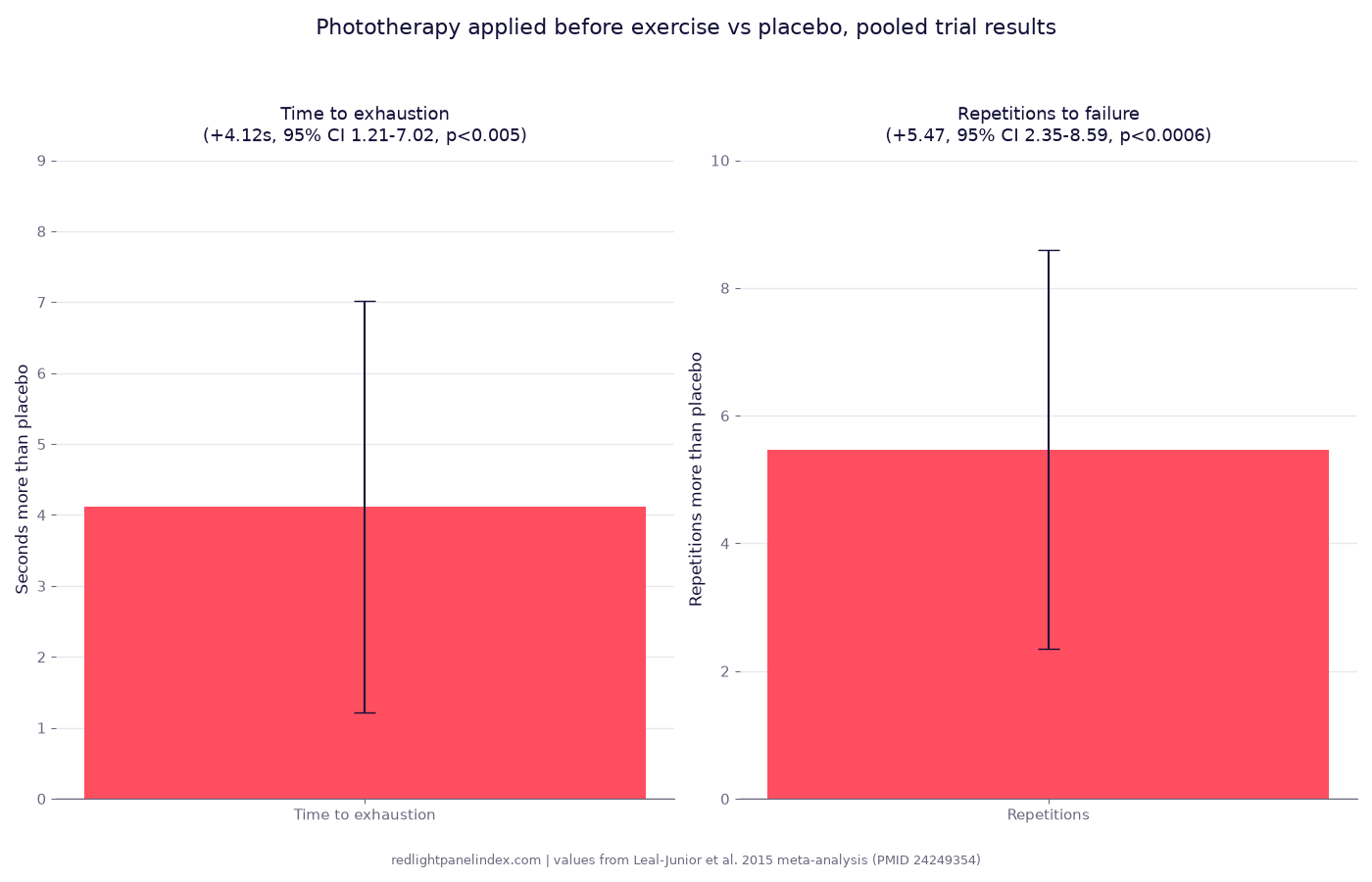
A 2015 meta-analysis pooling 13 higher-quality randomized trials found that phototherapy (low-level laser or LED light) applied before exercise increased the time to exhaustion by 4.12 seconds and the number of repetitions completed by 5.47, both compared with placebo (PMID 24249354). The most consistent results came from trials that irradiated before exercise using red or infrared light at low power.
Choosing a panel? Our ranking of the best red light therapy panels is computed from published, method-labeled specs across 188 devices. For exercise performance, the spec that matters is total optical power output, not the irradiance density number brands advertise.
What the study asked
Leal-Junior and colleagues set out to answer whether phototherapy, applied before, during or after exercise, changes muscle performance or the biochemical signs of exercise-induced muscle damage. They searched PubMed/Medline for randomized controlled trials published between 2000 and 2012, then scored each trial's methodological quality with the ten-item PEDro scale. The review combined results where trial designs were similar enough to pool, and reported the rest as a simple vote count of positive versus negative results.
Who was studied
The review does not describe a single population; it pools trials across the human exercise-performance literature that met its inclusion criteria. The literature search returned 16 randomized controlled trials, three of which were excluded for low PEDro scores, leaving 13 trials of acceptable methodological quality (a PEDro score of 6 or more out of 10). Of those 13, 12 applied phototherapy before exercise, and 10 trials reported a significant improvement in their main performance outcome. Because the review is a meta-analysis of trials rather than a single-arm study, it cannot say who those individual trial participants were beyond "exercising adults" as a group; the abstract does not give a pooled sample size or demographic breakdown.
Device and parameters as stated
The review pooled results across both low-level laser therapy (LLLT) and light-emitting diode therapy (LEDT) devices, not one specific model. It does not report a single wavelength, dose or session count for the pooled group as a whole. What it does report is which parameters were associated with the most consistent, positive results across trials: red or infrared wavelengths, phototherapy applied before exercise rather than during or after, power outputs between 50 and 200 mW, and doses of 5 to 6 joules per irradiated point (spot). Those power figures are in milliwatts of total optical output, the same total-power measurement this site's dose calculator and its explainer on irradiance versus total power distinguish from an irradiance density (mW/cm2) figure; a trial device's total power output is not directly comparable to a home panel's irradiance claim without knowing the treated area.
What was measured and what was found
The two outcomes the review could formally pool were time until exhaustion and number of repetitions completed, both measured against placebo (sham) treatment. Time to exhaustion increased by a mean of 4.12 seconds compared with placebo (95% CI 1.21 to 7.02, p<0.005). The number of repetitions completed increased by a mean of 5.47 compared with placebo (95% CI 2.35 to 8.59, p<0.0006). Both results reached statistical significance.
For the biochemical side, the review looked at creatine kinase (CK) activity, a blood marker used to judge exercise-induced muscle damage. Differences in how trials measured and reported CK across studies were too large to combine into one pooled effect size, so the authors instead counted how many individual trial comparisons favored phototherapy. Thirteen of 16 comparisons showed a positive result for phototherapy over placebo on this marker. The authors' overall conclusion was that phototherapy with lasers and LEDs improves muscular performance and speeds recovery, mainly when applied before exercise.
Limitations
This is a review of other trials, not a new trial itself, so its findings are only as strong as the underlying literature it pooled. Three of the 16 identified trials were excluded outright for low methodological quality, and even among the 13 that were kept, the authors note real heterogeneity in trial design, which is exactly why they could not pool the CK marker into a single effect size and had to fall back on a vote count instead. A vote count of comparisons is a weaker form of evidence than a pooled effect size with a confidence interval, since it treats every comparison as equally informative regardless of trial size or quality. The search window stops at 2012, so it does not include the following decade of exercise-phototherapy research, including newer trials on consumer-style LED panels rather than clinical lasers. The abstract does not report a combined participant count, so the precision behind the pooled estimates cannot be judged from the abstract alone. And because the review spans many different devices and protocols rather than one, "phototherapy before exercise" here describes a pattern across trials, not a single validated protocol that a buyer could replicate exactly.
What this means for a home panel
The devices in these trials were clinical lasers and LED arrays, not the consumer panels this site tracks, and the review reports its parameters in milliwatts of total power delivered to a small treated spot, not the mW/cm2 irradiance figure most home panels advertise. That gap matters: a home panel's marketing number cannot be converted into the review's "50 to 200 mW per point" figure without knowing the panel's treated area and the true measurement method behind its claim, which is why this site labels every irradiance figure by the instrument and distance behind it. What does carry over directly is the timing pattern: the most consistent results in this review came from phototherapy applied before exercise, not after, and from red or infrared wavelengths rather than other parts of the spectrum. Anyone using a home panel for a pre-workout session can use the dose calculator to estimate exposure time at their own panel's stated irradiance, and the guide on how often to use red light therapy for how session frequency compares with what published trials have tested. The near-infrared band most closely associated with deeper, muscle-focused targets, 850nm, is profiled on its own page, including how much of a panel's published output actually reaches that band. The broader case for red light and exercise recovery, including trials that looked at soreness and strength days after a workout rather than performance during it, is covered on the muscle recovery evidence page. For panels ranked specifically on published near-infrared density and standing-distance irradiance for training and recovery use, see the best panels for athletes and muscle recovery.