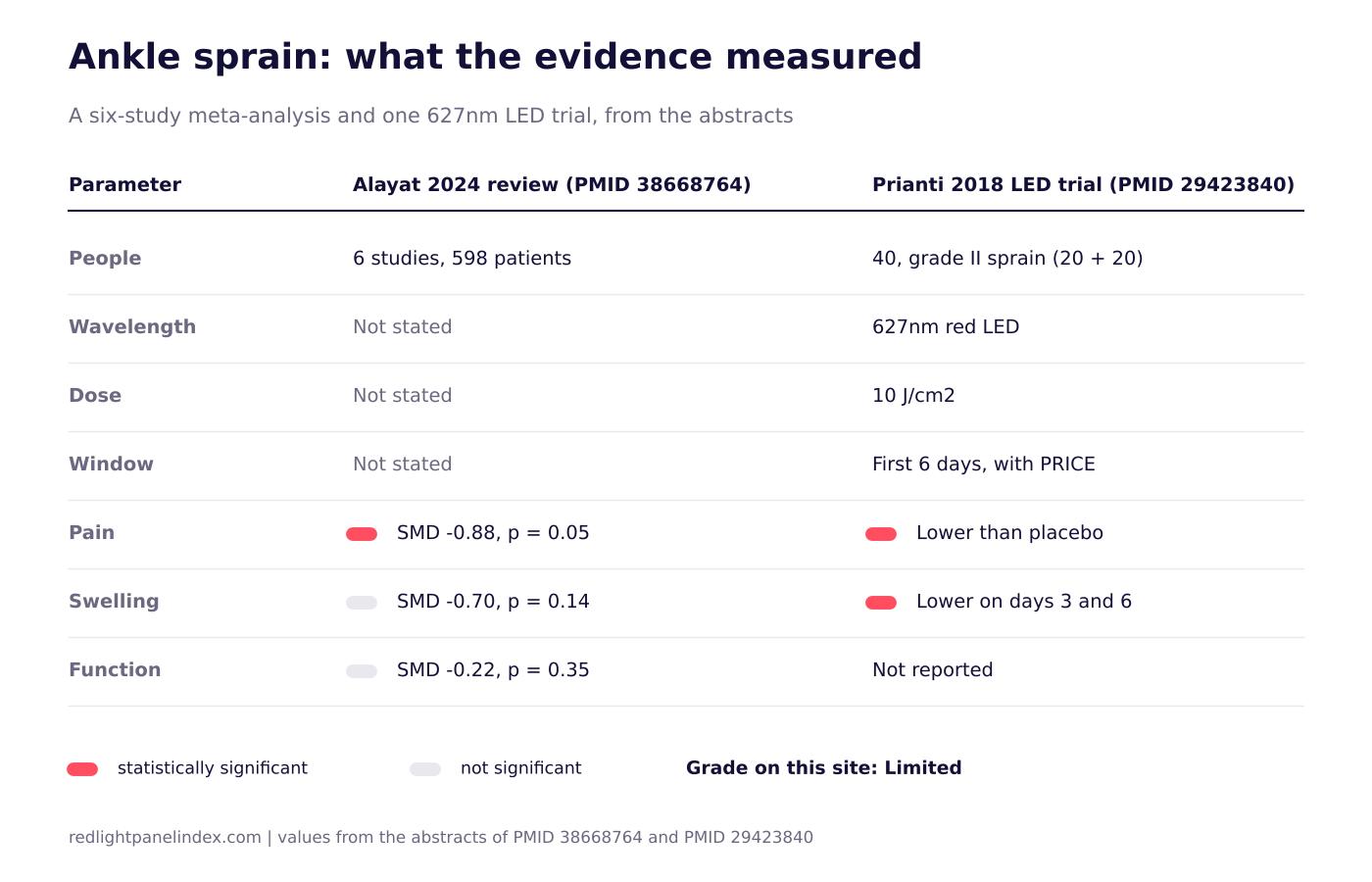
The evidence grade for red light therapy in ankle sprain is Limited: a 2024 meta-analysis of six trials reported a pain reduction that only just reached statistical significance and found no significant effect on swelling or function (PMID 38668764), and the one trial that used an LED, a 627nm red source in the first six days after a grade II sprain, is a single study of 40 people (PMID 29423840). Nothing tested a home panel, and nothing tested light in the later weeks of rehabilitation, when most of the work of recovery happens.
Choosing a panel? Our ranking of the best red light therapy panels is computed from published, method-labeled specs across 188 devices. For a sprained ankle, the spec that matters is method-labeled red irradiance at your working distance, because the only LED trial dosed red light alone.
What an ankle sprain is
An ankle sprain is a stretch or tear of the ligaments that hold the ankle bones together, most often on the outer side after the foot rolls inward. It is graded by severity, from a mild stretch (grade I) through a partial tear (grade II) to a complete rupture (grade III), and most sprains improve over weeks with protection, gradual loading and exercise.
The injury has two phases that matter for any treatment claim. The acute phase covers roughly the first days, when pain and swelling peak and standard first aid is protection, rest, ice, compression and elevation (PRICE). The rehabilitation phase follows, when the goals shift to restoring range of motion, strength and balance so the ankle does not give way again. A therapy can help in one phase and do nothing in the other, so a trial's timing is as important as its result.
What the trials used
This table is built only from what the two abstracts state. Cells marked "not stated" are gaps in the abstract, not in this page.
| Alayat 2024 review | Prianti 2018 LED trial | |
|---|---|---|
| Type | Systematic review and meta-analysis | Randomized, placebo-controlled |
| People | 6 studies, 598 patients; 5 studies pooled | 40 with acute grade II inversion sprain, 20 per group |
| Wavelength | Not stated | 627nm, plus or minus 10nm (red LED) |
| Dose | Not stated | 10 J/cm2 |
| Irradiance, time per site | Not stated | Not stated |
| Site and area | Not stated | Not stated |
| Sessions | Not stated | Over 6 days; number not stated |
| Timing | Not stated | Initial phase of the sprain |
| Background care | Not stated | PRICE in both groups |
| Control | Control groups in included trials | Same LED switched off |
| Pain | SMD -0.88 (95% CI -1.76 to -0.00), p = 0.05; moderate certainty | Less pain than placebo on VAS and McGill scales |
| Swelling | SMD -0.70 (95% CI -1.64 to 0.24), p = 0.14; low certainty | Less swelling than placebo on days 3 and 6, p below 0.0001 |
| Function | SMD -0.22 (95% CI -0.69 to 0.24), p = 0.35; low certainty | Not reported |
The review searched eight databases from their start to the end of 2023 and rated two included studies fair and four good on the PEDro scale. Heterogeneity was above 75 percent for pain and swelling, meaning the trials disagreed far more than chance would explain. The LED trial reported pain reductions of 85.79 percent against 55.73 percent on the visual analogue scale and 83.33 percent against 52.52 percent on the McGill questionnaire. The placebo group improved a great deal too, as natural recovery and PRICE care would predict. The site's study review of both papers goes through each result in detail.
The grade and why
The site's evidence grades explainer gives Moderate when controlled trials exist but are fewer, smaller or run on clinic devices, and Limited when the support is a single trial, a pilot, or parameters a consumer panel is not built to reach. Ankle sprain lands at Limited for three reasons:
- The pooled pain result is borderline. The upper end of the confidence interval touches zero, p is 0.05, and heterogeneity is high. The authors rate the pain evidence moderate in certainty, but the size of a real effect could be anywhere from large to negligible.
- Swelling and function did not reach significance in the pooled data. The one LED trial reported less swelling, but a single trial of 40 people does not outweigh a pooled estimate that found no significant difference.
- Only one trial is close to home use. The LED trial used a red wavelength many panels carry and a dose a panel could deliver in principle, but it did not publish the irradiance or time needed to reproduce it.
The joint pain evidence page carries a Strong grade, but that rests on knee osteoarthritis trials, a chronic condition with a different tissue and timeline. That grade does not transfer to an acute ligament injury.
What was not studied
- Home panels. No trial in either abstract used a panel at a distance.
- The rehabilitation phase. The LED trial stopped at day 6. Neither abstract reports light used weeks later alongside balance and strength exercise.
- Return to activity and re-injury. Neither abstract reports time to return to sport or work, or whether the ankle sprained again.
- Grade I and grade III sprains. The LED trial enrolled grade II only, and the review abstract does not break results down by grade.
- Near-infrared versus red. The review does not state wavelengths, so no comparison between bands is possible.
- Chronic ankle instability after repeated sprains, a separate problem with no trial here.
Practical: distance and session length for a swollen ankle
If you choose to try a panel, the closest model is the LED trial: red light near 627nm, 10 J/cm2, over the first several days, on top of PRICE care. The site's 630nm page covers the red band that sits nearest to 627nm and how many panels carry it; the ankle ligaments lie close to the surface, so red light is less of a mismatch here than it would be for a hip.
Session time comes from the dose formula: J/cm2 equals irradiance in mW/cm2 times seconds, divided by 1000. On the dose calculator, a panel delivering a method-labeled 50 mW/cm2 reaches 10 J/cm2 in about 3.3 minutes. Two cautions apply:
- Use the red share, not the headline. Most panels publish one irradiance figure for all bands combined, and the trial dosed red alone. If red is roughly half of a panel's output, the red dose is roughly half of the calculated total.
- Use the measured distance. A published irradiance figure holds only at the distance it was measured, usually 6 inches. The distance guide explains how output falls as you move back. A swollen ankle is easier to keep still and evenly lit with the foot elevated and the panel aimed at the outer ankle from the stated distance.
Keep the skin cool. A fresh sprain is being iced, and a panel held too close can warm the skin, which runs against the aim of first aid. If the skin feels warm, move back. More light is not better: the biphasic dose response page explains why a higher dose can blunt the effect rather than add to it. On timing, the evidence covers only the first week; nothing here says light speeds a return to sport.
What a home panel can and cannot reproduce
A panel can deliver red light near 627nm and, at a known irradiance, a 10 J/cm2 dose. It cannot reproduce what the trial abstract left out: the area treated, the time per application and how many sessions fell within the six days. It cannot stand in for the review's trials either, because their devices and wavelengths are not given in the abstract, and the site's LED vs laser page explains why clinic doses do not translate directly to home devices. Light was added to PRICE in the trial, never used in its place.
Cautions and when to see a clinician
- Get it checked if you cannot bear weight, if there is tenderness over the bone, if the ankle looks deformed, or if numbness or tingling spreads into the foot. A fracture or complete ligament tear can look like a sprain in the first days.
- Swelling that keeps growing, or pain that worsens after the first few days, needs a clinician, not a longer session. The inflammation evidence page makes the same point about swelling after any injury.
- Rehabilitation exercise matters more than any device. Balance and strengthening work is what restores a stable ankle, and no light trial here measured it.
- Medications and eyes. Check photosensitizing medications and use eye protection with high-output panels; the safety and side effects page covers both.
For muscle soreness after training, a different problem with its own trials, see the DOMS evidence page. This page summarizes studies; it is not medical advice.