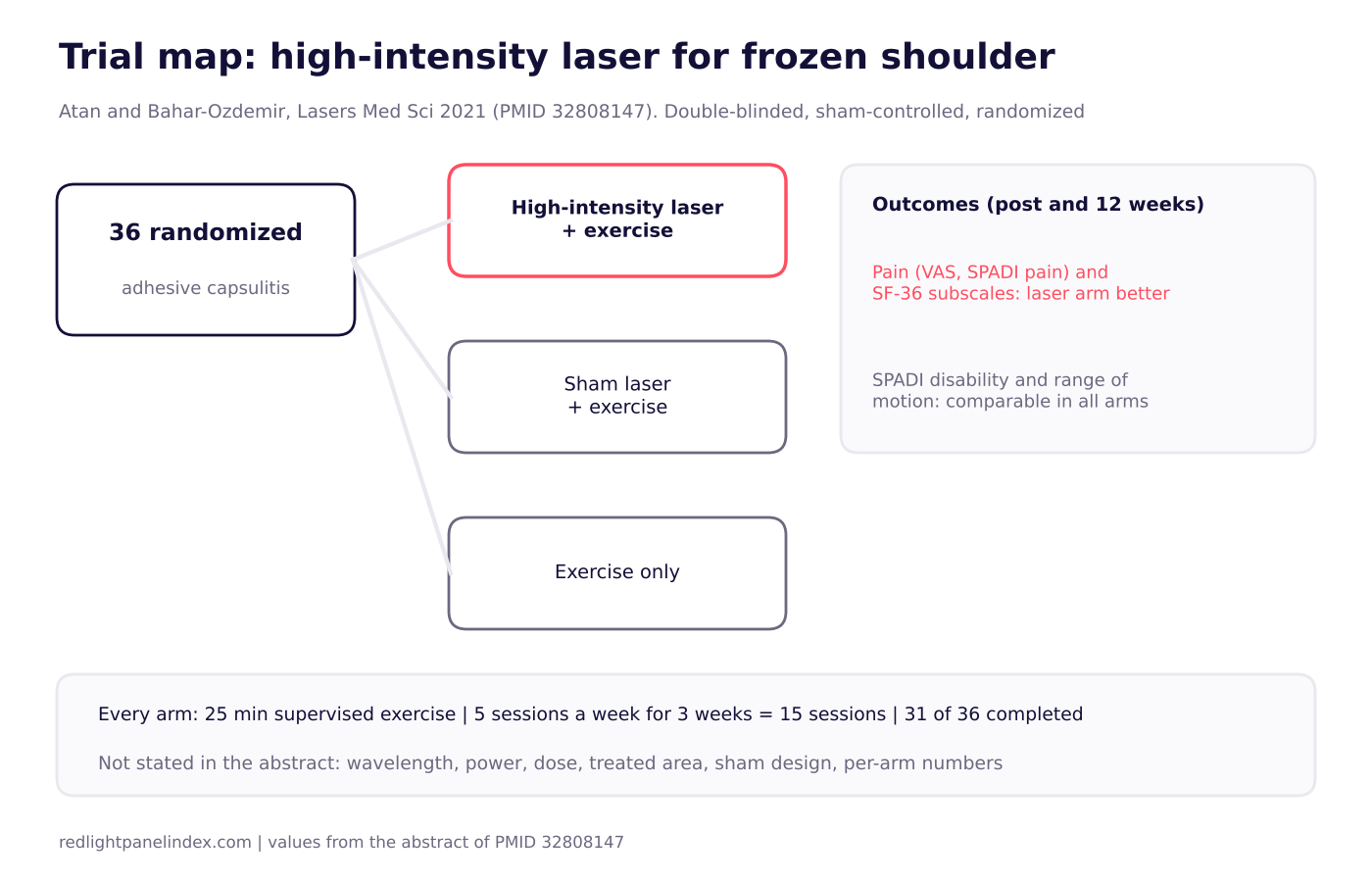
A 2021 double-blinded, sham-controlled randomized trial in 36 people with adhesive capsulitis (frozen shoulder) reported that high-intensity laser therapy added to exercise improved pain and some quality-of-life scores more than sham laser plus exercise or exercise alone, but not disability or range of motion, which improved comparably in all three groups (PMID 32808147). The device was a high-intensity clinic laser, the abstract gives no wavelength or dose, and the result does not transfer to a home LED panel.
Choosing a panel? Our ranking of the best red light therapy panels is computed from published, method-labeled specs across 188 devices. For a deep joint like the shoulder, the spec that matters is method-labeled near-infrared irradiance at your real distance, though no panel reproduces the laser used here.
Where this fits
The site's shoulder pain evidence page grades low-level laser for shoulder tendinopathy and lists frozen shoulder among the diagnoses it does not cover. This trial is one of the few controlled studies on frozen shoulder itself, which is why it gets its own review; the frozen shoulder evidence page grades it alongside two rotator cuff laser trials and explains why capsule stiffness is a different target from tendon pain. The wider joint picture is on the joint pain and arthritis hub. Everything below comes from the abstract, read through a database record; where the abstract is silent, this page says so.
What the study asked
Adhesive capsulitis is a condition in which the shoulder becomes painful and stiff without a clear cause, limiting daily activity and quality of life. Atan and Bahar-Ozdemir, writing in Lasers in Medical Science, asked whether high-intensity laser therapy (HILT) improves pain, disability and quality of life when added to a supervised exercise program.
The question is narrower than "does light help a frozen shoulder." Every participant exercised. The trial tested whether the laser added anything on top of that, and the sham arm let it separate the laser from the experience of being treated with one.
Who was studied
The abstract reports 36 patients diagnosed with adhesive capsulitis, randomized into three groups. Thirty-one completed the study, so five did not. The abstract does not give the number in each arm, the participants' ages, how long they had had symptoms, which stage of the condition they were in, or whether any had related conditions such as diabetes. With roughly a dozen people per arm before dropouts, small differences between groups could easily be missed.
Device and parameters as stated
- Design: prospective, randomized, double-blinded and sham-controlled.
- Arms: HILT plus therapeutic exercise; sham laser plus therapeutic exercise; therapeutic exercise only.
- Exercise: 25 minutes of shoulder exercises supervised by a physiotherapist, for every group.
- Schedule: five times a week for 3 weeks, 15 sessions in total.
- Blinding: patients in the laser and sham arms did not know their allocation, and a blinded investigator did the assessments.
- Assessments: before treatment, after treatment and at a 12-week follow-up.
- Registration: NCT03929276.
The abstract does not state the laser's wavelength, power, pulse settings, energy per session or the area treated, and it does not describe the sham device or the exercises. That is the central gap for a reader. A high-intensity laser is a clinic device that delivers far more power than a low-level laser or an LED, and it also produces warmth on the skin, which matters for both the biology and the blinding. Without the parameters, the dose calculator cannot be filled in from this paper.
What was measured and found
The primary outcome was pain on a visual analogue scale (VAS). Secondary outcomes were the Shoulder Pain and Disability Index (SPADI), the SF-36 quality-of-life survey and shoulder range of motion.
The abstract reports that the HILT group showed significant differences in VAS pain, the SPADI pain subscale and three SF-36 subscales (energy and fatigue, pain, and general health), all with p below 0.05. It reports that all three groups improved comparably on SPADI disability and on shoulder range of motion, both after treatment and at follow-up.
The authors conclude that 15 sessions of HILT were superior for pain and quality of life but not for disability or function. The abstract gives no group means, effect sizes or confidence intervals, so this page quotes none. The finding is a direction: more pain relief with the laser, the same gains in movement and function with or without it.
That split is the most useful thing in the paper. Frozen shoulder is defined by stiffness, and range of motion is the outcome most people with the condition care about. In this trial, the stiffness side of the problem responded to exercise, and the laser did not add to it.
Why the sham arm matters
Pain is self-reported, and pain scores are the outcome most exposed to placebo response, as the guide to reading sham-controlled trials explains. A three-arm design helps: the exercise-only group shows what exercise and time achieve, and the sham group shows what the ritual of laser treatment adds. Reporting the pain difference against both is stronger than a comparison with exercise alone.
The limit is warmth. An active high-intensity laser can feel warm, and a sham may not, so patients could guess their arm. The abstract does not say whether the sham was built to match the sensation or whether blinding was checked. The thermal vs photochemical page explains why heat is a confounder in light research generally.
Limitations
- Small sample. Thirty-six randomized and 31 completing, across three arms.
- Unstated parameters. No wavelength, power or dose in the abstract, so the treatment cannot be reproduced or compared with other trials.
- Unknown group balance. No per-arm numbers, ages, symptom duration or stage.
- Ambiguous reporting. The abstract describes comparable improvement in disability and range of motion with "all p below 0.05", which most likely refers to within-group change over time rather than a difference between groups, but the abstract does not say so.
- Short follow-up. Twelve weeks is brief for a condition that often runs its course over many months.
- Single trial. One device, one schedule, one center. It has not been replicated in the sources this page has read.
What it means for a home panel
Very little directly. This trial tested a high-intensity clinic laser, applied to one shoulder in a clinic, five days a week, alongside supervised exercise. A home LED panel delivers a much lower irradiance spread across a wide area, and nothing in the abstract allows a session on a panel to be matched to what the laser delivered. The irradiance guide and the penetration depth page explain why depth matters for a joint capsule that sits beneath the deltoid.
What does transfer is the pattern of the result. The pain outcome responded to the added laser; movement and function responded to exercise in every group. Anyone with a frozen shoulder who uses a panel should treat it, at most, as an add-on to a rehabilitation program and not as a way to restore range of motion. The site's joint pain panel ranking applies method-labeled criteria if you are comparing devices, and the 810nm page covers the near-infrared band most often chosen for deeper tissue.
Before using any light device on a stiff, painful shoulder, have the diagnosis confirmed, since a rotator cuff tear, arthritis or referred neck pain can look similar. Check photosensitizing medications, use eye protection with bright near-infrared sources, and stop if pain worsens. This page describes a study; it is not advice to replace physiotherapy or medical care.