Randomized trials in knee osteoarthritis report reduced pain when photobiomodulation is added to a routine, using near-infrared light in the 785 to 860nm band and, in the newest trial, right at that band's low end at 790nm (PMID 40545487). Ranking a home panel against that evidence means checking three things: how much of its output sits in that 810 to 850nm range plus 1064nm where a model offers it, whether its irradiance figure names the instrument that measured it, and whether its size actually fits over a single knee or shoulder rather than being built for a full body. Four panels in this site's database clear that bar, priced from $1,095 to $2,799.
Choosing a panel? Our ranking of the best red light therapy panels is computed from published, method-labeled specs across 188 devices. For joint pain specifically, the spec that matters is near-infrared share at 810 to 850nm and 1064nm, not total wattage.
How these picks are ranked
Every list on this site scores models the same way: an irradiance figure only counts at full weight if it names the instrument and distance behind it. See how rankings work for the full method. Among panels that publish a usable wavelength breakdown, these four combine the strongest near-infrared share with the clearest irradiance evidence and a size a single joint can actually sit under.
| Criteria | What it measures here |
|---|---|
| Method-labeled irradiance | mW/cm2 at 6in, with the instrument named or flagged as unlabeled |
| Near-infrared share | Published percentage at 810, 830, 850 and 1064nm |
| Fit for one joint | Panel length against a single knee or shoulder, not a full body |
| Price and buyer terms | Verified price, warranty length, trial window and restocking terms |
What the trials used
A 2020 randomized placebo-controlled trial split 62 women with knee osteoarthritis into four groups combining exercise with active or placebo photobiomodulation, delivered through a cluster probe at 808nm, 100 mW, seven points per side, 56 J total, over sixteen sessions (PMID 31144070). Both PBM groups showed a significant drop in pain versus placebo, but PBM added no extra benefit on top of exercise for walking distance, timed-up-and-go or muscle strength, a result worth knowing before expecting a panel to out-perform an existing exercise routine rather than support it; our full review of that trial covers all four study arms.
A 2025 trial went further toward home-relevant dosing: 65 participants with symptomatic knee osteoarthritis were randomized to active photobiomodulation, sham, or no treatment, using a 790nm laser at 120 mW delivering 4 J to each of nine points around the knee, following World Association for Laser Therapy, or WALT, dosing recommendations (PMID 40545487). The active group showed significant reductions in pain and significant WOMAC improvements in pain, stiffness and function against both sham and control, while neither comparison group changed; see our review of that WALT-dosed trial for the full protocol.
A 2019 systematic review and meta-analysis pooled 22 randomized placebo-controlled trials and 1,063 participants and found pain reduced by 14.23mm on a visual analogue scale versus placebo at the end of therapy, with the benefit persisting through follow-up (PMID 31662383). The review's own conclusion sets a usable target: doses of 4 to 8 J at 785 to 860nm, or 1 to 3 J at 904nm, per treatment spot, with the best results appearing two to four weeks after treatment finished; our full review of that meta-analysis breaks down the dose subgroups.
None of the three trials used a flat home panel; all delivered light through a laser or cluster probe moved point by point, a different geometry from a panel illuminating a whole area at once, the same gap this site's dose calculator flags for point-applied protocols. What carries over from clinic to home is the wavelength band, 785 to 860nm, not the exact point-by-point delivery method, which is why NIR share in that band is the ranking criterion below rather than an attempt to replicate the trials' per-point joule counts. This site's joint pain evidence page grades the combined literature Strong, and the knee osteoarthritis condition page covers these same three papers, plus a fourth, at Moderate specifically for the home-relevance gap between clinic lasers and consumer panels.
The picks
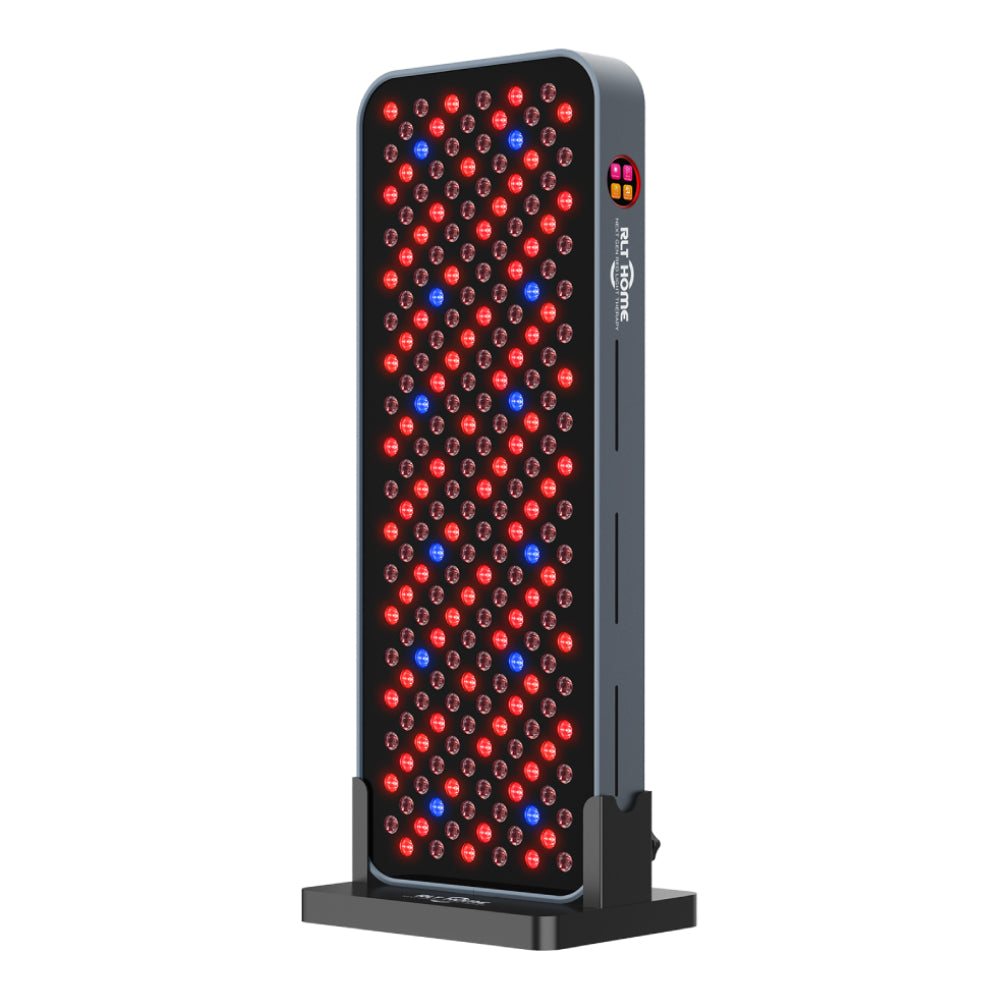
1. RLT Home Total Spectrum COMPACT posts an independently spectrometer-measured 99.0 mW/cm2 at 6 inches, tested by Electropossible Ltd with a named HP350IR instrument, the clearest irradiance evidence of the four. Its seven-band mix puts 19 percent of output at 810nm, 14 percent at 830nm, 9 percent at 850nm and 14 percent at 1064nm, a combined 56 percent of its output inside or adjacent to the trials' 785 to 860nm band, plus the deepest-reaching 1064nm band the knee osteoarthritis trials did not test but this site's deep-tissue 1064nm ranking covers separately. At 30.3 by 11.8 inches, it is sized to sit directly over a knee or shoulder without the unused length of a full-body panel. At $1,095 (verified 2026-09-12) it carries a 3-year warranty and a 60-day trial with no restocking fee.
2. RLT Home Total Spectrum MAX shares the same seven-band wavelength mix and the same independent Electropossible Ltd testing, with a marginally higher measured 100.53 mW/cm2 at 6 inches. At 49.2 by 11.8 inches it is considerably longer than a single joint needs, though still usable propped or wall-mounted over a knee or shoulder; the extra length pays off more for someone who also wants to cover a second area, such as both knees, in the same placement. At $1,795 (verified 2026-09-12) it carries the same 3-year warranty and 60-day, no-restocking-fee trial as the COMPACT, at a higher price for a size most single-joint routines will not use in full.
3. PlatinumLED BioMax 900 (classic 9th gen) is independently measured too, 113 mW/cm2 peak and 90.3 mW/cm2 average at 6 inches per Light Therapy Insiders, though the brand does not publish its own wavelength percentages; LTI's independent reconstruction puts roughly 36 percent of its output at 850nm, with 810nm, 830nm and 1060nm sharing a smaller remaining slice alongside 480 and 660nm, a usable but less precise NIR picture than the two panels above. At 36 by 12 inches it fits over a knee or shoulder about as well as the COMPACT. At $1,299 (verified 2026-08-13) it carries the weakest buyer terms here, a 20 percent restocking fee plus customer-paid return shipping on an elective return, against the same 3-year warranty and 60-day trial window.
4. Helio Blaze publishes the highest single-wavelength share for deep reach, 16.7 percent at 1064nm, alongside 20 percent at 810nm and 13.3 percent at 830nm, a combined near-infrared share around 60 percent, the widest of the four. Its 71 mW/cm2 at 6 inches figure does not name a measurement instrument, so per this site's convention for unlabeled figures it should be read conservatively as roughly half that, about 35 mW/cm2, well behind the three method-labeled picks above. At 64.3 by 11.8 inches it is a full-body panel, more length than a single joint needs, though it can still be positioned over one. At $2,799 (verified 2026-09-12) it is the most expensive of the four, offset by the most generous return terms, a no-restocking-fee 60-day trial with no-questions-asked returns.
Session time for a knee or shoulder
Using this site's dose calculator at a common 20 J/cm2 home target, a placement with the COMPACT's 99.0 mW/cm2 takes about 3.4 minutes, the MAX's 100.53 mW/cm2 about 3.3 minutes, and the BioMax 900's 90.3 mW/cm2 average about 3.7 minutes. The Helio Blaze takes about 4.7 minutes at its stated 71 mW/cm2, or about 9.4 minutes at the conservative, unlabeled-figure estimate of roughly 35 mW/cm2, a real difference in session length depending on which figure turns out to be closer to the panel's actual output at that distance.
Picking between these four
A buyer who wants the clearest independent irradiance evidence and a size built for one joint gets that from the RLT Home Total Spectrum COMPACT. Someone who also wants to cover a second area in the same placement, and is willing to pay more for length that goes unused on a single joint, gets that from the Total Spectrum MAX. A buyer comfortable with a less precisely published wavelength breakdown in exchange for a mid-size panel and a lower price than the MAX gets that from the PlatinumLED BioMax 900, accepting its weaker return terms. And a buyer prioritizing the single highest 1064nm share and the most generous return policy, while accepting an unlabeled irradiance figure at the highest price on this list, gets that from the Helio Blaze. Since the underlying trials used a laser at 785 to 860nm rather than any of these four panels, NIR share in that band and honest irradiance evidence matter here more than matching a specific brand's marketing claim.