The two neuropathy trials behind the evidence used clinic devices, not home panels, so any ranking of panels for the feet is a ranking of specs, not of results: the panels below are picked for near-infrared share, a labeled irradiance figure and a way to aim light at the feet. The site grades the evidence for neuropathy as Moderate, and that grade belongs to the trials, not to these products.
Choosing a panel? Our ranking of the best red light therapy panels is computed from published, method-labeled specs across 188 devices. For neuropathy and foot use, the spec that matters is how much of the output is near-infrared, because red light is largely absorbed near the skin.
What the trials studied
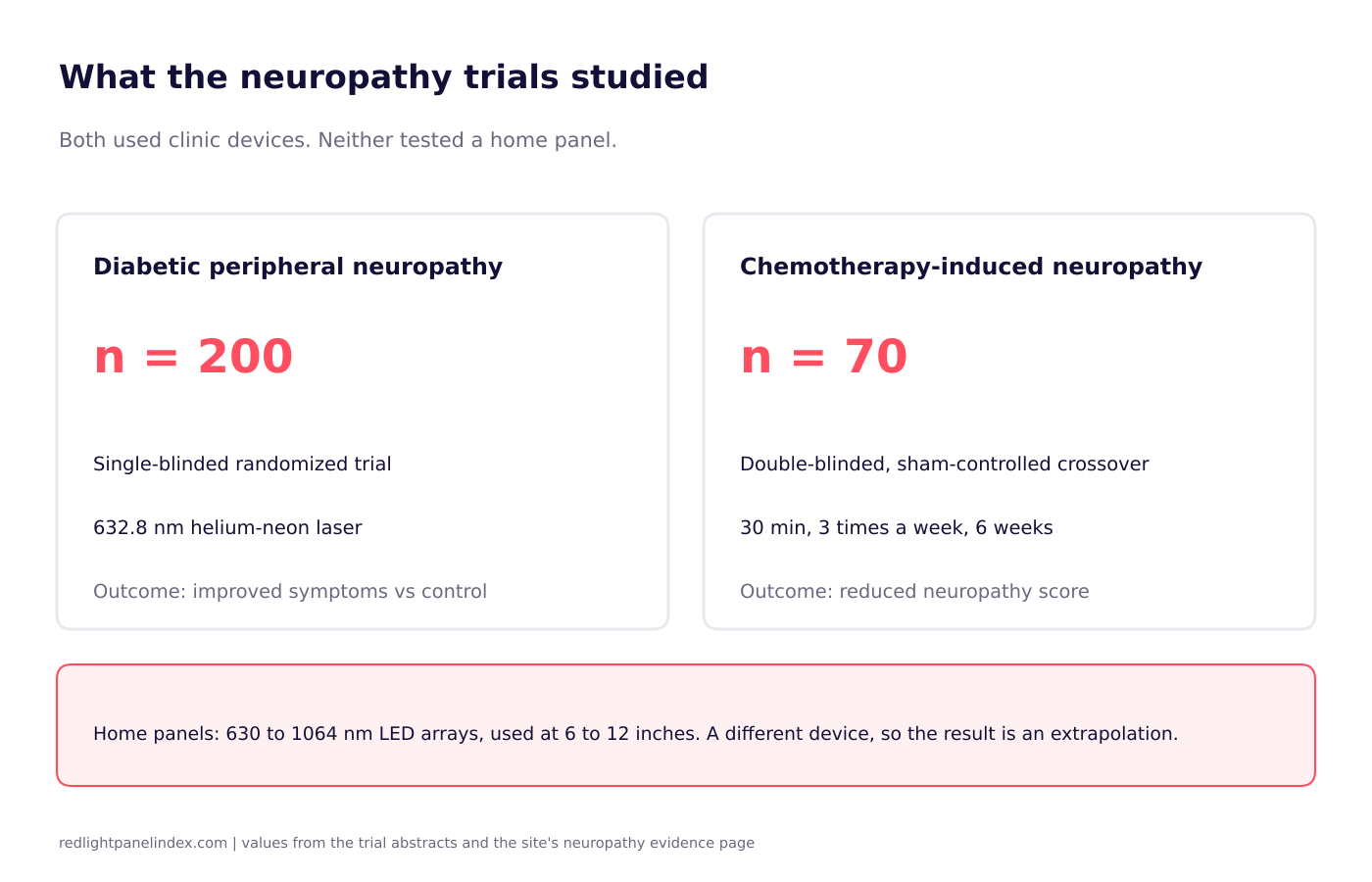
The larger trial enrolled 200 people with diabetic peripheral neuropathy and was a single-blinded randomized trial using a 632.8 nm helium-neon laser over a ten-day course (PMID 40090424). It reported improved neuropathy symptoms compared with control. The site's diabetic neuropathy study review covers the design in detail. It supports a symptom benefit; it does not show that light reverses nerve damage.
The second trial enrolled 70 patients with chemotherapy-induced peripheral neuropathy in a double-blinded, sham-controlled crossover design, with 30-minute sessions three times a week for six weeks, scored on a modified total neuropathy score at baseline and at 4, 8 and 16 weeks (PMID 27887804). The authors concluded that photobiomodulation reduced neuropathy symptoms, and that adding physiotherapy did not improve outcomes beyond photobiomodulation alone. See the chemotherapy neuropathy evidence page, graded Limited, and the study review.
Both trials used clinic devices, not home LED panels. The main neuropathy evidence page says so plainly: home panels are extrapolating from them. Neither trial tells you how long to run a home panel, at what distance, or whether it works at all.
How these picks were made
This follows the rules for every best-of on the site; see how rankings work. RLT Home is one brand among 41 and gets the same criteria and cautions as every other entry. The criteria, all from database fields:
| Criterion | Why it matters at the feet |
|---|---|
| Share of LEDs at 810 nm or longer, from the published allocation | The neuropathy page recommends 810 to 850 nm, with 1064 nm reaching deepest, and calls red 630 to 660 nm the wrong band for deep structures |
| Irradiance with method and distance | You need it to set a session length in the dose calculator; read the irradiance explainer |
| A way to aim at the feet | Stand included, stand price, or a size small enough for a tabletop |
| Price with verification date, warranty, trial | Terms differ widely |
The database does not record a floor-mount or low-angle field, so "a way to aim at the feet" is judged from the stand information each page gives. Confirm a panel can be positioned low with the brand before buying.
The criteria at a glance
| Model | Near-infrared share of LEDs (810 nm and up) | Irradiance (method, distance) | Stand | Price (verified) | Warranty | Trial |
|---|---|---|---|---|---|---|
| RLT Home Total Spectrum COMPACT | about 56 percent (810, 830, 850, 1064) | 99.0 at 6 in, spectrometer | Included; vertical orientation only | $1,095 (2026-09-12) | 3 years | 60 days |
| RLT Home Total Spectrum ULTRA | about 55 percent | 119.28 at 6 in, spectrometer | Motorized stand included | $2,895 (2026-09-12) | 3 years | 60 days |
| MitoMIN 2.0 | 50 percent (850 nm in a 50/50 split with 660) | 115 at 6 in, solar meter and spectrometer both disclosed | Not needed at 12 x 9 x 3 in | $249 (2026-08-13) | 3 years | 60 days |
| MitoPRO MegaX | about 51 percent (810, 830, 850) | 130 at 6 in, both instruments disclosed; independent reading lower | Sold separately, about $139 | $2,649 (2026-08-13) | 3 years | 60 days |
| BlockBlueLight PowerPanel MEGA PLUS | about 50 percent (810, 830, 850, 1060) | 83.1 at 6 in, spectrometer | No | $2,559 (2026-09-12) | 5 years | 30 days |
The near-infrared share is the sum of the published percentages for bands at 810 nm and longer, so it is a comparison aid, not a brand figure. Brands that do not publish an allocation are left out, because the share cannot be computed.
The picks
1. RLT Home Total Spectrum COMPACT
The COMPACT has a stand included at the lowest price among the stand-inclusive models here. It is 30.3 x 11.8 inches, with 56 percent of LEDs at 810 nm or longer, including 14 percent at 1064 nm, and a spectrometer reading of 99.0 mW/cm2 at 6 inches from Electropossible Ltd. The database notes a conflict about whether that test was independent or commissioned by the brand, so treat the figure as a lab number with that caveat. Its page says it mounts in vertical orientation only, which matters if you want it angled low toward the feet. Price is $1,095, with a 3-year warranty, a 60-day trial and no restocking fee.
2. RLT Home Total Spectrum ULTRA
The ULTRA has the best-labeled irradiance in the set, 119.28 mW/cm2 at 6 inches by spectrometer, with about 55 percent of LEDs at 810 nm and longer and a motorized stand in the price. The brand commissioned the published tests, and no unaffiliated reading is on file. At $2,895 and 64.3 inches long, it is far larger than a feet-only use needs; it is the pick if you will also use it for the whole body, as covered in the premium panel ranking.
3. MitoMIN 2.0
At $249 it is the lowest price here, and the only one whose irradiance page names both instruments: 115 mW/cm2 at 6 inches. The database notes an independent spectrometer test measured lower than the brand figure, so plan from a lower number. Half of its output is 850 nm and half is 660 nm, so the red half does little for deep tissue. At 12 x 9 x 3 inches it sits on a table or floor, aimed at the feet. It also carries a 60-day trial and a 3-year warranty. The under $500 ranking covers its terms.
4. MitoPRO MegaX
A full 64-inch panel with about 51 percent of LEDs at 810, 830 and 850 nm and no 1064 nm band. The brand discloses 130 mW/cm2 at 6 inches by both instruments, but an independent reading of peak 63 and average 56.5 is also recorded, so plan from the lower figure. A stand costs extra (about $139 for one panel). Warranty is 3 years with a 60-day trial.
5. BlockBlueLight PowerPanel MEGA PLUS
It has a spectrometer-labeled 83.1 mW/cm2 at 6 inches, about 50 percent of LEDs from 810 nm to 1060 nm, and the longest warranty in the set, 5 years. There is no stand, the trial is 30 days, and the customer pays return shipping. At 37 x 16 inches it is smaller than the full-length models.
What was not studied
- Home panels. No trial in the evidence base used a consumer LED panel.
- Dose. The site's neuropathy page gives typical home parameters of 6 to 12 inches, 10 to 20 minutes per session and several sessions a week for at least 8 weeks, and states these are general guidance, not from the trials. Use the dose calculator with the lower of any two irradiance figures.
- Foot ulcers. Wound healing is a separate question; see diabetic foot ulcers.
- Other pain at the foot or ankle. For joints, see the joint pain panel ranking.
Foot safety, especially with diabetes
Reduced sensation is the central caution. If you cannot feel heat reliably, warmth is not a safe guide, so control exposure by time and distance, not by how the skin feels, and keep the panel at or beyond the distances in your dose calculation. Check the skin of your feet before and after each session, and stop if you see redness, blistering or a new sore. Ask a clinician before starting a home protocol on the feet: reduced sensation can hide foot problems, and glycemic control remains the foundation of diabetic neuropathy care. Light does not regenerate nerves or cure neuropathy. Use eye protection, and read the wavelengths guide before choosing a band. If you use photosensitizing medication, talk with your prescriber first.
Choosing by use case
- Lowest cost and a labeled figure: the MitoMIN 2.0, planning from a lower irradiance number.
- A stand in the box and a 1064 nm band: the COMPACT, noting vertical-only mounting.
- Whole body as well as the feet: the ULTRA or MegaX, with the stand difference above.
- Longest warranty: the MEGA PLUS, with a shorter trial.
Prices and terms change; each figure carries the date the database verified it. Confirm on the brand site before buying, and confirm with the brand that the panel can be positioned low enough for foot use.