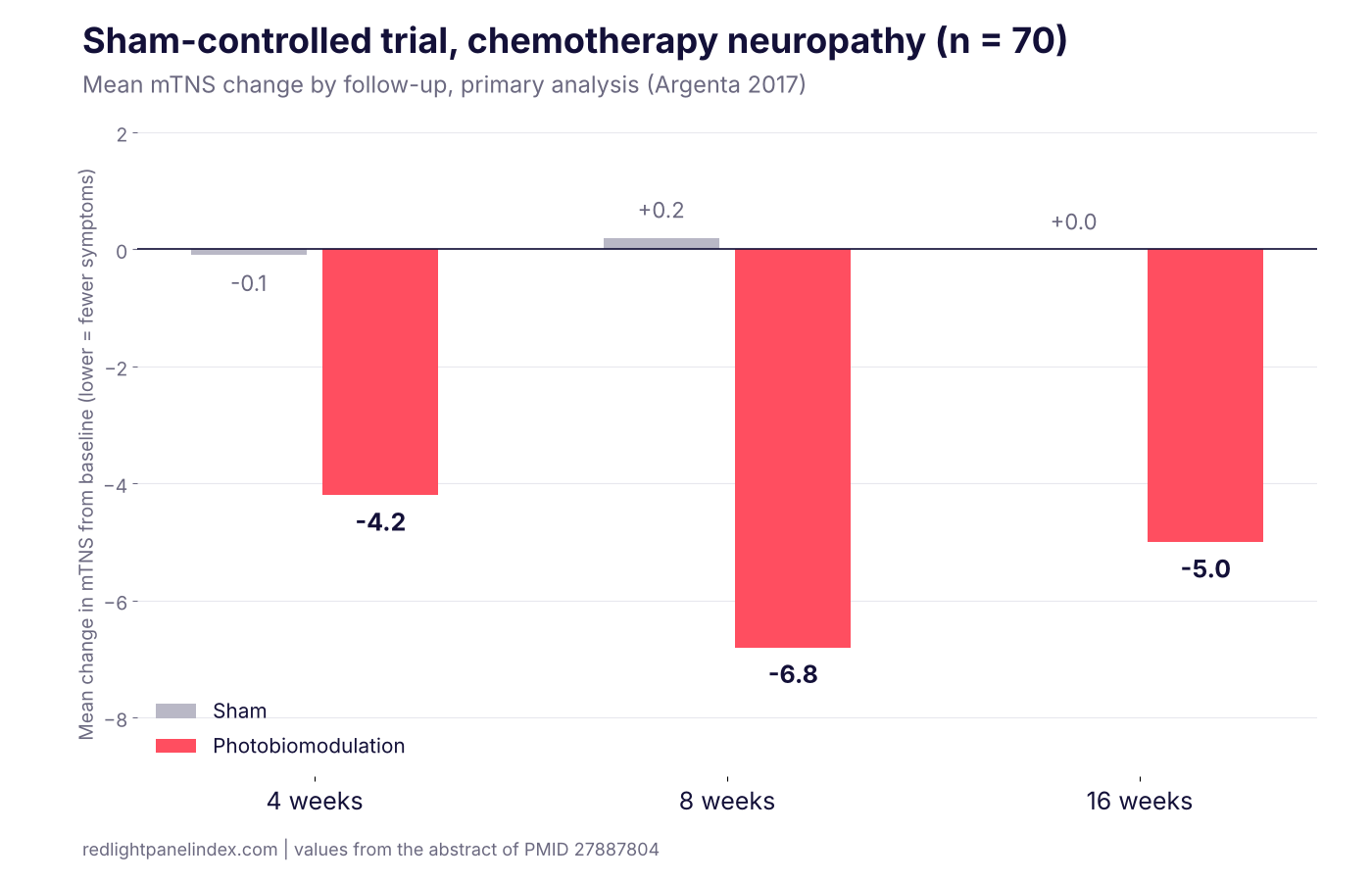
A 2017 randomized, double-blinded, sham-controlled trial of 70 patients with chemotherapy-induced peripheral neuropathy reported that photobiomodulation lowered neuropathy scores at 4, 8 and 16 weeks, while the sham group showed no significant change (PMID 27887804). It is one of the few sham-controlled trials in this area, and its abstract leaves out the wavelength, device and dose, so it cannot be copied with a home panel.
Choosing a panel? Our ranking of the best red light therapy panels is computed from published, method-labeled specs across 188 devices. For nerve symptoms, the spec that matters is verified irradiance at the distance you will actually sit, because this trial's dose is not stated.
Where this fits
This review supports the Limited grade on the chemotherapy neuropathy evidence page, which also covers a separate tumor-safety review. The wider nerve picture is on the neuropathy evidence page. Everything below comes from the paper's abstract, read through a database summary, because the full text sits behind a paywall. Where the abstract is silent, this page says so and does not fill the gap.
What the study asked
The trial, by Argenta and colleagues in Gynecologic Oncology, asked whether photobiomodulation (PBM), with or without physiotherapy, reduces the symptoms of chemotherapy-induced peripheral neuropathy compared with a sham treatment. Chemotherapy-induced neuropathy is nerve damage in the hands and feet that can follow some cancer drugs, and it has few established treatments, which is why a controlled test of light was worth running. For background on the mechanism, see the photobiomodulation explainer.
Who was studied
The abstract reports 70 patients with chemotherapy-induced peripheral neuropathy. It does not give the number in each arm, the type of cancer, the chemotherapy agents, baseline severity or any dropout figures. Those are real gaps, because neuropathy from one drug class can behave differently from another, and a reader cannot judge how well the arms were balanced from the abstract alone.
Design and parameters as stated
- Design: randomized, double-blinded, sham-controlled, with a crossover step.
- Schedule: 30-minute sessions, three times a week, for six weeks. That is 18 sessions.
- Arms: PBM, PBM plus physiotherapy, or sham.
- Crossover: patients in the sham arm could move to a PBM plus physiotherapy arm after the primary follow-up.
- Outcome measure: the modified Total Neuropathy Score (mTNS), at baseline and at 4, 8 and 16 weeks.
The abstract does not state the wavelength, the device, the power, the irradiance, the energy density or the treated body sites. It also does not describe the sham device or the physiotherapy protocol. For a reader trying to learn what dose was delivered, that is the central limitation. The dose calculator cannot be filled in from this paper, and anyone who tells you the trial "used" a specific wavelength should be asked for the full-text source.
What was measured and found
The mTNS is a clinician-scored composite of neuropathy symptoms and signs, and a lower score means fewer findings. The table gives the mean change from baseline for the primary analysis, as the abstract reports it.
| Follow-up | Sham | PBM |
|---|---|---|
| 4 weeks | -0.1 | -4.2 |
| 8 weeks | +0.2 | -6.8 |
| 16 weeks | 0.0 | -5.0 |
The abstract describes the PBM changes as significant at every time point (p<0.001) and the sham group as showing no significant change at any point. The largest reduction appeared at 8 weeks, and the score at 16 weeks was somewhat higher than at 8 weeks while still below baseline. That pattern can be read as a response that persisted at the last follow-up with some drift back, but the abstract does not test that reading or say how the time points are counted from the start of treatment.
For the patients who crossed over from sham to PBM plus physiotherapy, the abstract reports mean changes of -5.5 at 4 weeks, -6.9 at 8 weeks and -4.9 at 16 weeks, again significant. The authors report that adding physiotherapy did not improve results beyond PBM alone, which means the benefit they saw is attributed to the light and not to the exercises. The abstract does not say whether the crossover figures are measured against the original baseline or against the post-sham baseline, so they are best read as a second, uncontrolled look and not a replication.
The authors conclude that PBM significantly reduced neuropathy symptoms in these patients.
Why a sham arm matters here
Neuropathy symptoms are partly subjective and vary from week to week, so a trial without a sham can mistake the placebo response or natural fluctuation for an effect. A flat sham curve, as reported here, is the most useful feature of this trial. Our guide to reading sham-controlled trials lists what to check: how the sham was built, who was masked, and whether the comparison is between groups and not just within one group. On the first of those, this abstract is silent.
Limitations
- Unstated dose. No wavelength, device or energy figure appears in the abstract, so the result cannot be translated into a session at home.
- Unreported group sizes. Seventy patients is a modest sample, and the split across three arms leaves each group smaller still.
- Unknown mix of cancers and drugs. The abstract does not say who the patients were beyond having neuropathy.
- Crossover design. After the primary follow-up the sham group could receive active treatment, so the 16-week comparison with sham is not as clean as the 4-week one, and the abstract does not say how this was handled.
- Single trial. One study from one group tests one device and one schedule. The diabetic neuropathy trial review looks at a different cause of nerve damage with a different laser, and it should not be pooled with this one.
- Clinician-scored outcome. A composite score can move for reasons unrelated to how a patient feels day to day, and the abstract reports no patient-reported outcome.
What this means for a home panel
The honest reading is narrow. A controlled trial of 70 patients reported lower mTNS scores after 18 sessions of PBM and no change after sham. It did not report what light, at what dose, on which body sites, so it cannot tell a buyer how long to sit in front of a panel or at what distance. A clinical device and a home panel differ in irradiance, beam spread and treated area, and the irradiance guide explains why the same minutes can deliver very different doses.
If you are in or after cancer treatment and are thinking about a panel, talk to your oncology team first, especially about treating areas near a tumor site or a radiation field. Use the dose calculator with a verified irradiance figure and the wavelength guide to see what a panel actually delivers, and start well below any clinic schedule. Check photosensitizing medications and use eye protection as the manufacturer advises. This page describes a study; it is not advice to replace or delay any treatment.
The same cautions apply to nerve symptoms with other causes. Where the question is hand symptoms, the carpal tunnel evidence page shows how the grade changes with the cause and the device.
What the study does not show
It does not show that a home panel reduces chemotherapy-induced neuropathy. It does not show prevention, because the patients already had symptoms. It does not show long-term benefit beyond 16 weeks, and it does not identify which wavelength or dose was responsible for the change in scores.