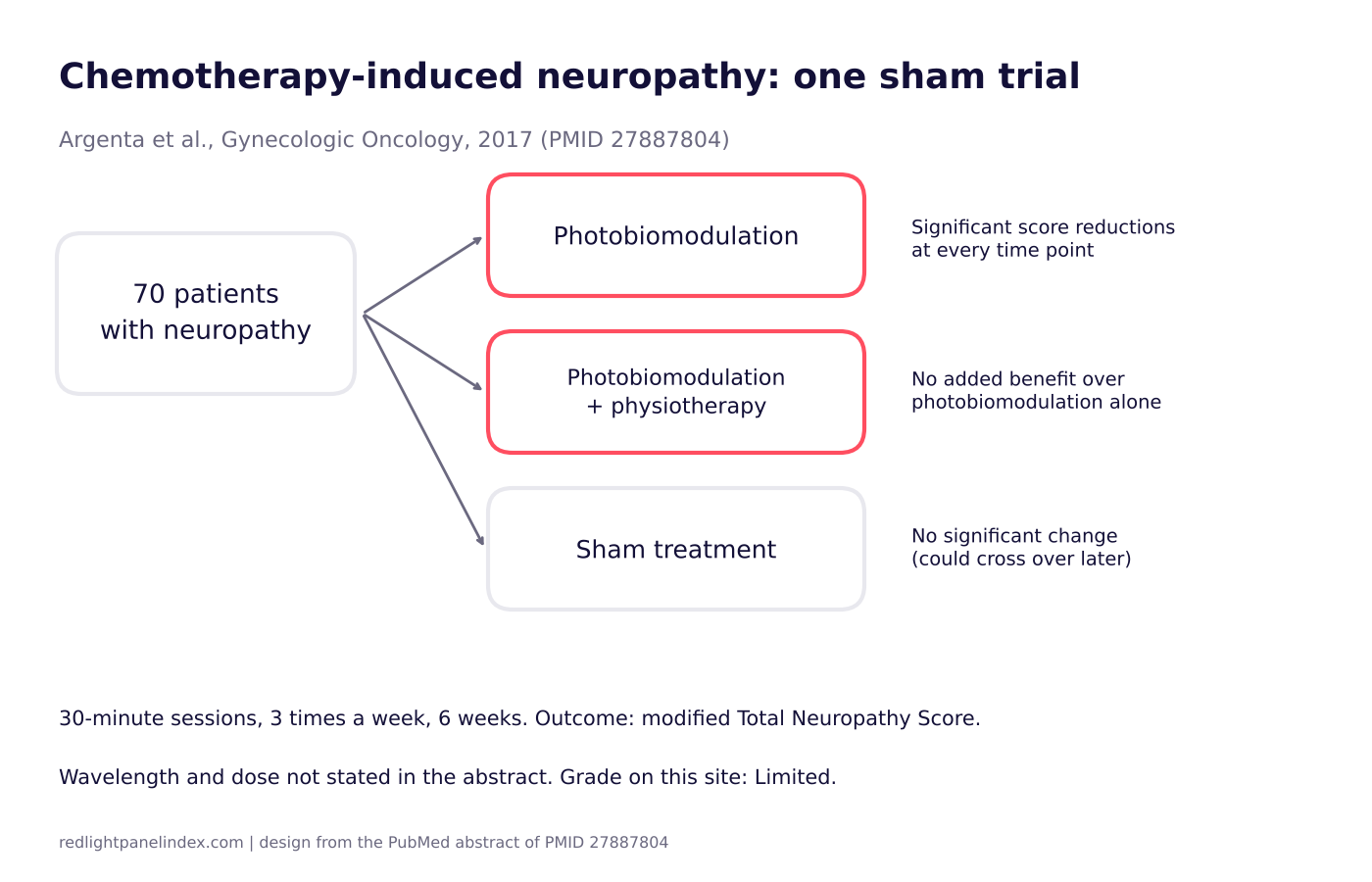
The evidence grade for red light therapy and chemotherapy-induced peripheral neuropathy is Limited: it rests on a single randomized, sham-controlled trial of 70 patients that reported lower neuropathy scores in the treated group (PMID 27887804), supported by a safety review but not yet by replication across devices or protocols. Anyone in or after cancer treatment should coordinate with their oncology team before using a home panel.
Choosing a panel? Our ranking of the best red light therapy panels is computed from published, method-labeled specs across 188 devices. For nerve symptoms, the spec that matters is verified irradiance at the working distance, because the one trial here used a clinical device and its dose cannot be assumed from a home panel's label.
Why the grade is Limited
This site grades evidence as Strong, Moderate, Limited or Insufficient, and the evidence grades explained page describes what each level asks for. Chemotherapy-induced peripheral neuropathy earns Limited because there is one sham-controlled randomized trial in this register, 70 patients is a small sample, and the abstract available for this review gave no device wavelength or dose figures, so a home user cannot reproduce the protocol from the paper alone. The second source is a systematic review about safety, not about whether the light reduces symptoms. Together they give a reason to take the question seriously, not a basis for a protocol.
For context, this site's neuropathy evidence page grades diabetic neuropathy Moderate on a larger trial, reviewed in the 200-patient diabetic neuropathy study review. That is a different cause of nerve damage in a different population, so the grade does not carry over.
The trial: Argenta and colleagues
The study (PMID 27887804; see the full study review of the sham-controlled trial) is a randomized, double-blinded, sham-controlled crossover clinical trial published in Gynecologic Oncology in 2017.
- Who: 70 patients with chemotherapy-induced peripheral neuropathy.
- What was compared: photobiomodulation, with or without physiotherapy, against a sham treatment. The sham arm could later cross over to a combined photobiomodulation and physiotherapy arm.
- Schedule: 30-minute sessions, three times a week, for six weeks.
- Outcome: neuropathy was scored with the modified Total Neuropathy Score.
- What it reported: patients who received photobiomodulation showed significant reductions in neuropathy scores at every time point, while sham-treated patients showed no significant change. Adding physiotherapy did not improve results beyond photobiomodulation alone.
The authors concluded that photobiomodulation produced a significant reduction in neuropathy symptoms. The sham control and the double blinding are the strengths here: a sham arm means the difference cannot be put down to simply receiving attention or expecting to improve. The abstract as available to this review did not give a wavelength, power or per-session dose, so none is quoted here.
The safety review: de Pauli Paglioni and colleagues
A 2019 systematic review in Oral Oncology (PMID 31109692) searched Scopus, MEDLINE/PubMed and Embase and included 27 articles on photobiomodulation used for cancer treatment toxicities, among them oral mucositis, lymphedema, radiodermatitis and peripheral neuropathy. Its question was whether light could stimulate residual cancer cells that survived treatment and raise the risk of recurrence.
It reported that most studies observed no side effects, and concluded that photobiomodulation did not appear to create tumor safety concerns on the current literature. The authors also named the open question plainly: whether the light could stimulate residual cancer cells. This site's safety and side effects page covers the same review and grades overall safety evidence Limited, because the reassurance comes mostly from studies built to test whether the therapy works.
Reading the two sources together
A useful way to hold the two together is to ask what each can and cannot carry. The trial can speak to whether a supervised course produced a different score than a sham course in 70 people over six weeks. It cannot speak to dose, because the abstract gave none, or to home use. The review can speak to whether supportive-care studies flagged tumor problems, and it says they mostly did not. It cannot speak to home panels either, and its authors keep the residual-cell question open.
The trial suggests a symptom signal under sham-controlled conditions, and the review suggests no tumor-safety signal in the supportive-care literature. Neither answers whether a home panel at home-use doses does the same thing, and neither is a reason to skip your oncology team. The review's own stated limitation, the unanswered question about residual cells, is exactly why the decision belongs with the clinicians who know the cancer type and stage. The same reasoning applies to swelling after breast cancer surgery, covered on the lymphedema evidence page.
How this compares with other nerve conditions
Nerve pain has several causes, and the evidence differs by cause. The diabetic neuropathy trial on this site tested a helium-neon laser for ten days in 200 people, the carpal tunnel page covers a review of laser trials for a compressed nerve, and the chemotherapy trial here ran six weeks in 70 people. The populations, devices and schedules differ, so results from one do not transfer to the others. What they share is the premise described on the photobiomodulation page: light absorbed by mitochondria may change cell signaling, which is a mechanism for plausibility, not proof that any given condition improves. Chemotherapy-induced neuropathy adds a layer the others lack, because the people studied are in the middle of cancer care and the question of safety around residual tumor cells applies.
What was not studied
- Home panels. The trial used a clinical protocol with a supervised schedule. No study in this register tested an off-the-shelf panel for this condition.
- Prevention. The register has no trial of light used to prevent neuropathy during chemotherapy.
- Specific drugs and cancer types. The abstract does not break results out by chemotherapy agent, and this review cannot say which patients respond.
- Long-term follow-up. The trial ran six weeks of treatment; how long any change lasts after sessions stop is not established here.
- Wavelength and dose comparisons. No head-to-head test of red against near-infrared, or of different doses, for this condition.
Practical notes if your oncologist agrees
Treat this section as questions to bring to your care team, not a protocol.
- Ask first. Ask whether light on the hands or feet fits your treatment plan, and whether timing around infusions matters.
- Work from the trial's structure, not a number. The trial used 30-minute sessions three times a week for six weeks. Use the dose calculator to see what dose your panel delivers at a chosen distance, and start well below it, since a biphasic dose response means more is not better.
- Pick wavelengths deliberately. The wavelength guide explains why near-infrared reaches deeper than red, though the trial's wavelength is not in the abstract this review read.
- Check irradiance honestly. A claimed figure with no method is a weak basis for dosing; see irradiance and how it is measured.
- Panels compared on specs. If you are weighing devices, the neuropathy and foot panel ranking compares near-infrared share, labeled irradiance and stand options, with the same caveat that no panel was tested.
- Do not rely on feeling. Numb skin can hide heat, so keep sessions short and the panel at a working distance, and check the skin afterward.
Nerve compression at the wrist is a separate problem with its own grade; see the carpal tunnel evidence page.
Cautions
Some cancer medicines are flagged as photosensitizing; the photosensitizing medications guide explains why most of that concern is about ultraviolet light and why a prescriber should still be asked. Ask your oncologist before aiming light at any area near a tumor site or a radiation field, since the review's open question about residual cells is exactly that case. Use eye protection per the eye protection guide. Light therapy has not been shown to prevent or reverse chemotherapy-induced nerve damage, and it is not a replacement for dose adjustment, medication or other care your team recommends. This is general wellness information, not medical advice.