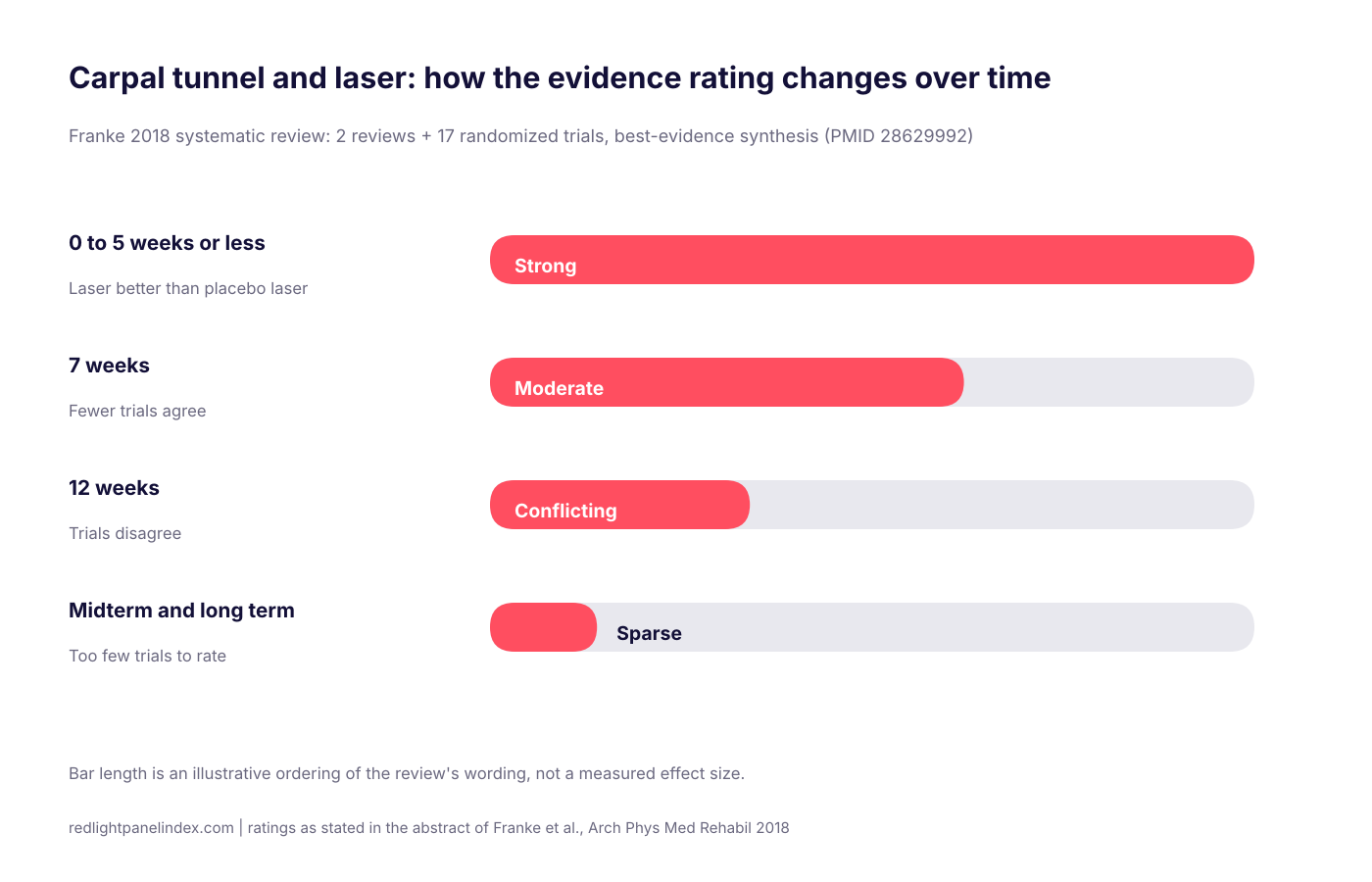
The evidence grade for red light and low-level laser in carpal tunnel syndrome is Limited: a 2018 systematic review of randomized trials found strong evidence for a short-lived benefit over placebo laser, but the benefit faded at longer follow-up and almost all the data come from clinic lasers, not home panels (PMID 28629992).
Choosing a panel? Our ranking of the best red light therapy panels is computed from published, method-labeled specs across 188 devices. For a wrist, the spec that matters is the near-infrared output at the surface, because the median nerve sits below the skin and the evidence comes from laser studies rather than panel studies.
What the evidence is
One review carries this page. Franke and colleagues searched the Cochrane Library, PubMed, Embase, CINAHL and PEDro up to April 2016 for systematic reviews and randomized controlled trials of low-level laser therapy in carpal tunnel syndrome. They included 2 systematic reviews and 17 randomized trials and summarized them with a best-evidence synthesis (PMID 28629992). The review was published in Archives of Physical Medicine and Rehabilitation in 2018.
Their ratings, as stated in the abstract:
- Strong evidence that laser beat placebo laser in the very short term, defined as 0 to 5 weeks or less.
- Moderate evidence at the 7 week follow-up.
- Conflicting evidence at the 12 week follow-up.
- Sparse evidence in the midterm and long term.
The authors concluded that laser as a single treatment was more effective than placebo laser in the very short term, and that its effects tend to subside afterward.
Why the grade is Limited and not higher
The "Strong" label in the review is a statement about the consistency of trials within a narrow time window. It is not a statement about durable relief. Three things hold the grade down on this site's scale (see how evidence grades work):
- The benefit window is short. By 12 weeks the review calls the evidence conflicting. A person with carpal tunnel syndrome is usually interested in months, not weeks.
- The comparison is placebo laser. The review rated laser against sham laser. It does not tell you how laser compares with night splinting, steroid injection or surgery, which are the standard options a clinician discusses.
- The devices were lasers. The review is about low-level laser therapy, a clinic technique applied over the wrist. A panel is a different delivery: wider beam, lower irradiance at any one spot, longer sessions. The review abstract does not give per-trial wavelengths or doses, so this page does not quote any. Treat any specific dose you see attributed to these trials with caution unless it cites the primary paper.
How to read "strong" in a best-evidence synthesis
A best-evidence synthesis ranks conclusions by how many trials agree and how well they were run, rather than pooling every number into one effect size. That is a sensible choice when trials differ in device, dose and outcome measure, but it means the review can tell you the direction and consistency of findings without telling you how large the benefit is. This page therefore quotes no effect sizes. If a product page or video states one for carpal tunnel syndrome, ask for the primary paper.
What was not studied
- Home panels. No panel trial in carpal tunnel syndrome is covered by the review.
- Severe or long-standing cases. The abstract does not break out outcomes by severity, so no claim is made here about advanced disease or nerve damage that has already occurred.
- Long-term outcomes. The review itself describes evidence beyond the midterm as sparse.
- Head-to-head with splints or surgery. Not what the review tested.
- Dose. Whether more or less energy changes the result is not answerable from the abstract. The biphasic dose-response literature suggests more is not always better, but that is a general finding, not a carpal tunnel finding.
How this compares with other nerve and tendon pages
Carpal tunnel syndrome is a nerve compression problem, so it sits next to the neuropathy evidence page, which is graded Moderate on the strength of a 200-person trial of a red helium-neon laser in diabetic neuropathy. That trial reported symptom improvement at four weeks but used a different condition, a different device and a handheld beam; see the study review of that trial. The two conditions should not be merged: a foot neuropathy result does not transfer to a compressed nerve at the wrist.
The wrist is also a tendon-rich area. Flexor tendon irritation can overlap with carpal tunnel symptoms, and the laser literature on tendinopathy uses dose guidelines that are summarized in the WALT dosing recommendations. Those guidelines were written for specific tendons and clinic lasers.
A practical section for panel owners
If you and your clinician decide to try light on a wrist alongside standard care, these points follow from the evidence and from how panels work:
- Wavelength. The median nerve lies below skin, tendon sheath and the transverse ligament. Red light at 630 to 660nm is largely absorbed in the skin, which is why this site's wavelength guide points to near-infrared for deeper targets. Read the penetration depth page for the physics.
- Irradiance and distance. Check the method behind a panel's irradiance number before you rely on it. The irradiance page explains the measurement methods, and claimed vs measured irradiance shows how much labels can differ from readings.
- Dose. Use the dose calculator to convert a distance and session length into joules per square centimeter, then compare with the clinic ranges you find in primary papers. The joules per cm2 explainer covers the unit.
- Frequency. The trials that showed benefit did so in the first weeks. A reasonable approach is to track symptoms for a defined period, as in the how often guide, and stop if there is no change.
- Positioning. A panel designed for a torso is a poor fit for a small area. The treatment area and coverage page explains why a smaller device or a closer distance may match a wrist better, and why closer also raises the dose per minute.
Cautions
- Carpal tunnel syndrome can progress. Numbness that persists, weakness in grip or muscle wasting at the base of the thumb needs a clinician, not a light panel.
- Light does not remove the cause of compression. Repetitive strain, wrist posture, pregnancy and thyroid or diabetic conditions can all contribute, and a clinician should address them.
- Do not use a panel on a wrist that has an open wound or a recent injection site without asking the clinician who treated it.
- Protect your eyes; see the eye protection guide.
- Anyone taking a photosensitizing medication should read the photosensitizing medications guide first.
Bottom line
For carpal tunnel syndrome, red and near-infrared light has a real but narrow evidence base: one 2018 review of randomized trials rated laser better than placebo laser in the first weeks and inconsistent by 12 weeks (PMID 28629992). That supports treating light as an optional, time-limited adjunct while standard care continues, and it does not support a claim that a panel replaces a splint, an injection or surgery. The review is also a reminder to check the claim behind any "carpal tunnel" marketing: ask which trial, which device, and how far out the benefit was measured. Nerve symptoms from chemotherapy are another separate case, covered on the chemotherapy-induced neuropathy page. Our methodology explains how we grade the evidence on every condition page.