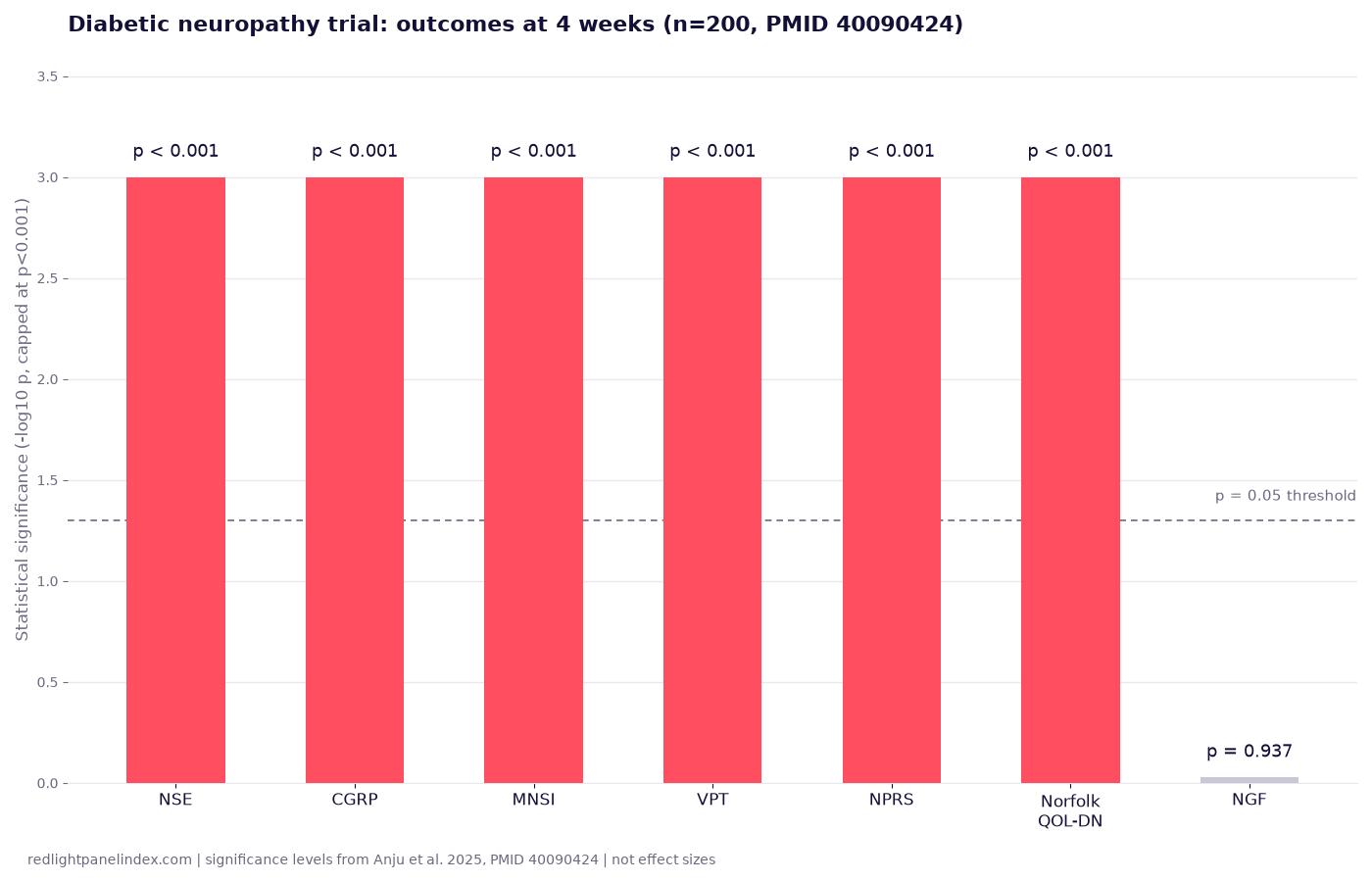
A 2025 single-blinded randomized controlled trial in Diabetes Research and Clinical Practice put 200 people with diabetic peripheral neuropathy through a ten-day course of low-level helium-neon laser and reported significant improvement across five of six outcome measures four weeks later, from nerve-related blood markers to pain scores and quality of life (PMID 40090424). It is the largest trial in this index's neuropathy evidence page, and it is useful mainly for what it measured rather than for how it was delivered, since the delivery device was nothing like a home panel.
Choosing a panel? Our ranking of the best red light therapy panels is computed from published, method-labeled specs across 188 devices. For a neuropathy protocol like this one, the spec that matters is the total dose reaching the skin, not the number of wavelengths a panel lists.
What the study asked
The stated purpose was to test whether photobiomodulation therapy changes neuron-specific biomarkers, clinical neuropathy scores, and quality of life in people with type 2 diabetes and peripheral neuropathy. The authors frame diabetic peripheral neuropathy as one of the more disabling long-term complications of diabetes, with real effects on function and quality of life, and they set out to see whether a fixed laser course moves both the blood markers thought to track nerve damage and the bedside tests a clinician would actually use.
The trial is described as single-blinded, with a sham-laser control arm rather than a no-treatment arm, which is the stronger of the two placebo designs used in this literature.
Who was studied
Two hundred people with type 2 diabetes and peripheral neuropathy were randomized into two equal arms of 100. The abstract does not report age, sex distribution, diabetes duration, or baseline neuropathy severity, so none of that appears here. It also does not state how many completed the trial or whether any dropped out between day 0 and the four-week assessment.
Device and parameters as stated
- Device: low-level helium-neon laser
- Wavelength: 632.8 nm
- Dose: 3.1 J/cm2
- Session length: 9 minutes
- Treatment sites: dorsal and plantar surfaces of both feet
- Course: ten consecutive days
- Control: sham laser, same schedule
632.8 nm sits in the red band, close to the 630 to 660 nm range most home panels also carry, which makes this one of the more directly comparable wavelengths in this index's study register even though the delivery hardware is completely different: a coherent laser held to the skin, not an LED array at a working distance.
What was measured and what was found
Patients were assessed at day 0 and again four weeks after the ten-day course. The outcome set mixed blood biomarkers with bedside clinical tests:
- Serum neuron-specific enolase (NSE)
- Serum calcitonin gene-related peptide (CGRP)
- Serum nerve growth factor (NGF)
- Michigan Neuropathy Screening Instrument (MNSI)
- Vibration perception threshold by biothesiometer (VPT)
- Pain on the Numeric Pain Rating Scale (NPRS)
- Quality of life on the Norfolk Quality of Life Questionnaire, Diabetic Neuropathy version (Norfolk QOL-DN)
The trial reports significant changes in the intervention group at four weeks in NSE, CGRP, MNSI, VPT, NPRS, and the Norfolk QOL-DN score (each p < 0.001), with the authors noting this pattern correlated with improved neuropathic pain and quality of life. NGF showed no significant change (p = 0.937). The authors conclude that serum NSE and CGRP may work as usable indicators of photobiomodulation effect in this condition.
The abstract reports significance levels, not effect sizes. No mean differences, percentage improvements, or confidence intervals appear in it, and none are estimated here.
Limitations
- Within-group framing. The abstract describes changes "in the intervention group" at four weeks rather than stating a direct intervention-versus-sham comparison for each measure. A sham-controlled design supports that comparison, but the abstract as written does not spell out the between-group result, so this review does not either.
- No effect sizes. Six measures reaching p < 0.001 says the changes are unlikely to be chance; it says nothing about whether a patient would notice the difference day to day.
- Short follow-up. Four weeks is the only assessment point after the ten-day course. Whether any of it holds, or fades, past that window is not addressed.
- One biomarker went nowhere. NGF did not move (p = 0.937), a reminder that "photobiomodulation changes nerve biomarkers" is not a blanket finding across every marker tested.
- Sparse population detail. No age, sex split, diabetes duration, or baseline severity is given, so it is not possible to say which patients this generalizes to.
- A laser, not a panel. Coherent light delivered by hand to specific foot surfaces for a fixed 9 minutes is a different exposure than an LED panel illuminating the same area from a distance, and nothing in the abstract lets one dose be converted into the other.
What this means for a home panel
The wavelength band translates better here than it does in most of this index's study reviews. At 632.8 nm, the laser sits inside the red range most panels already carry, so a reader is not stretching to make an argument about a wavelength their device does not emit; check your panel's wavelength allocation for how much of its output actually sits near 630 to 660 nm rather than assuming the whole spec sheet applies.
The dose does not translate as cleanly. This trial delivered 3.1 J/cm2 over 9 minutes from a handheld laser pressed close to two specific foot surfaces, and a panel spreads that same class of dose across a wider area from a fixed working distance. If you want to approximate the exposure with a panel, use your device's method-verified irradiance in the dose calculator and work out how long you would need to sit at your working distance to reach a comparable J/cm2, then hold that session length and frequency constant long enough to judge it, the same steady-frequency approach this index recommends for any condition.
Diabetic feet deserve particular caution regardless of the device. Reduced sensation from neuropathy itself can mask heat or irritation that a person with normal sensation would notice and stop. Go by the panel's stated distance and timer, not by how the light feels on skin that may already have reduced feeling, and treat any new foot symptom as a reason to see a clinician rather than to add more light.
None of this makes the case that a 9-minute LED session will reproduce what a ten-day laser course reported. It does mean that of the wavelengths in this index's neuropathy literature, this is one of the few where the device's own wavelength is one most home panels can actually deliver, which is more than can be said for every trial that lands in this evidence register.