Photobiomodulation is the use of red or near-infrared light to trigger a specific chain of reactions inside cells, starting with a light-absorbing enzyme in the mitochondria and ending in more ATP, calmer inflammatory signaling and faster tissue repair. The name replaced "low-level laser therapy," or LLLT, in 2015, once LED research made clear the effect has nothing to do with lasers as such.
Choosing a panel? Our ranking of the best red light therapy panels is computed from published, method-labeled specs across 188 devices. For photobiomodulation to actually reach a target tissue, the spec that matters is measured irradiance at your treatment distance, not the number printed on the box.
Where "low-level laser therapy" came from
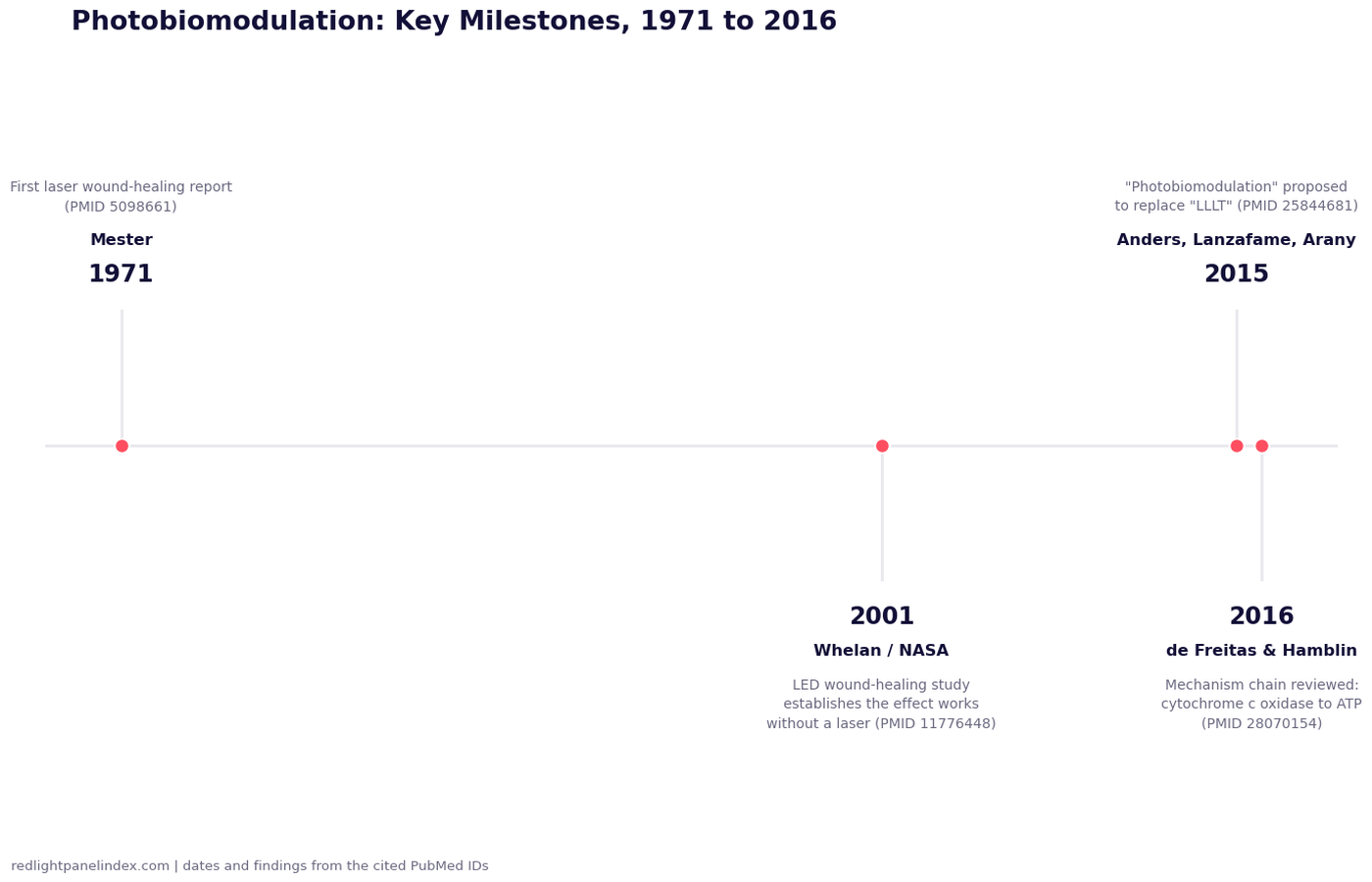
The field traces back to Endre Mester, a Hungarian surgeon who reported in 1971 that laser irradiation sped up wound healing in animal experiments (PMID 5098661). PubMed does not carry an abstract for that paper, so the specific figures are not available to quote, but the paper is the reason the therapy was named after its light source: for roughly three decades afterward, the light came almost exclusively from lasers, and researchers called the technique "low-level laser therapy" to describe both the tool and the effect in one phrase.
That naming held up as long as lasers were the only practical light source for this kind of research. It stopped holding up once LEDs entered the picture.
Why the word "laser" stopped fitting the research
By the early 2000s, NASA-funded work led by Harry Whelan was testing light-emitting diodes instead of lasers, on the theory that LEDs were cheaper, more durable and easier to build into wearable arrays for astronauts on long missions (PMID 11776448). The 2001 paper reporting that work described near-infrared LED light at 670, 728 and 880 nanometers, the same wavelength bands laser devices used, tested across a range of models: cell cultures, a rat ischemic wound model and small human studies.
The results were the point. In cell culture, LED irradiation increased growth rates by 140 to 200 percent in fibroblasts, osteoblasts and skeletal muscle cells compared with untreated controls. In the rat wound model, wounds treated with a combination of hyperbaric oxygen and 880 nanometer LED light were 36 percent smaller at day 7 than untreated wounds. In human applications summarized in the same paper, LED treatment was associated with a 47 percent reduction in pain among pediatric patients with oral mucositis, and with improved recovery, exceeding 40 percent, from musculoskeletal injuries in a military population.
None of that depended on a laser. The biological trigger was the wavelength and the dose delivered to tissue, not the coherence or beam properties that make a laser a laser; this site's LED vs laser comparison works through that distinction in more depth, including what does and does not carry over between the two source types. Once that was established for LEDs across multiple tissue types, the name "low-level laser therapy" was describing the wrong thing.
Why "LLLT" caused real confusion
"Low-level laser therapy" carries two claims in its name, and both turned out to be misleading. The first is that the light source has to be a laser, which the LED research directly contradicted. The second is that "low-level" describes a single safe, effective dose band, when the actual dose response is biphasic: too little light under-stimulates the pathway, and too much light past a certain irradiance and exposure time can suppress the same effect it was meant to produce. A name that implies "more laser, more effect, always" does not describe a therapy where dosing has an optimal range and a ceiling.
There was also a practical problem for anyone trying to read the literature: some journals and researchers used "LLLT" narrowly for laser-only studies, others used it to cover LED studies too, and neither convention was consistent enough to search or compare results reliably.
The 2015 consensus: photobiomodulation becomes the name
In 2015, Juanita Anders, Raymond Lanzafame and Praveen Arany published an editorial in Photomedicine and Laser Surgery arguing that the field needed a name that described the effect rather than the light source (PMID 25844681). Their proposal, "photobiomodulation," covers both laser and LED devices operating at doses meant to stimulate cellular activity rather than cut or ablate tissue. The editorial does not carry a public abstract on PubMed, so no figures from it are quoted here, but the direction of the argument is straightforward: standardize the vocabulary around the mechanism, not the hardware, so that laser studies and LED studies could finally be compared on equal terms.
The term caught on quickly in the research community, and by the following decade it had mostly replaced "LLLT" in new publications, though "low-level laser therapy" and "LLLT" still appear in older papers and in some consumer marketing.
The mechanism chain, in one paragraph
A 2016 review by Leonardo de Freitas and Michael Hamblin lays out the accepted mechanism chain (PMID 28070154). Red and near-infrared photons are absorbed by cytochrome c oxidase, a heme-and-copper-containing enzyme that sits in the mitochondrial respiratory chain and happens to also absorb light in the near-infrared range. The leading hypothesis is that absorbed photons dissociate an inhibitory nitric oxide molecule bound to the enzyme, which increases electron transport, raises the mitochondrial membrane potential and increases ATP production. A separate hypothesis involves light-sensitive ion channels opening to let calcium into the cell. From there, both pathways feed into signaling cascades built on reactive oxygen species, cyclic AMP, nitric oxide and calcium, which activate transcription factors. Those transcription factors raise expression of genes tied to protein synthesis, cell migration and proliferation, anti-inflammatory signaling, anti-apoptotic proteins and antioxidant enzymes. Stem cells and progenitor cells appear to respond to this chain more strongly than mature cells.
That is a lot of biochemistry to compress into practical advice, but the load-bearing point for a home device is the first step: the light has to actually reach the mitochondria at a useful depth in the target tissue, at a wavelength cytochrome c oxidase actually absorbs, and at an irradiance high enough to matter but not so high that it overshoots the dose window.
A worked example from the wavelength side
The site's own wavelength breakdown shows why this history still shapes buying decisions. Panels sold today cluster around a handful of bands: 660 nanometer red light, described on that page as the market's workhorse for surface-level work, and 850 nanometer near-infrared light, its counterpart for deeper tissue. Both bands sit inside the range Whelan's team tested in 2001 and the range de Freitas and Hamblin's mechanism review describes cytochrome c oxidase as absorbing. A panel advertising a wavelength far outside that range, or omitting a wavelength number entirely, is not delivering light matched to the mechanism this article describes, whatever else its marketing claims.
Why the timeline matters for a home panel
None of this history changes what to look for in a panel, but it explains why the checklist looks the way it does. Look for a stated wavelength in the range the mechanism research actually tested, a measured irradiance figure rather than a marketing number, and a session length and frequency consistent with the dosing guidance built from that same research, not from the number that happens to sound impressive on a spec sheet. Our guide to how often to use red light therapy walks through session frequency in more detail, and the LED chip page covers how the diodes themselves are built and rated.
"Photobiomodulation" is, in the end, a more honest name than "low-level laser therapy" ever was. It says what the light does, not what kind of bulb produced it, and it leaves room for the dose-response curve that "low-level" glossed over. Anywhere on this site that discusses cytochrome c oxidase or mitochondrial ATP production in more depth is building directly on the 2015 renaming and the mechanism research that justified it. This site's glossary has short definitions for that vocabulary, cytochrome c oxidase, LLLT, biphasic dose response and the rest, each linking back to a fuller explainer.