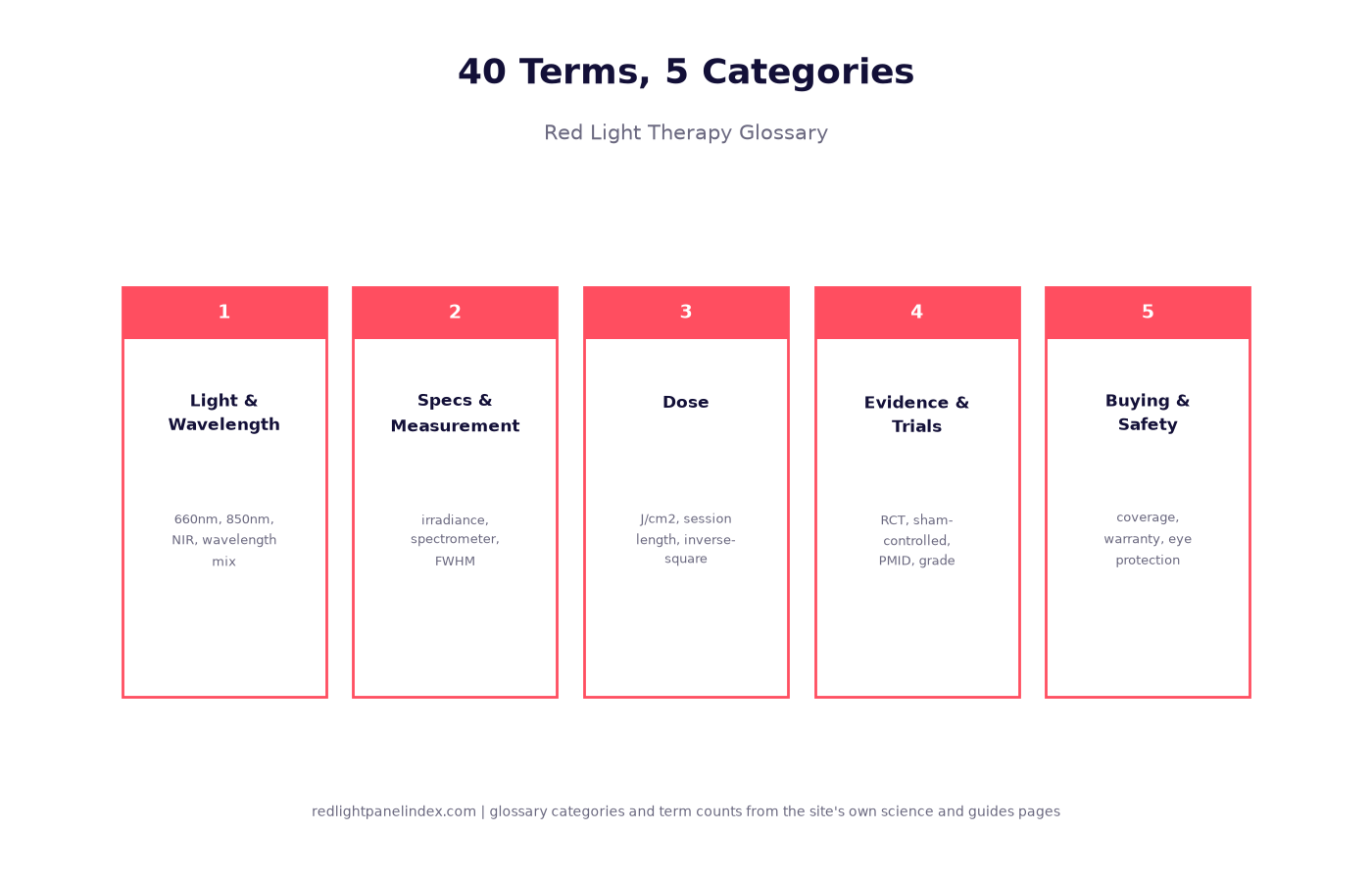
Red light therapy comes with its own vocabulary, wavelength names, dose units, spec labels and trial jargon, and most of it is not explained where you first run into it. This glossary gives a short definition for each term along with a link to this site's full explainer, so a two-sentence answer is never more than a click from the data behind it. The 40 terms below are grouped into five categories: light and wavelength, panel specs and measurement, dose, evidence and trials, and buying and safety, roughly the order a first-time buyer runs into them.
Choosing a panel? Our ranking of the best red light therapy panels is computed from published, method-labeled specs across 188 devices. Several terms below, irradiance, method-labeled spec and wavelength mix, describe exactly what that ranking measures.
Light and wavelength
Photobiomodulation (PBM). The umbrella term for using red or near-infrared light to trigger a cellular response, mainly absorption by the mitochondrial enzyme cytochrome c oxidase. Covers both laser and LED devices, low-power and higher-power, in a clinic or at home. See the full photobiomodulation explainer.
Low-level laser therapy (LLLT). An older term for the same underlying mechanism as photobiomodulation, used mainly for laser devices before LED panels became common. The two terms overlap heavily in the trial literature; a study titled "LLLT" and one titled "PBM" may be testing the same biological effect.
Red light. Visible light roughly 600 to 700 nanometers, the shorter of the two bands used in red light therapy. Absorbed mostly at the skin and just beneath it. See red versus near-infrared.
Near-infrared light (NIR). Invisible light roughly 700 to 1,100 nanometers, the longer of the two bands. Travels farther through tissue before it is absorbed, reaching toward muscle and joint depth. A panel running only its near-infrared diodes can look dark while still delivering a full dose. See red versus near-infrared.
660nm. The single most common red wavelength on home panels, appearing on 93 percent of the 188 devices this site tracks. Sits near the boundary between visible red and near-infrared. Full page: 660nm.
850nm. The single most common near-infrared wavelength, also on 93 percent of tracked panels. Used in most of the joint, muscle and exercise-recovery trials this site cites. Full page: 850nm.
1064nm. A deep near-infrared wavelength some researchers treat as its own category rather than folding into "near-infrared" generally. The least common band on the site, appearing on about 18 percent of panels, usually paired with a claim about reaching joints or fascia specifically, and worth checking for a published density figure before paying a premium for it. The 810 and 830 nanometer bands sit between 660nm and 850nm in prevalence, each appearing on roughly half of tracked panels (52 to 55 percent), and most spec sheets group them with 850nm under a general "near-infrared" label.
Wavelength mix. The full set of wavelengths a panel ships and the share of total output allocated to each. Two panels listing the same wavelengths can deliver very different doses at any one band; the mix, not the count, is what to check. A panel can list seven wavelengths while concentrating most of its real output in only two of them. See wavelengths explained.
Panel specs and measurement
Irradiance. How much light lands on a square centimeter of skin at a stated distance, measured in milliwatts per square centimeter (mW/cm2). The input the entire dose calculation runs on. See the full irradiance page.
Total power (total optical output). The sum of light output across a panel's entire face, usually in watts, separate from irradiance, which is a per-area figure at one distance. A panel with high total power and a large face can still have modest irradiance at any single point, and a small, strong panel can post a higher irradiance reading while delivering less total output overall. Neither number alone tells you what you need; the two answer different questions. See irradiance versus total power.
Claimed vs measured irradiance. The gap between a brand's headline irradiance figure and what an independent spectrometer reads on the same panel. Across the 44 panels on this site where both numbers exist, the claim runs a median 2.18 times the spectrometer figure. See claimed vs measured.
Spectrometer. A lab instrument that measures irradiance within a narrow, defined light band, the more reliable of the two instruments used to test panels. See irradiance.
Solar meter. A broader-spectrum light meter that reads roughly twice as high as a spectrometer on the same panel, because it responds to a wider range of wavelengths. See irradiance.
Peak wavelength. The single wavelength at the center of an LED's output, the number printed on most spec sheets. Does not by itself say how tightly or loosely the light is clustered around that number. See peak wavelength and FWHM.
FWHM (full width at half maximum). How wide an LED's output spans around its peak wavelength, typically 20 to 30 nanometers for a red diode. A narrower FWHM concentrates more output at the stated peak; a wider one spreads it across a broader band. See peak wavelength and FWHM.
LED chip design (single, dual, quad). How many diodes are packed into one physical LED chip on a panel's face. More diodes per chip generally means more wavelengths from the same board space, at a tradeoff other specs have to account for. See LED chip design.
Dose
Dose (fluence, J/cm2). The total amount of light delivered to a square centimeter of skin during a session: irradiance multiplied by time, divided by 1000. The unit trials use to report how much light a treatment actually received. See joules per cm2 explained.
Energy density. Another name for dose in J/cm2, used interchangeably with "fluence" in the trial literature. See joules per cm2.
Power density. Another name for irradiance in mW/cm2, the rate at which light lands on the skin rather than the accumulated total. See irradiance.
Session length. How long you sit in front of a panel, the other half of the dose equation alongside irradiance. The dose calculator converts a target dose and a panel's measured irradiance into a session length in seconds or minutes.
Distance from panel. How far you sit from the light source, which changes irradiance sharply because output falls off with the inverse-square law, not in a straight line. See distance from panel.
Inverse-square law. The physical rule that irradiance falls off with the square of the distance from a point source, so doubling your distance from a panel cuts irradiance to roughly a quarter, not a half. See the full inverse-square law explainer.
Biphasic dose response (Arndt-Schulz curve). The pattern seen across photobiomodulation trials where too little light does nothing, a middle range of dose works, and too much either does nothing or works against the effect. The reason "longer is always better" does not hold as a rule for session length.
Penetration depth. How far light travels into tissue before it is absorbed or scattered away. Increases with wavelength, but the numbers behind that claim come mostly from computational modeling, not a depth gauge in living tissue: one modeling study put the maximum modeled depth at 5,378 micrometers, about 5.4 millimeters, at its longest tested wavelength, and marketing claims of light reaching "two inches" go well past what the literature supports. See penetration depth.
Evidence and trials
Randomized controlled trial (RCT). A trial where participants are randomly assigned to an active-treatment group and a comparison group, the study design behind nearly every dose and outcome figure this site cites. Randomization is what lets a trial attribute a difference in outcomes to the treatment rather than to differences between the people who happened to receive it.
Sham-controlled trial. An RCT where the comparison group receives a device built to look and feel like the real one but that does not deliver an active dose, the design used to separate a light-specific effect from expectation or handling alone. See sham-controlled trials.
Placebo device. The inactive device used in a sham-controlled trial, built to match the active device's appearance, weight, sound and warmth as closely as possible so participants cannot tell which group they are in. A trial's credibility depends heavily on how well the placebo device actually pulls this off.
Meta-analysis. A study that statistically pools the results of multiple individual trials on the same question, producing a combined effect estimate that carries more weight than any single trial alone. Several of this site's study reviews, including the Stausholm knee OA meta-analysis, are of this type.
Evidence grade (Strong, Moderate, Limited, Insufficient). This site's four-tier rating for how well a condition is supported by published trials, based on the number, size, design and consistency of studies behind it, not on whether any single trial reported a large effect. See evidence grades explained.
PMID. A PubMed ID, the unique identifier the National Library of Medicine assigns to an indexed study. Every figure cited on this site traces back to a PMID that has been checked against PubMed directly. See behind the database.
WALT dosing. Dose ranges recommended by the World Association for Laser Therapy for specific conditions, for example 4 to 8 joules per spot at 785 to 860 nanometers for knee osteoarthritis, used as a reference point in trials that deliberately dose to that standard rather than an arbitrary figure. Those figures are per-spot laser doses, not J/cm2, and cannot be converted to a panel dose without a stated spot size. See the 790nm WALT-dosed knee OA trial.
Systematic review. A study that follows a defined, documented search process to find and evaluate every trial on a question, whether or not it goes on to pool the results statistically. A meta-analysis is a systematic review that also pools the numbers; not every systematic review does.
Buying and safety
Coverage area. The physical area of a panel's face that emits light, which determines how much of a body part a single session can treat without repositioning, separate from how strong that light is at any one point. A genuine full-body lie-down panel runs roughly 64 inches tall and 12 inches wide; a shorter or narrower panel treats less of the body per position, regardless of its irradiance. See how to choose a panel.
Warranty and trial period. How long a brand covers defects and how long a buyer can return a panel for a refund. Both figures vary by brand and sometimes by model within the same brand, so a panel-specific database page, not a brand-wide assumption, is the figure to check; one example, RLT Home's Total Spectrum line, lists a 3-year warranty and a 60-day trial across its models. Both terms are among the inputs behind this site's ranking. See how to choose a panel.
Method-labeled spec. A published figure, usually irradiance, that states the instrument, distance and whether it is a peak or average reading, rather than a bare number with no way to check it. The distinction this site's ranking rewards over an unlabeled claim. See behind the database.
Panel finder / database. This site's searchable index of all 188 tracked devices from 41 brands, filterable by wavelength, price, irradiance and brand, with each card linking to its full method-checked spec record. See the full panel database.
Best-of ranking. This site's ordered list of panels within a category, scored only on published, method-labeled specs, wavelength mix, coverage, buyer terms and price, never on affiliate relationships or brand reputation. See how rankings work.
Cytochrome c oxidase. The mitochondrial enzyme widely accepted as the first step in the photobiomodulation effect, absorbing red and near-infrared light and triggering a chain of cellular reactions, including increased ATP production, from there. It is the same enzyme whether the light comes from a 660nm red diode or an 850nm near-infrared one, which is why the two bands are treated as one mechanism reaching different depths rather than two separate effects. See photobiomodulation.
Eye protection. Guidance on shielding the eyes during a session, since near-infrared light is invisible and some panels are bright enough at close range to warrant caution, particularly for the lens and retina. No brand in this site's database publishes a photobiological risk group under IEC 62471, the standard that would actually settle the question, but 30 of the 41 tracked brands ship goggles anyway. See eye protection.
Photosensitizing medication. A drug or supplement that increases skin sensitivity to light, a caution category worth checking against before starting sessions, since most photobiomodulation trials do not specifically test for interactions with these medications. See safety and side effects.
Using this glossary
Each definition above points to the page that backs it with real trial figures or database numbers rather than a general description; a short definition can tell you what a term means, but only the linked page shows the study, the spec, or the dataset it comes from. If a term you are looking for is not here, the dose calculator, the panel database and this site's science section cover most of the specifics a short definition cannot, and the how to choose a panel checklist walks through applying several of these terms, wavelength mix, method-labeled irradiance, coverage and buyer terms, in the order they actually matter when comparing two devices. For a question phrased as a question rather than a term, this site's 40-question FAQ covers most of what a first-time buyer actually asks, in the same short-answer-plus-link format as this page.