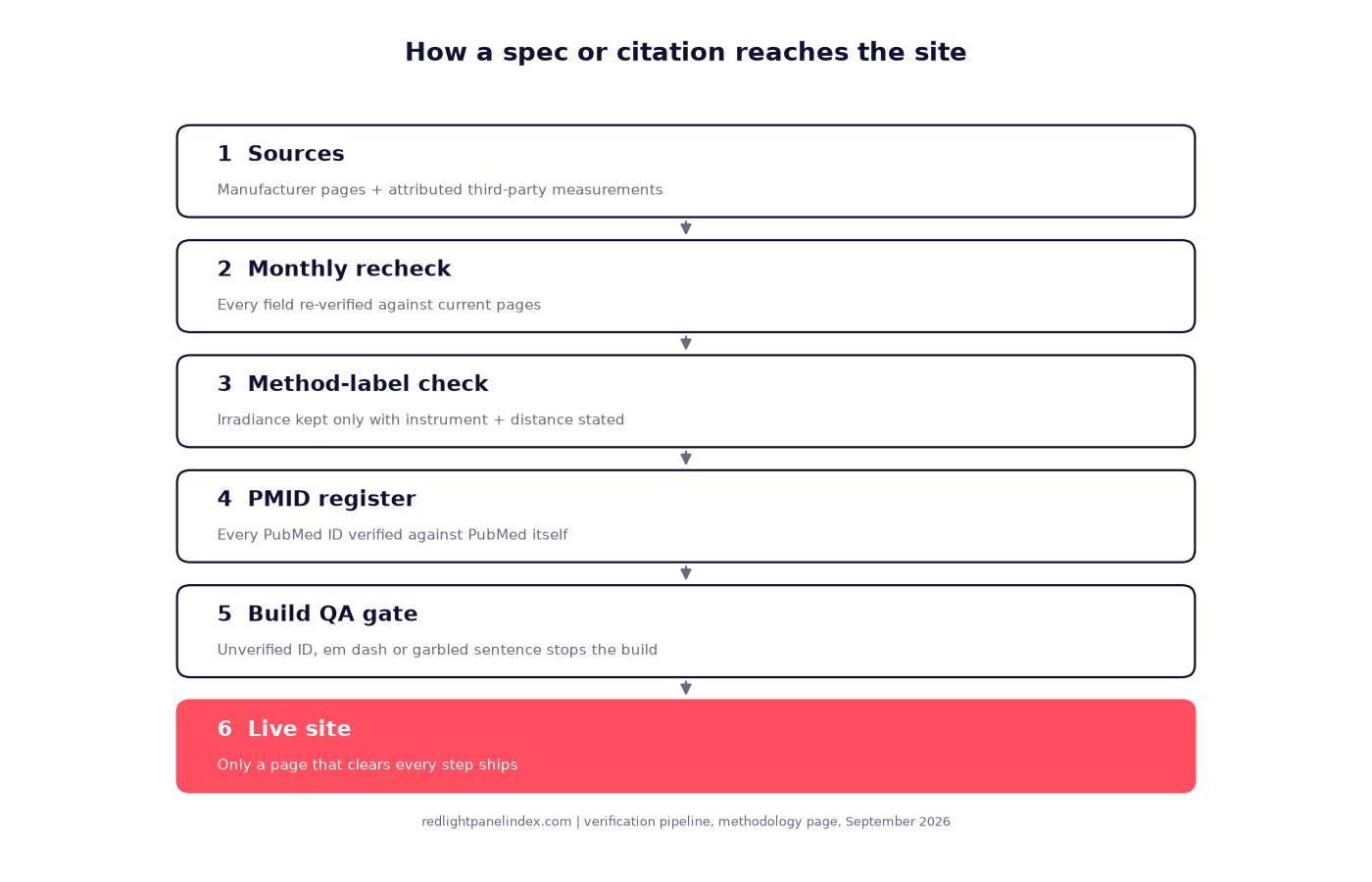
Every spec on this site starts as a manufacturer's published figure or an attributed third-party measurement, gets rechecked on a monthly pass, and is only usable in a ranking if it names its measurement instrument. Every clinical citation goes through a separate gate: the build itself checks each PubMed ID against PubMed and refuses to publish a page if one fails. What happens to a verified spec once it reaches a category page, the four fields that turn it into a rank, is covered separately on this site's how rankings work page.
Choosing a panel? Our ranking of the best red light therapy panels is computed from published, method-labeled specs across 188 devices. For trusting any of those numbers, the spec that matters is whether the irradiance figure names its measurement instrument.
Where the numbers come from
The database covers 188 red light therapy panels across 41 brands, and every field in it traces back to one of two sources: a manufacturer's own published page, or an independent measurement from a named source such as Light Therapy Insiders or Outliyr. Manufacturer pages are the primary source for wavelengths, LED counts, chip type, coverage dimensions, price and buyer terms. Independent measurements are layered in separately and always cited by source rather than blended silently into the brand's own claim, because a brand's claimed irradiance and an independent lab's measured irradiance are not the same number and should not be presented as if they were.
When a field cannot be sourced to either, it is marked "not published" rather than filled with an estimate. That distinction matters more than it sounds: a blank field tells a buyer the manufacturer has not disclosed something, while a guessed number would quietly imply verification that never happened.
How often the data gets rechecked
Prices and specs go through a monthly re-verification pass against the brands' own current pages, since both change without notice. The most recent full audit, in August 2026, produced 777 field corrections and fills across the database, the kind of drift that accumulates when 41 brands update pricing and specs on their own schedules. A follow-up pass used AI-assisted lookups to move 55 previously "not published" fields to sourced values, again citing where each number came from rather than filling the gap silently.
Every price on the site carries the date it was last checked, and that date is what a reader should trust, not an assumption that a listed price is current at the moment they read it. A price checked in September 2026 could be stale by October; the check date tells you exactly how stale it might be, which a bare number does not.
The method-label rule
Irradiance is the single field most often inflated, and it is inflated in a specific, well-documented way: a solar power meter typically reads roughly double what a laboratory spectrometer records from the same panel, because solar meters respond to a broader slice of the spectrum than a panel's LEDs actually emit. Across a 44-panel dataset this site has checked, the average gap is 2.11 times the spectrometer figure, with a median of 2.18 and a range of 1.36 to 2.60, detailed on the claimed vs. measured page.
Because of that gap, an irradiance number without a stated instrument and distance is not treated as a usable spec here; it is treated as unverified until a method is attached, the same rule the irradiance page walks through in more depth. This is also why two panels that each claim "100 mW/cm²" can perform very differently in practice: one figure might be a center-panel peak from a spectrometer at 6 inches, and the other an unstated reading that is likely a solar-meter number roughly double the real output. Rankings only use the labeled, lower-confidence-adjusted figure, which is part of why a panel with a smaller-looking claimed number sometimes outranks one with a bigger one.
The PMID register and the build gate
Every clinical claim on this site cites a PubMed ID, written as "PMID" followed by its number in parentheses, and every one of those IDs is checked against PubMed itself before it can appear on a live page. New citations go into a pending file, get verified or rejected against PubMed's own record, and only a verified ID is added to the permanent register the build reads from. If a page contains a PMID that is not in that register, the build fails for that page and nothing goes live, rather than shipping an uncheckable citation and hoping it holds up.
This is the same mechanism that keeps a page like the joint pain evidence page graded Strong: the grade reflects specific, checkable trials, not a general impression, and every PMID behind that grade has cleared the same PubMed check as every other citation on the site. How that grade is actually assembled from those trials, from Strong down to Insufficient, is explained on the site's evidence grading page.
What the gate rejects, and why it matters more than it sounds
Beyond unverified PMIDs, the same build step rejects a short list of specific problems: em dashes, double periods, a handful of garbled template phrases that can leak through when content is stitched together programmatically, and language that claims editorial independence in a way the site does not actually define or enforce. None of these are stylistic nitpicks. An unverified PMID is a citation nobody checked; a garbled sentence is a sign the content pipeline broke somewhere upstream. Catching both before publication, rather than after, is the difference between a database a buyer can spot-check against a manufacturer's own page and one that just has to be taken on faith.
How affiliate links are handled
Many "check price" buttons on this site use an affiliate link, and that relationship is disclosed on a separate affiliate disclosure page rather than folded into the specs themselves. The rule that keeps the two apart is simple to state and, more importantly, mechanical to enforce: a brand's affiliate program has no field in the database, so it cannot factor into a spec, a grade or a ranking calculation even by accident. A brand with no affiliate program at all is scored on exactly the same wavelength, irradiance, coverage, terms and price fields as a brand that pays a commission on every sale, because those are the only fields the ranking math reads.
What this means for you as a buyer
None of this makes any individual number infallible; a manufacturer can still publish a misleading figure, and independent measurements can still disagree with each other. What the pipeline above is built to guarantee is narrower and more useful: that every figure on this site is attributed to a real source, checked on a schedule, labeled with its measurement method when that applies, and, for any clinical claim, checkable against PubMed by anyone who wants to follow the citation back. If a number here does not match what you find on a brand's own page, the database page, the filterable panel table and this guide together tell you exactly what to check next: the verification date, the stated measurement method, and, for a research claim, the PMID itself.
The same three checks work off this site entirely. Before trusting an irradiance number anywhere, ask what instrument produced it and at what distance. Before trusting a health claim, look for a specific, citable trial rather than a general appeal to "research shows," and check what it was compared against; the difference between a real sham arm and no comparator at all is explained in how to read a sham-controlled trial. And before trusting a price, look for a verification date; a number with no date attached could be a year old. None of these checks require taking this site's word for anything, which is the point: they are the same three questions this database runs on itself, and the methodology page documents the full rubric behind the ranking math they feed into.