A 2019 systematic review and meta-analysis in BMJ Open pooled 22 randomized placebo-controlled trials of low-level laser therapy for knee osteoarthritis, 1,063 participants in total, and found that pain and disability were reduced more at the end of therapy in trials that used doses inside the World Association for Laser Therapy recommendations than in the pooled set overall (PMID 31662383). It is the single largest piece of evidence behind this site's knee osteoarthritis grade, and it is worth reading on its own because a meta-analysis is a different kind of evidence than any one trial: it answers a different question than any single study can.
Choosing a panel? Our ranking of the best red light therapy panels is computed from published, method-labeled specs across 188 devices. For knee osteoarthritis, the spec that matters is how much output sits in the 810 to 850 nm band, not total wattage.
What the study asked
A meta-analysis does not run new patients through a new protocol. It searches for every trial that already tested a question, pools their results into one weighted estimate, and asks whether the combined evidence is stronger, weaker, or different from what any single trial suggested on its own. That matters here because low-level laser therapy is not recommended in major knee osteoarthritis treatment guidelines, and individual trials on the topic have long produced a mix of positive and null results. Stausholm and colleagues set out to test a specific hypothesis buried inside that mixed record: whether a dose-response relationship exists, meaning whether trials that used a recommended dose produced a different result than trials that did not.
That framing is what separates this page from the site's knee osteoarthritis evidence hub, which grades the condition broadly using this meta-analysis alongside newer individual trials. This page stays inside the meta-analysis itself: how it searched for trials, what it pooled, and what the dose-subgroup comparison specifically found.
Who was studied
The authors searched five databases, PubMed, Embase, CINAHL, PEDro and the Cochrane Central Register of Controlled Trials, on 18 February 2019, and supplemented that search with reference lists, a book, citations and contact with experts in the field. No language restriction was applied. Eligible trials were randomized, placebo-controlled, enrolled participants meeting American College of Rheumatology or Kellgren and Lawrence criteria for knee osteoarthritis, and applied low-level laser therapy to the knee.
Twenty-two trials met those criteria, contributing 1,063 participants to the pooled analysis. The abstract reports risk of bias across the set as insignificant, but it does not give patient-level detail such as age or sex distribution, and it does not state how many of the 22 trials fell inside the recommended-dose subgroup versus outside it, so this review does not either. Reading this page alongside a specific included trial fills that gap in one direction: the 790nm three-arm trial and the PBM-plus-exercise trial are both individual studies from this same literature, reviewed on their own elsewhere on this site, though neither is stated in the abstract as one of the 22 pooled here.
Device and parameters as stated
A pooled analysis does not use one device; it combines trials that each used their own laser, wavelength and dosing protocol, which is exactly the variable the dose-response question is testing. The abstract does not list each of the 22 trials' individual parameters. What it does give is the dosing framework the authors used to split trials into subgroups, and the conclusion those subgroups pointed to: reductions in pain and disability were associated with 4 to 8 J per treatment spot at 785 to 860 nm, and with 1 to 3 J per spot at 904 nm, the two wavelength-and-dose windows the World Association for Laser Therapy recommends for musculoskeletal conditions.
Every trial in this set used a point laser applied to the knee, not the broad-array LED panels sold for home use. That device gap, not the dosing math, is the main reason this evidence earns a Moderate rather than a Strong grade on the site's grading scale: the trial base is large and reasonably consistent, but it was generated with a different class of device than most readers of this page own.
What was measured and found
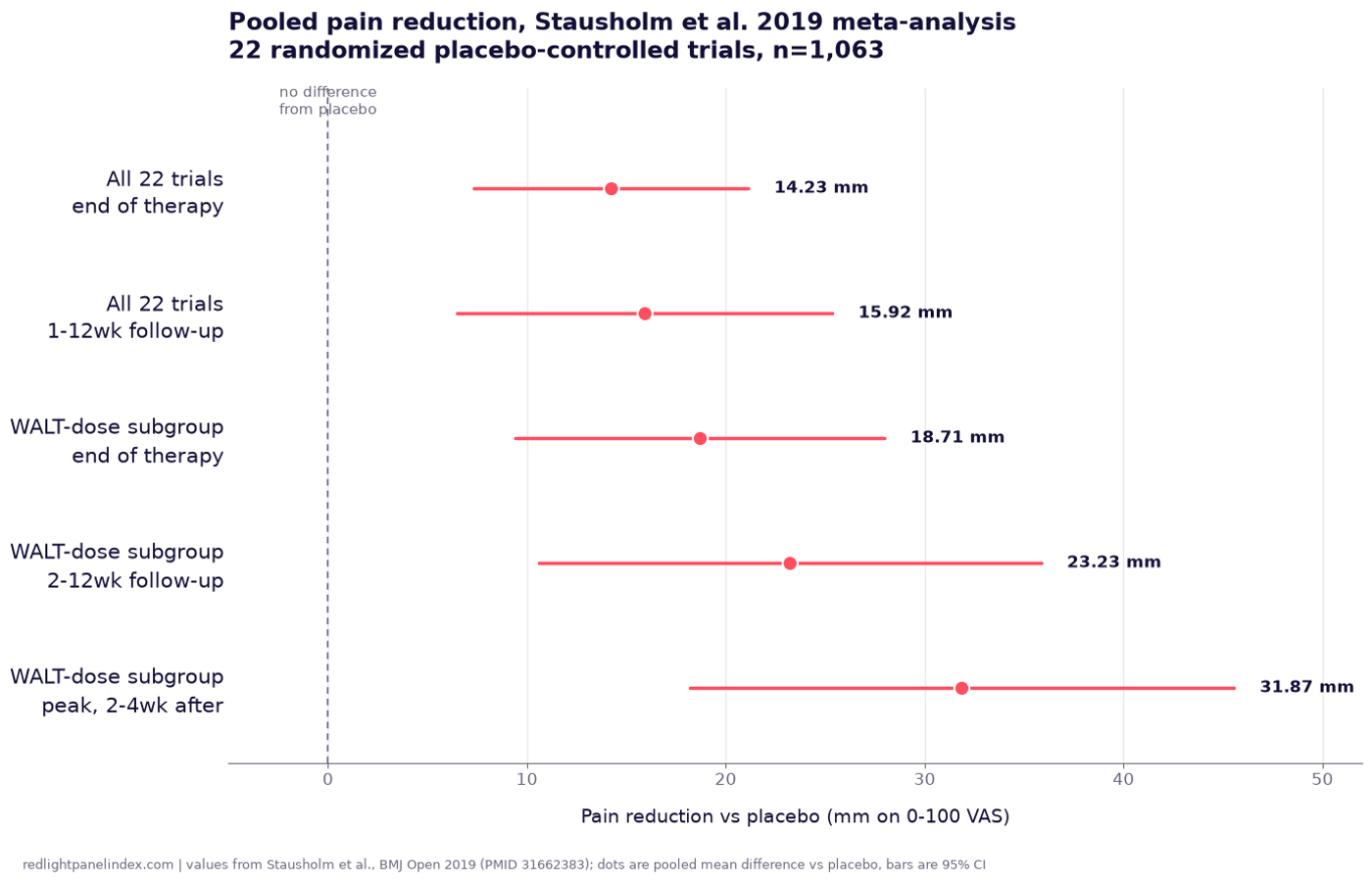
Pain, measured on a 0-100mm visual analog scale, was the primary outcome pooled across the full set of 22 trials. Averaged across all doses, active treatment reduced pain by 14.23mm compared with placebo at the end of therapy (95% CI 7.31 to 21.14) and by 15.92mm during follow-ups measured 1 to 12 weeks later (95% CI 6.47 to 25.37).
The subgroup of trials that used World Association for Laser Therapy-recommended doses separated further from placebo at every time point measured. Pain fell by 18.71mm at the end of therapy in that subgroup (95% CI 9.42 to 27.99), by 23.23mm at follow-ups 2 to 12 weeks afterward (95% CI 10.60 to 35.86), and by as much as 31.87mm 2 to 4 weeks after the last session, the largest separation from placebo reported anywhere in the analysis (95% CI 18.18 to 45.56). The chart above lines up all five pooled estimates on the same scale; none of the confidence intervals cross zero, meaning each pooled comparison reached statistical significance, and the recommended-dose subgroup's intervals sit consistently to the right of, and mostly above, the all-trials intervals.
Disability was also significantly reduced in the pooled analysis, though the abstract does not give a millimeter figure for it the way it does for pain. No adverse events were reported across the pooled set.
Two details in that result are easy to miss and worth holding onto. First, the effect grew for a few weeks after treatment stopped rather than fading immediately, which is not how a typical analgesic behaves and is a pattern more consistent with a biological repair process than with pain masking. Second, the same dose-response framing that produced the recommended-dose subgroup's stronger numbers implies the opposite is also true: trials outside that dose window pulled the all-trials average down, which is the practical meaning of "dose-response" in this context, more energy delivered inside a specific window mattered, and simply pointing a laser at a knee did not guarantee the same result.
Limitations
Pooling 22 trials into five numbers hides real variation underneath. The included studies differed in laser device, treatment schedule and outcome timing, and the abstract's "insignificant risk of bias" verdict covers the set as a whole rather than describing any individual trial's design in detail. The subgroup split itself is not fully transparent from the abstract: it states the recommended-dose window produced better results, but not how many of the 22 trials landed in each subgroup, so there is no way from this abstract alone to judge how much of the analysis rests on a handful of well-dosed trials versus a broad base.
The pooled follow-up window tops out at 12 weeks, so nothing in this analysis speaks to whether the effect holds at six months or a year. And every trial used a laser applied point by point, not a panel used at a working distance across the whole joint, which is the gap the "what this means for a home panel" section below addresses directly.
What this means for a home panel
The practical read is closer to the 790nm trial's read than to a simple "it works" headline: the wavelength band carries over, the exact dose figure does not. The 785 to 860nm window this analysis names sits inside the 810 and 850nm bands many panels publish, and a panel that is mostly 660nm red with little near-infrared output is the wrong tool for a knee, whatever else it is good for.
On dose, there is no verified conversion from "4 to 8 J at a laser spot" to a panel's irradiance in mW/cm2 measured across a broad area; nobody has published that conversion. The reasonable approach is to use the dose calculator with your panel's method-verified irradiance figure to hold a consistent session dose, rather than trying to hit the trial's point-dose number directly, and to check whether a panel's irradiance claim states its measurement method before trusting it at face value. Dosing explained covers that same point-dose-versus-panel-dose gap with worked examples, including this meta-analysis's recommended-dose range. On schedule, these were supervised courses of sessions rather than open-ended daily use, and the site's session frequency guide covers how published protocols in this literature are typically structured.
The honest summary of this meta-analysis, on its own terms, is that it is strong evidence for a dose-response relationship inside a body of laser trials, not proof that a home LED panel reproduces the same result. That is exactly the gap the knee osteoarthritis evidence hub and the wider joint pain register are built to track as more trials, ideally ones using actual panels, accumulate.